Get Full Government Meeting Transcripts, Videos, & Alerts Forever!
Get email alerts on the Social Safety Net topic
No spam. Unsubscribe anytime.
Larimer County: HR1 would shift SNAP and Medicaid costs to states, raise redetermination and staffing burdens
Summary
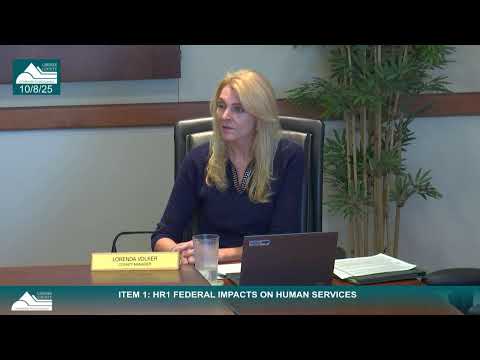
In an Oct. 8 work session, Larimer County human services staff told commissioners that provisions of federal HR1 would shift large administrative and benefit costs to states and counties, expand work requirements, increase redeterminations and likely increase coverage losses and workloads without current federal guidance.
Larimer County human services leaders told the Board of County Commissioners on Oct. 8 that changes in the federal law known as HR1 would shift significant costs to Colorado and local governments, expand work requirements for SNAP and Medicaid beneficiaries, and sharply increase eligibility redeterminations and staffing needs.
The county’s presentation said Colorado faces two simultaneous cost shifts: smaller federal support for SNAP administrative costs and a new state match for some SNAP benefit dollars tied to each state’s payment error rate. County staff also outlined a separate set of Medicaid changes that would require redeterminations every six months and add an activity-based work requirement for certain adults.
Why it matters: County staff said the combined effects could mean millions in added local costs, heavier caseloads for eligibility staff, and potential losses of health and food benefits for residents who do not meet new documentation or activity requirements. The county is awaiting federal guidance on many details, so staff emphasized planning, staffing and coordinated community outreach to reduce harms.
What county staff said
Heather O’Hare, Larimer County human services director, said the county is preparing for added workload and cross-system impacts. "We are waiting on guidance from USDA on implementing these provisions," Hannah Ditzenberger, a policy analyst, told commissioners when outlining SNAP changes; O’Hare and Vanessa Fuel, division manager with the county Department of Human Services, described the local impacts and planning steps.
Hannah Ditzenberger, human services policy analyst, summarized SNAP changes in HR1: the bill raises the maximum age for able-bodied adults subject to SNAP work requirements from 54 to 64; it narrows exemptions for parents to those with children under 14; it removes refugees and some humanitarian immigrants from SNAP eligibility; and it eliminates federal funding for SNAP-Ed. "This provision was effective immediately, but Colorado is still waiting on guidance from the federal government before we start implementing these changes," Ditzenberger said.
Vanessa Fuel described two distinct cost shifts: reduced federal share of SNAP administrative funding and a new state share of benefit costs based on the state payment error rate. Fuel said Colorado’s fiscal year 2024 payment error rate was 9.97 percent; if that percentage remained, Colorado would face roughly a 10 percent state match on benefits (estimated in the presentation at about $125 million to $160 million annually statewide). Separately, administrative cost-sharing will change so the federal share drops and the state share rises, which Fuel said translates to about $50 million annually statewide in administrative cost increases. Larimer County staff estimated the county’s portion of lost SNAP administrative funding at about $1.6 million per state fiscal year.
On Medicaid, staff said HR1 would remove refugees from eligibility starting Oct. 2026, require redeterminations every six months instead of annually, and add a monthly 80-hour activity requirement for able-bodied adults with certain exemptions. "In states that have tried Medicaid work requirements before, they have not seen an increase in workforce participation. Rather, they simply saw people lose coverage," Ditzenberger said, citing Arkansas as an example.
Local counts and projected workload
County presenters provided local estimates drawn from county and state data: - Larimer County currently has about 71,000 residents on Medicaid; county staff estimate about 14,000 of those would be subject to the new work requirement. - Staff estimate roughly 28,000 redeterminations annually would be required under six-month renewals. - County staff estimated about 3,500 people could lose Medicaid coverage because of the new work requirements, based on observed results from other states. - For SNAP, Ditzenberger and Fuel said an estimated 4,200 additional adults in Larimer County may become subject to work requirements because the age cutoff rises to 64 and parental exemptions narrow. - The county reported 16,264 children, 3,253 older adults and 4,879 adults with disabilities among its SNAP caseload in the presented data; these groups are exempt from work requirements.
Staff described expected operational impacts: more change reports and documentation to process, more phone calls and front-desk traffic, longer processing times and risks of increased payment errors if households do not report changed circumstances. Fuel described Colorado’s payment-error sampling process and said state reviews sample only a small number of cases each month, which county staff questioned as potentially unrepresentative.
Cross-system ripple effects
County leaders warned that lost benefits or coverage could pressure other county services. Heather O’Hare said about 95 percent of families currently served by Larimer County child welfare receive SNAP, Medicaid or TANF; if those families lose benefits or access to providers, the child welfare program could face increased caseloads and costs because services the county now bills to Medicaid might shift onto county budgets.
Differences between SNAP and Medicaid work requirements also matter operationally: county staff said SNAP allows an initial benefit period while new recipients find work or meet requirements, but under the HR1 changes described by staff, Medicaid requires proof of activity before coverage begins, potentially blocking access at intake.
County response and next steps
To prepare, county staff said they are hiring additional eligibility workers (training time estimated at four to six months), convening a locally led community collaborative funded by an approximately $30,000 grant from the Colorado Department of Health Care Policy and Financing, and coordinating with state and national partners (including the Colorado Department of Human Services, the National Association of Counties and the American Public Human Services Association) to pursue implementation guidance and potential flexibilities. Fuel and O’Hare said they are tracking federal shutdown developments and awaiting formal guidance from USDA and federal health agencies.
County Manager Lorenda Volker and commissioners asked staff to provide written clarifications of monthly processing numbers and to return with updates; the human services team said HR1 impacts will be a recurring agenda item at the quarterly Board of Social Services meeting and that they will share a sign-up link for the community collaborative.
No formal votes or ordinances were taken at the work session.