
City engineer outlines Weeks Wash flood-control plan, says $44.5 million federal award won but major design steps await environmental review
Get AI-powered insights, summaries, and transcripts
Subscribe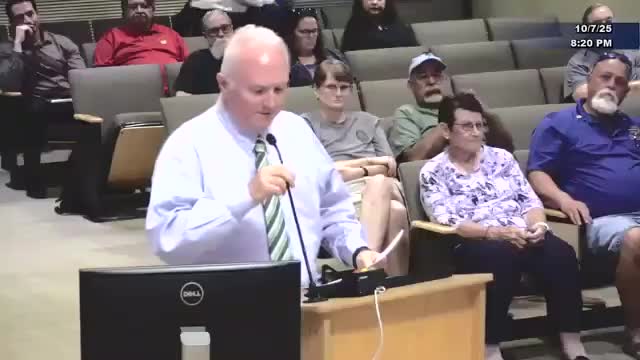
Summary
City engineer Emil Schmidt updated the council on a proposed large regional flood-control structure on Weeks Wash. The city secured a $44.5 million FEMA Flood Mitigation Assistance grant but must complete environmental/historical reviews and geotechnical work before final design and construction.
City Engineer Emil Schmidt told the council on Oct. 7 that Apache Junction has secured a $44.5 million Flood Mitigation Assistance (FMA) grant for a proposed regional flood-control structure on the Weeks Wash corridor but cannot begin earthwork until federal environmental and historic-preservation reviews are complete.
Schmidt described the preferred alternative as a roughly 30-foot-high structure north of Lost Dutchman Boulevard that would impound about 1,100 acre-feet of storm runoff across an 80-acre surface area—roughly 358,500,000 gallons—and provide flood protection for more than 4,200 parcels downstream. Initial cost estimates indicate the project will exceed the FMA award by approximately twofold, driven primarily by an estimated 1,400,000 cubic yards of earthwork.
Why it matters: The facility is intended to reduce flood risk to thousands of properties in Apache Junction and downstream in neighboring counties. The grant award is the single largest FMA award in Arizona to date, Schmidt said, but additional funding and interagency agreements will be needed to complete design and construction.
Land and partnerships Schmidt said the city purchased roughly 76 acres at public auction through the State Land Department (green area in staff maps) and is negotiating long-term use agreements with the Salt River Project and federal land managers to use adjacent easement areas. The city is coordinating with FEMA, the Bureau of Reclamation, the U.S. Army Corps of Engineers, SRP, Pinal County and Maricopa County on environmental review, permits and long-term operations.
Schedule and next steps FEMA’s environmental/historic-preservation (EHP) review must be finished before the city can access the site for geotechnical investigation; Schmidt said staff expects the EHP process to be complete in 2026 but emphasized FEMA’s timeline is uncertain. Without soils and geotechnical data the design remains preliminary. Project delivery will require accelerated or alternative delivery methods to move large volumes of material quickly; staff estimated an overall 3–4 year design-and-construction effort after EHP clearance, with the earliest practical project completion near 2030.
Funding and questions Schmidt said the city will continue pursuing additional funding sources—regional partners (Pinal and Maricopa counties), state revolving funds, WIFA loans and other sources—and will continue talks with SRP and federal agencies about land use and permitting. Councilors asked about potential water-capture and groundwater-crediting opportunities; Schmidt said staff will explore water-harvesting possibilities but cautioned that capture, monitoring and crediting have separate costs and regulatory steps.
Ending Schmidt asked for the council’s continued support as staff pursues intergovernmental agreements, completes required environmental reviews and advances design once site access is authorized by FEMA.