Get AI Briefings, Transcripts & Alerts on Local & National Government Meetings — Forever.
Southborough seeks $100,000 to design cleanup after tests show lead under former Atwood Road water tower
Loading...
Summary
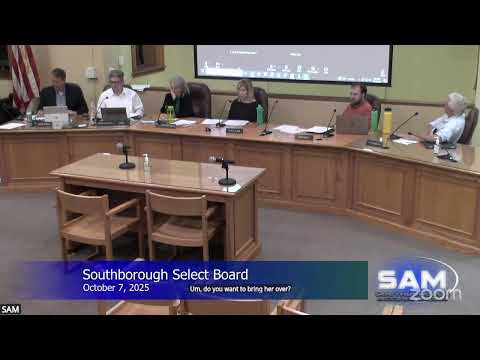
Town water consultant Tim Tees told the Select Board on Oct. 7 that soil beneath the demolished Atwood Road water tank contains elevated lead; the board voted to support a $100,000 appropriation for design and bidding work, funded from free cash, to prepare for remediation.
The Southborough Select Board on Oct. 7 agreed to support a town-meeting article asking voters to appropriate $100,000 to advance design and bidding for remediation of lead-contaminated soil beneath the site of a former water tank on Atwood Road.
Tim Tees of engineering firm PAR, engaged by the town, told the board that a July 2024 field investigation and a more detailed grid of follow-up samples found elevated lead concentrations concentrated under the former tank’s footprint and at several small “hot spots” nearby. "We found that, in fact, the lead paint from the tank had fallen off into the soil as we had suspected, and left some fairly significant concentrations of lead, in that soil, specifically directly beneath the tank," Tees said.
Why it matters: the tank was a steel structure built in the 1930s and demolished in the early 1990s; paints used during its life are likely to have contained lead. PAR’s testing showed many samples above the state cleanup standard of 200 parts per million (ppm), and a few spots with concentrations high enough that, if excavated and shipped off-site without treatment, would be classified as hazardous waste under the Toxicity Characteristic Leaching Procedure (TCLP), greatly increasing disposal costs.
What the town will do next: the $100,000 article on the special town meeting warrant for Oct. 27 would fund work to move the project from investigation to bidding. Tees said the budget request is intended to produce a remedial plan, a risk assessment that defines limits of excavation based on likely future site uses, survey plans, and technical specifications for contractors. "The town meeting appropriation is to take it beyond the investigation, develop that remedial plan, and then get the project out to bid for cleanup," Tees told the board.
Scope of contamination and testing: PAR reported it carried out an initial set of samples and later a dense grid focused beneath the tank footprint. The team did about 520 samples total, taking repeated 6-inch intervals down to roughly 54 inches near the former ground surface beneath the tank. The highest concentrations aligned with the tank’s center standpipe and inside the tank’s drip line. Tees said some small areas exceeded the TCLP threshold; others were above the state cleanup standard but below the TCLP threshold. He explained that some shallow areas directly under the tank had low concentrations because clean fill had been brought in after the tank was demolished.
Short- and longer-term response: the warrant article packages the work in two parts. About $85,000 would fund the remedial planning, risk assessment and engineering necessary to price and scope the cleanup; $15,000 was included to implement immediate, temporary safety measures such as laying filter fabric and stone or mulch to reduce surface exposure until the permanent remediation occurs. Tees said the short-term measure is non-invasive and "is essentially just creating a temporary barrier until the final remediation can be done." He estimated the temporary barrier work could be done within weeks after funds are available; the full site stabilization and excavation work, once contracted, would likely be a 4–6 week construction activity with additional weeks for stabilization, sampling and final restoration.
Timing and costs: Tees said PAR expects to hire a risk assessor after the appropriation and return to the board with two options and estimated costs within about two months: (1) excavate and remove soil such that all lead on the site would be at or below the state background concentration, or (2) remove the hottest spots and reduce risk to an acceptable level while leaving some lead on-site that would require long-term management. The firm will price the two options so the town can compare the cost difference before deciding on a construction appropriation at a future town meeting.
Funding debate: board members, residents and others discussed which fund should pay the $100,000 design appropriation. Some Select Board members and residents argued the water enterprise fund — which pays for water system operation from user fees and was established in FY2020 — should carry the cost because the contamination originated from the town’s water infrastructure. Other members and residents said the contamination is primarily a public-health and town-owned property issue and that the immediate design appropriation is small relative to town reserves; they favored funding from general free cash. After discussion the Select Board voted to support the article with the funding source designated as free cash.
Community concerns and public comments: nearby residents pressed the board for quick action. Sarah Warden, who identified herself as living across the street at 27 Atwood, said she had personally stopped people from entering the site and urged immediate measures to reduce exposure: "I've had to physically stop people from going up there… I can't always stop everyone. I'm not always home. So if we could move forward with the $15,000 just to put that on there… it still makes me nervous, and I just want people to be safe," she said. Another neighbor asked whether the town had looked for grant funding; Tees said PAR had not searched grants and that the town could explore that as an additional action.
Technical clarifications: Tees described typical on‑site stabilization techniques for soil that would otherwise test as hazardous under TCLP. Those soils are usually treated (stabilized by mixing with Portland cement or other reagents) on-site and retested before removal to reduce off-site disposal costs. He said the excavation approach is repetitive: dig, stabilize, sample, pile and ship once treatment meets criteria. He also said the team did not encounter bedrock within the deepest samples taken (about 54 inches). Tees cautioned that while some samples showed a leaching potential into groundwater, the soils immediately beneath the hottest surface spots were generally cleaner and PAR saw no clear evidence of an existing groundwater impact in the samples they took.
Next steps and schedule: if voters approve the $100,000 article on Oct. 27, the appropriation would be available after town meeting and PAR expects the temporary barrier work could follow quickly. The risk assessment and remedial plan would follow; PAR estimates two months to deliver the two options and cost estimates and — if the town later approves a construction appropriation at a spring town meeting — bidding and cleanup could be scheduled for spring into early summer.
What the Select Board voted: the Select Board voted at the Oct. 7 meeting to support placing the $100,000 article on the Oct. 27 special town meeting warrant and to fund that design phase from free cash. The motion’s supporters said they preferred not to delay the design step while the financing source is further debated.
Funding and transparency follow-up: residents urged the board to keep communication open about which fund ultimately pays for construction and whether town water customers should bear cleanup costs. DPW Superintendent Bill Cundiff reminded the board that many of the decisions about the original tank’s funding occurred before the enterprise fund existed, and that retained earnings in the enterprise fund were already planned for other capital needs. Cundiff said the water department would incorporate any longer-term funding decision into next year’s capital plan if the town elects to pay construction from the enterprise fund.
What remains undecided: the board voted only to place the design appropriation on the warrant and to support funding it from free cash. The Select Board, Finance Committee and town meeting would still have to approve any later construction appropriation for the cleanup, and the town will receive a formal two-option cost estimate from PAR after the risk assessment is complete.
Ending: Tees said PAR has prepared photos and detailed figures documenting the sample grid and offered to return to answer technical questions. The board directed staff to finalize the warrant language and included the article on the Oct. 27 special town meeting agenda so voters can decide whether to fund the next engineering stage.