Get Full Government Meeting Transcripts, Videos, & Alerts Forever!
Get email alerts on the Environmental Review Seqr topic
No spam. Unsubscribe anytime.
Environmental study delay leaves 55 Palmetto subdivision SEQR review unresolved
Summary
An ecological and engineering study for the 55 Palmetto Parkway subdivision remains incomplete because consultants could not access an updated federal species list during a government shutdown; the applicant declined to postpone, and the board must decide whether it has enough information to close SEQR.
Planning staff told the Mount Vernon Planning Board during a work session that an environmental consultant has not completed required study work for the 55 Palmetto Parkway subdivision because it could not obtain an updated species screening from the U.S. Fish and Wildlife Service during the federal government shutdown.
“The DEC documentation only provides known locations of state-listed species. The U.S. Fish and Wildlife Service screening accounts for federal species known to occur within the vicinity of the project area,” the assistant commissioner summarized from the consultant’s correspondence, explaining why both sources are needed.
Staff said the work awaiting completion includes phase 2, which had a seasonal element that needed to be completed “before the leaves fell off the trees,” and phase 5, an engineering study of rock and water that requires a separate team. The assistant commissioner said the field work for the seasonal phase had been completed but had not yet been rolled into the final report.
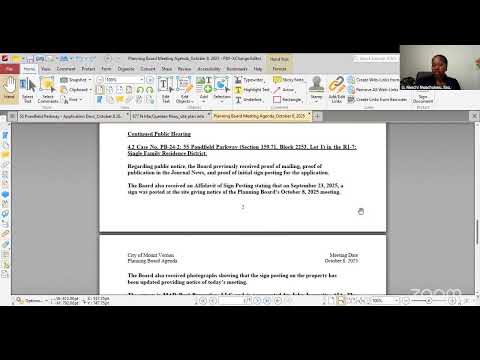
The board discussed whether to remove the application from the upcoming agenda until the study is complete. The applicant declined to postpone, according to staff, and submitted a letter from counsel that board members asked to review before deciding whether to proceed on the agenda. “If this board wants the results of the study before closing SEQR, then what more is there to discuss?” one commissioner asked; board counsel responded that SEQR/SECRA does not require exhaustive research and that the standard is “does the board have enough information to make an informed determination as to whether the action will have a significant adverse impact.”
Staff also noted the applicant had paid the escrow amounts for the two phases the consultant was contracted to perform. Commissioners asked staff to circulate the applicant’s correspondence and consultant emails to the board and to have the consultant provide a concise explanation of what the outstanding work would cover for the public at the regular meeting.
No vote was taken during the work session. The planning board agreed to review the applicant’s attorney letter and the consultant’s written status update before deciding whether to continue with SEQR review at the regular meeting.