Get Full Government Meeting Transcripts, Videos, & Alerts Forever!
Get email alerts on the Workforce Diversity topic
No spam. Unsubscribe anytime.
City's DEI audit: consultant finds workforce disparities, recommends vendor data and community survey
Summary
A $50,000 state grant funded an equity audit that found Black and Asian employees underrepresented in Framingham's workforce relative to the regional labor market and recommended steps to monitor vendor diversity and conduct a community needs survey.
Jesse Edwards, Framingham's diversity, equity and inclusion officer, told the council that a DEI audit funded by a $50,000 Commonwealth grant is complete and that the city retained the Racial Equity Group to conduct the review.
Bert Guess (presented as the consultant for Racial Equity Group) summarized the audit findings and recommendations. The audit invited 722 people to participate (including 644 employees, 67 board/committee members and 11 elected officials), received 399 responses and validated 233 complete responses for analysis. Using standard EEO-4 benchmarking and Census-derived labor-market measures across Middlesex, Norfolk and Worcester counties, the analysis showed Framingham's overall workforce is about 82 percent White versus about 76 percent White in the relevant regional labor pool; Black and Asian employees were identified as underrepresented relative to that regional benchmark, particularly in higher-paid official/administrator job categories. The consultant cautioned that disparities do not, by themselves, prove discrimination but warrant deeper review of recruitment, hiring, promotion and retention practices.
The audit also found sex- and job-category differences: males were overrepresented overall, while women were underrepresented in technical, protective-service and skilled-craft roles. The consultant said the municipal EEO-4 data limit the review to race/ethnicity and binary gender categories but recommended the city supplement with more local demographic collection.
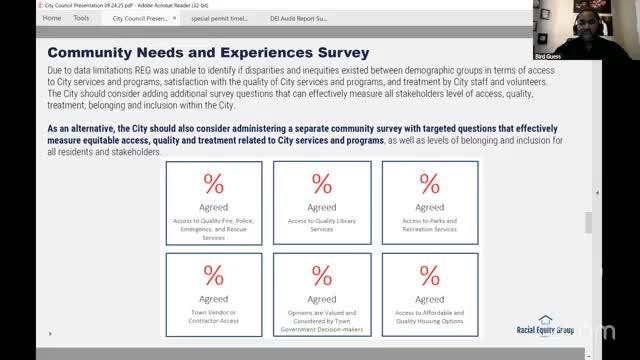
Key recommendations included: - Establishing routine vendor/contractor demographic collection so the city can measure whether procurement dollars are equitably distributed; the consultant noted the city's new OpenGov contracting system can be configured to collect this information. - Conducting a statistically valid community needs and experiences survey disaggregated by demographic groups to detect gaps in access to services and programs. - Creating accountability structures (a DEI task force or empowered DEI officer and committee) and a multi-step plan to attract and retain diverse talent, remove unnecessary hiring barriers and monitor progress over time.
Edwards told the council he is working with the internal advisory committee and the mayor's office to develop next steps and recommended a progress update in about four months.
Councilors asked about department-level results, response rates and how to translate findings into hiring and procurement practices; the consultant said department-level analysis is possible for larger departments but smaller units produce limited sample sizes. The presentation and full report will be provided to the council for follow-up action planning.