Get Full Government Meeting Transcripts, Videos, & Alerts Forever!
Get email alerts on the Municipal Budgeting topic
No spam. Unsubscribe anytime.
Commissioner of Finance outlines 2026 comprehensive budget, proposes 2% property tax increase and hiring freeze
Summary
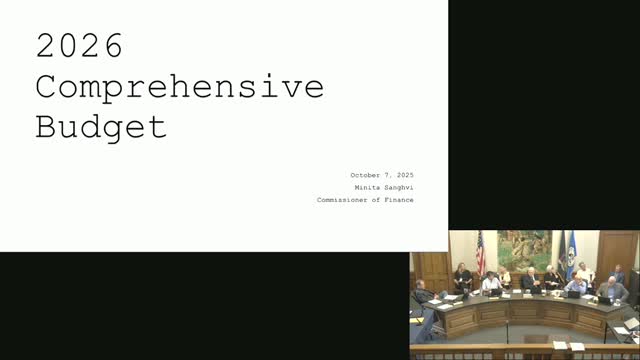
The Commissioner of Finance presented the proposed 2026 comprehensive budget to the Saratoga Springs City Council, saying, “I am here to present the 2026 comprehensive budget.”
The Commissioner of Finance presented the proposed 2026 comprehensive budget to the Saratoga Springs City Council, saying, “I am here to present the 2026 comprehensive budget.” The draft sets total spending at about $61,370,000 and includes a recommended 2% property tax increase to balance revenues and expenses.
The commissioner said the budget-building period will include two public hearings (the next October meeting and the November meeting) and several workshops, and noted the city charter requires adoption on or before Nov. 30. The presentation framed the gap between rising costs and comparatively slow revenue growth as driven largely by five categories: salaries, health insurance, retirement, liability insurance and capital expenses.
Why it matters: The budget contains near-term choices that affect operations and services for residents, including a proposed hiring freeze, reductions in part-time staff, and possible cuts to non-profit funding. The presentation also listed several options that would add revenue without directly raising residents' taxes, including expanded paid parking, removing a March early-payment tax discount and creating a short-term rental registration portal that could produce new receipts.
The finance commissioner described recent cost trends: the city's full-time workforce rose from 315 in 2021 to 361 (an increase of 46 employees), retirement costs were reported to have risen about 86% between 2022 and 2026, liability insurance rose about 188% over the same period, and health insurance increased roughly 27%. The commissioner said those pressures left only a small portion of the budget controllable through cuts because personnel and benefits account for roughly 84% of the operating budget.
Key proposals and assumptions - Tax rate: The comprehensive budget is balanced assuming a 2% property tax increase; the commissioner proposed that as the baseline, explaining, “I'm proposing a 2% tax rate for the comprehensive budget.” She also noted the legal tax-cap maximum this year (with carryovers and exclusions) would allow up to a 4.53% levy and that adopting that maximum would generate about $620,000 more for the amended budget. - Hiring: The finance office recommended a hiring freeze, saying the pace of employee growth is unsustainable without sizable new revenues. - Nonprofits and program cuts: The draft includes cuts to part-time staff, vacant positions, overtime and nonprofit funding. The commissioner said that if the council prioritized restoring nonprofit grants (for example, RISE and the Senior Center), those decisions could be made in the amended budget if additional revenues materialize. - New or expanded revenues: Options presented included expanding paid parking seasonally (April 1 to Oct. 31), removing a 2.25% early-payment property tax discount (estimated to free about $280,000 after estimated borrowing costs), reassessment (noted would cost about $7,000,000 and "does not change a penny of revenue"), and a future community preservation fund (a local real-estate transfer tax) for open space and climate initiatives. - Short-term rentals and occupancy tax: The budget assumes $150,000 in short-term rental registration revenue for 2026 pending portal activation; the commissioner said the state legislature had advanced occupancy-tax changes that could allow Saratoga Springs to collect occupancy tax on short-term rentals if the governor signs the bill.
Budget priorities and constraints The commissioner said the administration prioritized city operations and employees in the draft and proposed keeping capital spending relatively constrained (a capital program of about $2.25 million proposed for 2026). The presentation highlighted that certain departments (notably public safety/DPS and DPW) account for the largest shares of personnel, health insurance and retirement costs in the city budget.
Timing and next steps The finance commissioner concluded the presentation by listing two public hearings (listed in the presentation as Oct. 21 and Nov. 5) and four scheduled budget workshops in October. She said the administration would monitor short-term rental and occupancy-tax revenue developments and adjust the amended budget if receipts arrive before adoption.
Ending: The council reserved questions and detailed discussion for the scheduled workshops and hearings. The commissioner closed the formal budget presentation with, “And that concludes my budget hearing.”