
Weld County advances wide-ranging zoning rewrite on first reading after hours of public comment
Get AI-powered insights, summaries, and transcripts
Sign Up Free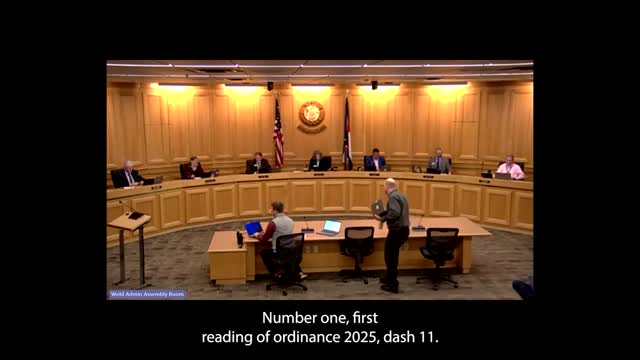
Summary
The Weld County Board of Commissioners approved first reading of Ordinance 2025-11, which revises Chapter 23 (Zoning) to change heavy-vehicle limits, new rules for home businesses and commercial vehicle standards. The vote was 5-0 after a lengthy public hearing in which multiple residents raised enforcement, noise, property-value and ADA concerns.
The Weld County Board of Commissioners approved on first reading Ordinance 2025-11, a rewrite of Chapter 23 (Zoning) that changes rules for heavy vehicles, home businesses and other uses in unincorporated parts of the county. Commissioner Ross moved the ordinance and Commissioner Maxey seconded; the board voted 5-0 to advance the measure to second reading.
The ordinance proposes zone-specific heavy-vehicle limits based on gross vehicle weight rating (GVWR): up to 26,000 pounds in agricultural, state commercial and industrial zones and up to 16,000 pounds in residential zones. Semi trailers would be prohibited in residential zones or agriculturally zoned subdivisions or historic townsites when lots are under one acre, and would be required to be set back at least 20 feet from rights of way and 5 feet from other property lines. The proposal also creates a new “trucking and transportation” use with permitting that varies by zone.
Home businesses would be allowed by zoning permit in agricultural, estate and residential zones but with limits. In residential zones the draft would allow no more than five customers, clients, patients, students or nonresident employees on-site at any one time, restrict hours to 7 a.m. to 7 p.m., require adequate off-street parking and require business-related activity to occur indoors. The ordinance defines “outdoor activity” for enforcement purposes and makes permit revocation by the director of Planning Services a potential remedy, subject to appeal under Chapter 2 of the county code.
Maxwell Nei of the Department of Planning Services presented the draft and said the rewrite is intended to clarify vehicle classifications, home-business standards and other uses. “Following the original first reading, the county held a public meeting on September 22 to hear concerns associated with the proposed ordinance,” he told the board.
Residents at a public hearing urged tighter limits or clearer enforcement. Audrey Ingram, who lives on Loma Linda Court, described semi trucks parked at a nearby property and said: “I believe rules are in place for a reason and are not a suggestion.” Carrie Reichert urged stricter parcel thresholds for outdoor business activity, saying, “I respectfully propose that home based businesses with employees or client traffic be restricted to parcels of 10 acres or more.” Mary Rose Cullen raised concerns about nonresident employees and appeals, pointing to the ordinance language “for gainful employment of residents of the lot.” Tom Potter of Weld County Building said that when a property undergoes a change of use an inspector will require compliance with the county’s accessibility code.
Commissioners discussed enforcement capacity and the ordinance’s intent to balance private-property rights with neighbors’ quality of life. Commissioner James said the draft has evolved after public meetings and pledged a further work session before second reading. Commissioner Ross noted the county’s earlier zoning action limiting certain facilities to industrial zones under Ordinance 24-18 and said that topic would not be addressed in this ordinance.
The board advanced the ordinance on a 5-0 vote; commissioners said they expect additional edits before second reading and several asked staff for another work session to address outstanding concerns about nonresident employees, parcel thresholds and enforcement procedures.
The ordinance remains at first reading; a second reading and potential amendments will be scheduled as the board continues deliberations.