
Athens committee reviews expanded sidewalk-and-public-areas ordinance, asks staff to revise draft
Get AI-powered insights, summaries, and transcripts
Subscribe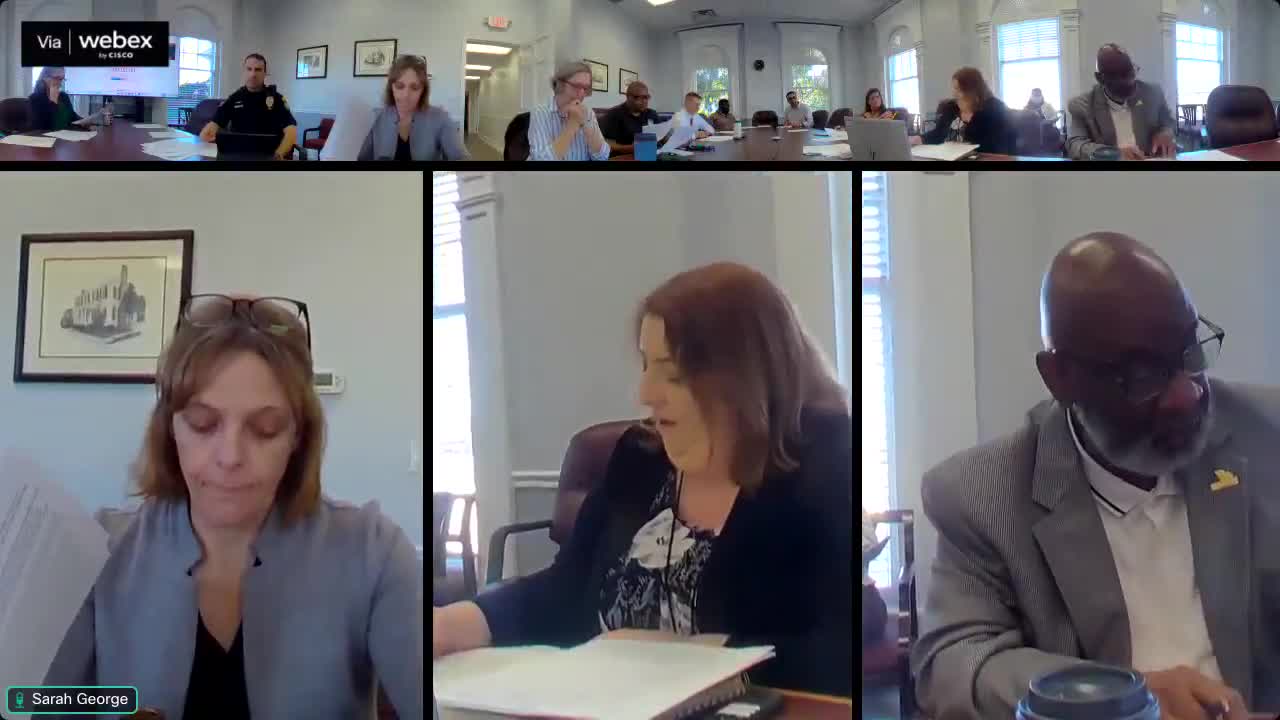
Summary
An ad hoc Right of Way Use Committee on Oct. 10 reviewed a proposed rewrite of Athens' obstructing sidewalks ordinance to cover broader public areas and the storage of personal property, instructed staff to revise the draft and return with more information on enforcement and abandoned-property practices.
The Right of Way Use Committee met Oct. 10 to review proposed changes to the city’s obstructing sidewalks ordinance and related approaches to abandoned personal property on public rights of way. Committee members directed staff to revise the draft ordinance to reflect suggestions raised during the meeting and to return with additional research and options at a future session.
The draft ordinance under review would expand local code section 3-5-23 beyond “public sidewalks and streets” to include other public areas and to describe prohibitions on storing personal property in rights of way. Committee members and staff discussed definitions, enforcement procedures, exceptions, and how the county currently handles abandoned items.
Why it matters: The draft would give officers a clearer local ordinance to address situations—from belongings left at bus stops to encampments under bridges—that staff and police say affect pedestrian safety, infrastructure risk and transit access. The committee emphasized balancing enforcement with protections for free speech and for people experiencing homelessness.
Solicitor summary and data limits The committee’s solicitor reviewed municipal-court data requested by the police department and said the municipal clerk provided “all of the cases in municipal court for someone who had been cited” under section 3-5-23 during the review period. The solicitor cautioned that citations that led to state- or superior-court charges (for example when a person was arrested on additional charges) would not appear in the municipal-court list and would require a separate records request.
“Those citations that were listed by the PD were all the citations issued under the entire code section … that went to municipal court,” the solicitor told the committee. Committee members noted the clerk’s data showed that the municipal-court citations during the period were concentrated downtown, but that street-level contacts where a person moved and no citation was issued are not tracked.
Definitions, “materially interfere” and the removed subsection Staff attorney Courtney Davis presented a consolidated draft that drew language from other cities (including Rome and Gainesville) to clarify which spaces are covered and to describe what it means to interfere with ingress or egress. The draft included two related subsections: one that would prohibit activity that “materially interferes” with ingress or egress and a second that would allow enforcement where activity “reasonably appears” to have the purpose or effect of blocking ingress or egress even if passage remains possible.
Committee members and staff debated the need for the second subsection. Several members and the county prosecutor’s office said subsection 1 (material interference) is broad and concrete and that subsection 2 (“reasonably appears” based on purpose) creates vagueness and greater scope for enforcement. The committee agreed to remove subsection 2 and direct staff to keep the materially-interferes standard.
Bridges, public-safety concerns and trespass Public-safety concerns under bridges — including past fires—factored into the discussion. Public-works staff and Police Deputy Chief Kelly described incidents under bridges and said current practice is to remove unauthorized encampments under certain bridges for safety reasons; those removals have been pursued under existing state trespass statutes in locations where signage, fences or other controls apply.
Courtney Davis said adding the language to the local ordinance could give officers a less-severe tool than criminal trespass in some situations. Committee members were advised that prosecuting criminal trespass under state law generally requires arrest and fingerprinting, while a local ordinance citation would be a lesser enforcement option.
Storage of personal property, bicycles and bus stops A large portion of the discussion focused on “storing personal property” in public areas and how to treat bicycles, benches and bus stops. The draft included an example threshold of goods “unattended for more than 1 hour,” a formulation pulled from other jurisdictions. Members urged refinement — for example, protecting reasonably parked locked bicycles that residents use for commuting and clarifying how bus stops and benches are treated given limited seating at many stops.
Transit and bus-stop enforcement Transit staff said the main transfer center already uses time limits (for example, a one-hour limit at some facilities) and that drivers and dispatchers notify maintenance when material is left at a stop. Transit operations staff said enforcement resources are limited — there are typically two operations supervisors on shift covering the county — and acknowledged frequent complaints from riders about people lingering or storing items at some stops. Committee members asked staff to consider how time limits and the “waiting for the bus” exception would be enforced in practice.
Arrest language and ordinance consequences Committee members raised a separate legal point: the draft included language saying an individual “may be issued a citation or arrested” for violations. Staff explained that Athens-Clarke County’s arrest rules for ordinances are narrowly drawn in Title 1 of the code and that adding a new general arrestable ordinance would be a major legal change. The committee directed staff to remove the provision that would expand arrest authority and to retain a warning-first approach consistent with current practice unless the commission wants to pursue a separate change to Title 1.
Abandoned property, stickers, lockers and next steps Staff confirmed the county does not currently maintain storage for abandoned personal property taken from rights of way; instead personnel use a sticker-and-notice process and community partners try to connect people with services. The committee asked staff to return with (a) the county’s current standard operating procedures for handling abandoned personal property, (b) examples from other jurisdictions that store and release personal effects, (c) data on Rome’s experience with its ordinance, and (d) options and costs for a locker or storage partnership. Staff said they would invite Sally Kimball Shepherd of the local homeless coalition to the next meeting to discuss locker feasibility and community partnerships.
Administrative actions and schedule The committee approved the meeting agenda and approved the Oct. 3 meeting minutes by unanimous voice votes earlier in the session. Members set a follow-up meeting for Oct. 24 to review a revised draft and the additional data requested. The committee did not adopt a final ordinance at this meeting; it directed staff to return with a revised draft reflecting these changes.
Ending note The draft ordinance and abandoned-property options will return to the committee for further consideration. Staff said the abandoned-property topic is complex and will likely require more than one additional meeting.