
Cheshire council narrows FY2026 capital plan, targets about $11 million annual bonding to meet 10% debt-policy goal
Get AI-powered insights, summaries, and transcripts
Subscribe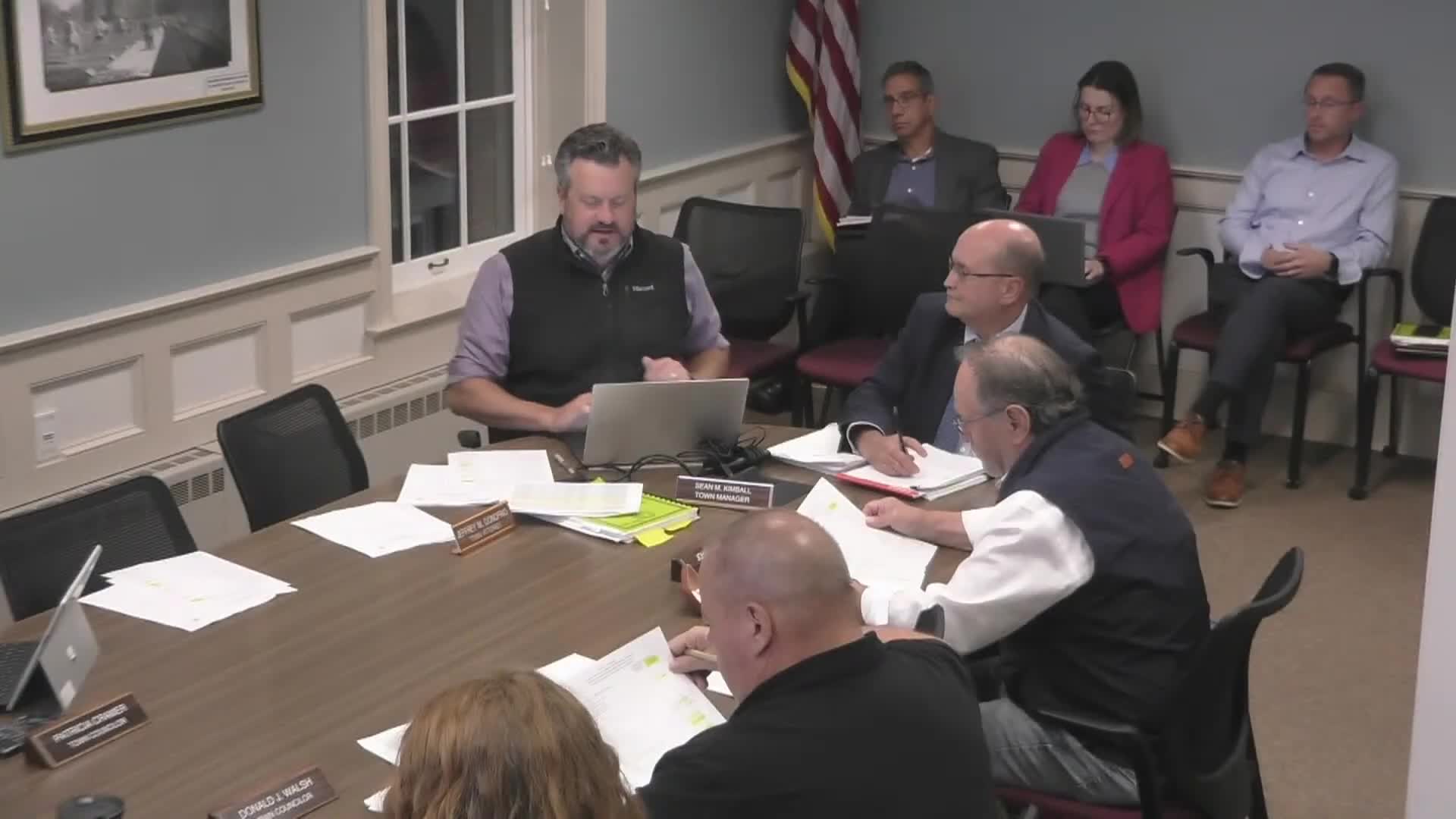
Summary
At a meeting of the Town of Cheshire Town Council, town staff walked councilors through the proposed FY2026 capital budget and five-year plan and showed how project deferrals, energy-performance contract savings and grant offsets affect projected debt service.
At a meeting of the Town of Cheshire Town Council, town staff walked councilors through the proposed fiscal year 2026 (FY2026) annual capital expenditure budget and five-year capital plan and showed how different combinations of project deferrals, energy-performance contract savings and grant offsets would affect the town’s projected debt service.
The discussion, led by Sean Kimball (town staff member), focused on bringing long-term debt-service projections in line with the council’s policy goal that net debt service remain at 10% or less of the operating budget. Kimball presented several scenarios, including removing roughly $14 million of projects moved to a “years 6–10” placeholder column, and an illustrative $22 million reduction in years two and three of the five-year plan; that mix produced debt-service projections the town manager described as “roughly policy consistent.”
Why it matters: Cheshire’s recently approved school borrowing and other large projects are driving a sharp increase in future debt-service costs. Council members said they want a realistic five-year plan that rating agencies and voters can rely on, and several members urged staff to pare placeholders that inflate projected borrowing without a clear timetable.
Most important facts
- Kimball said the current first-year bonded plan contained about $11.6 million in gross approvals and — after grant and other offsets — a net first-year bonding need of roughly $10.3 million in his initial worksheet. Later in the meeting the numbers discussed for the staff-revised first-year proposal were about $11.07 million gross and $10.04 million net after offsets and the addition of a $100,000 capital seed for hydrant work.
- Staff identified about $14 million of projects that could be shifted into a years 6–10 placeholder column (including several energy-performance contract candidates and select town projects), which reduces projected peak debt-service notably in the 8–10 year window.
- The council settled on an advisory target of about $11 million per year for years 2027–2030 (the out years) as a planning guide, with direction to staff to return a scrubbing of projects in consultation with the Cheshire Public Schools where appropriate.
- The council asked staff to keep the seven referendum items already advanced in year one (about $6.685 million previously approved and sent to referendum) and to prepare the finalized first-year bond language for an Oct. 14 meeting.
Energy-performance contract and board of education projects
Kimball said the town has roughly $14 million of work that could be included in an energy-performance contract (HVAC and other efficiency upgrades). Removing those items from the town’s bonded totals in the five-year plan reduced the town’s projected debt-service percentage closer to the 10% target.
Council members and staff repeatedly cautioned that many Board of Education projects remain as placeholders. Councilor Trisha Kramer and others said district projects (roofs, windows, HVAC) are necessary but should be prioritized and reconciled with any school modernization plan.
Hydrant maintenance and pilot
Councilors discussed a multi-step approach to fire-hydrant maintenance and replacement. The council heard that a pilot survey of hydrants would start soon (staff estimated a short field program beginning within weeks) and that the town currently has roughly $80,000 budgeted in operating funds and carryover for hydrant work.
Several councilors said they preferred funding an initial pilot and program through the operating budget rather than bonding the full estimated $400,000 program immediately. Councilors agreed to place a $100,000 capital seed in the first-year plan to allow earlier work if needed, and to pursue additional operating-budget funding in the next fiscal year depending on pilot results.
Public-safety equipment and fire apparatus
Staff and members discussed timing for replacement of breathing apparatus and an aerial ladder that together total more than $3 million in later years. Council and staff noted options to stage or defer purchases (for example moving one planned fire truck out a year) to smooth borrowing needs.
Next steps and direction to staff
Council asked staff to return a revised five-year plan that: (1) prioritizes projects that are shovel-ready or carry a safety imperative; (2) defers or moves placeholder projects to years 6–10 where appropriate; (3) coordinates with the Board of Education on district project prioritization; and (4) presents the first-year bond resolutions for a vote at the Oct. 14 meeting. Council set an aspirational planning target of roughly $11 million per year for the 2027–2030 period to align projected debt service with the 10% policy goal.
Quotes
"We can't be in a position where our debt service is $20,000,000 a year," Kimball said, describing the effect of leaving every placeholder in the five-year plan.
"If we're gonna put it off to 2027, I would rather put it in the operating budget because that'll get there sooner," Councilor (name recorded as) Trisha Kramer said during the hydrant discussion, arguing for earlier funding of hydrant repairs.
Ending
Councilors and staff said they plan to circulate the revised first-year bond language and a scrubbed five-year plan ahead of the Oct. 14 meeting. Staff will work with Board of Education representatives where school projects are affected and will return with recommended shifts that meet the council's direction to contain future annual net bonding near $11 million.