
Long Beach breaks ground on $64 million Studebaker Road transformation
Get AI-powered insights, summaries, and transcripts
Subscribe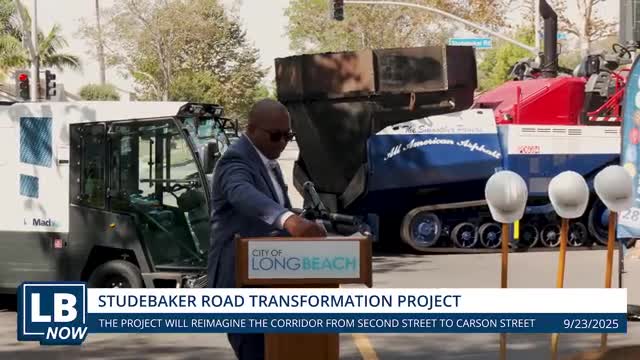
Summary
City of Long Beach officials on Sunday marked the start of a $64 million, roughly 5.9-mile overhaul of Studebaker Road aimed at safety, multimodal access and streetscape improvements funded by a mix of local, regional and federal sources.
Long Beach officials on Sunday broke ground on what Mayor Rex Richardson called the city's largest street-reconstruction project: a $64,000,000, roughly 5.9-mile overhaul of Studebaker Road and adjacent stretches.
The project, Richardson said, covers “5.1 miles on Studebaker Road, and about a mile on Loins Drive” and is part of the city’s broader Elevate ’28 capital plan to upgrade streets, parks and public facilities ahead of 2028. The mayor credited a combination of local, regional and federal funding and said the corridor will “reshape how we move, how we connect, how we experience Long Beach.”
Why it matters: The corridor links multiple neighborhoods and schools and is designed to improve safety and access for motorists, cyclists, pedestrians and transit riders. Officials emphasized multimodal features, new landscaping and street-level upgrades intended to reduce collisions, support transit riders and improve connections to local schools, parks and businesses.
Mayor Rex Richardson (Mayor, City of Long Beach) said the work will reshape the corridor and noted several funding partners; he described the effort as the city’s “largest corridor project” and said the work will support the Safe Streets Long Beach initiative. Richardson said Metro provided grant support and that Congressman Robert Garcia helped secure an additional federal contribution. Richardson also cited a recent increase in the city’s pavement condition index from 56 to 61 as part of a wider streets-repair effort.
U.S. Rep. Robert Garcia (Congressman) told attendees the project includes federal highway funding tied to the recent federal infrastructure package. “I believe this project also has about maybe 11 to $12,000,000 of federal highway money from the federal government,” Garcia said, and he praised local officials and public works staff for securing multiple funding sources for the work.
Third District Councilmember Christina Duggan highlighted landscaping and environmental design elements that will accompany the reconstruction. Duggan said the project will plant 100 trees and more than 2,000 shrubs, create buffers near wetlands and reduce light pollution in sensitive areas. “When complete, Studebaker Road will be smooth, safe, and it will be lined with new landscaping with a 100 trees and over 2,000 shrubs,” Duggan said.
Fourth District Councilmember Daryl Supernaugh noted the project has been long awaited in parts of his district and said a large segment extends from Seventh Street to Spring and then east to Wardlow. Fifth District Councilmember Megan Curtis described planned multimodal upgrades, including ADA-compliant sidewalks and ramps, upgraded protected bikeways converting an existing Class 2 route to a Class 4 protected facility with low concrete barriers, and additional transit amenities. Curtis said the project will add 16 transit shelters where there are currently two and will include ADA-compliant loading and offloading areas at bus stops.
Acting Public Works Director Josh Hickman said construction activity will intensify this fall, with traffic control and visible work appearing around October and November. Hickman also noted the project will include underground fiber-optic conduit to expand the city’s fiber network. He credited more than two dozen Public Works staff and outside consultants — including Ardura, Willdan and Michael Baker — and said contractor All American Asphalt will perform the construction.
Funding details given at the event were described by officials in multiple ways. Richardson said Metro provided $8,750,000 in grant funding and that Congressman Garcia secured an additional $1,000,000. Later in his remarks the mayor referenced “more than 11,000,000 from Measure M and 9,000,000 from Metro.” Garcia estimated $11 million–$12 million in federal highway funds and also cited Measure A voter-approved funding that has supported street repairs citywide. Officials did not provide a single reconciled funding table at the event; amounts quoted were those given by speakers on the record.
Project features emphasized by officials include wider sidewalks, larger medians, urban greening, rapid-flashing beacons at school crossings, sidewalk-level bikeways, improved park connections, vertical gateway signage at Las Coyotes intersection, and reduced light pollution near wetlands. Councilmembers and staff said the corridor connects a number of schools, including Sato Academy, Kettering, Keller, Cubberley and McBride, and that the design choices aim to make crossings safer for students and families.
No formal votes or legislative actions were taken at the event; the gathering was a ceremonial groundbreaking and briefing on scope, funding and next steps. Officials invited elected leaders, labor representatives and project partners to a ceremonial photo opportunity to conclude the program.
Notes on next steps and schedule: Acting Public Works Director Josh Hickman said visible construction activity will ramp up in late fall and that many intersections will receive safety improvements early in the construction period. The city did not provide a final construction completion date at the event.