
Commission approves maintenance plan for Metropolitan Club to enable transfer of development rights
Get AI-powered insights, summaries, and transcripts
Subscribe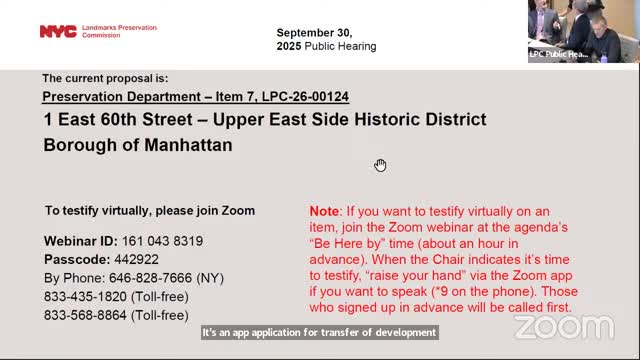
Summary
The Landmarks Preservation Commission issued a favorable report for a continuing maintenance plan for the Metropolitan Club, allowing the club to transfer unused development rights under Zoning Resolution Section 7‑542 after the commission’s conditions are recorded and funds established.
The Landmarks Preservation Commission voted Sept. 30 to issue a favorable report on a continuing maintenance plan for the Metropolitan Club at 1 East 60th Street, enabling the club to transfer unused development rights pursuant to Zoning Resolution Section 7‑542.
Melanie Myers, attorney for the applicant, said the application seeks the commission’s report required under the recently adopted Section 7‑542, which allows individual landmarks to sell unused development rights to receiving sites on adjacent blocks when a continuing maintenance plan is in place. “The plan that we’ll be presenting today builds on precedents established by East Midtown transfers,” Myers told the commissioners.
Mick Doyle of Atchison Doyle Partners, the club’s architect of record, outlined recent and planned conservation work. Doyle said the building—designed in the 1890s by McKim, Mead & White (with noted input from Stanford White) and later altered—has received multiple restoration projects over decades and that the current maintenance plan documents remaining capital needs (including courtyard repairs and masonry restoration) and a schedule for cyclical upkeep.
Key elements of the approved arrangement: The owners committed to a recorded restrictive declaration and a legally enforceable cyclical maintenance plan. The recorded agreement requires (1) completion of specified capital work to bring the landmark to “sound condition,” (2) a continuing maintenance cycle including inspections every seven years, and (3) a funding mechanism: 10 percent of gross proceeds of each transfer of development rights will be deposited into a dedicated fund to support ongoing maintenance and inspections. Myers said a separate escrow will also secure the upfront capital work if necessary.
Why it matters: Section 7‑542 creates a new path for landmark owners to monetize unused air rights while binding them to maintenance standards. The commission’s report does not itself approve a receiving site or a zoning transaction; it certifies that the club’s plan satisfies the continuing‑maintenance requirement that the Zoning Resolution conditions for an as‑of‑right transfer impose.
Public comment and board positions: Friends of the Upper East Side supported maintenance of the club but raised procedural concerns about air‑rights transfers under recent zoning changes and the elimination of certain public review steps. Manhattan Community Board 8 recommended denial of the transfer in its submission; other written comments raised concerns about scale on potential receiving sites. The applicant emphasized that the receiving site is outside the historic district and in a high‑density zone.
Commission action: Commissioner Ryan moved and Commissioner Goldblum seconded a resolution to issue a favorable report finding that the restorative work and the proposed cyclical maintenance plan will preserve the Metropolitan Club’s architectural and historic character and that the owners have committed to a recorded restrictive declaration and a 10 percent proceeds fund. The commission voted 7‑0 in favor.
Next steps: The favorable report enables the club to proceed with transfers permitted under the Zoning Resolution, subject to the City Planning Chair Certification and any required city approvals for the receiving site. The recorded restrictive declaration will be filed in New York County to make the maintenance obligations enforceable by the commission.