
Landmarks hearing on Madison Avenue proposal draws split reaction over scale, rear-yard work
Get AI-powered insights, summaries, and transcripts
Subscribe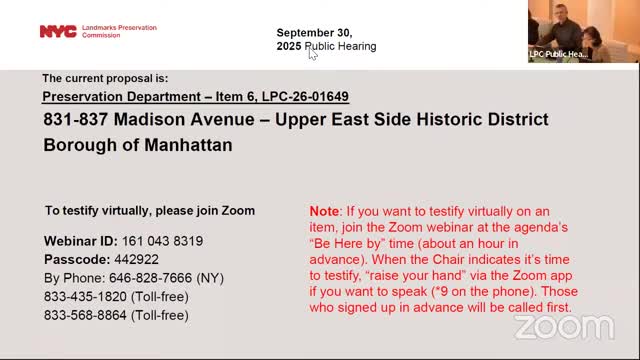
Summary
The Landmarks Preservation Commission on Sept. 30 heard an application to demolish 831 Madison Avenue and replace it with a new apartment building while adding rooftop and rear‑yard work to neighboring 19th‑century row houses; the proposal drew support from some preservation groups and property owners and sharp criticism from neighbors and other preservation organizations over scale and loss of rear‑yard fabric.
The Landmarks Preservation Commission on Sept. 30 heard an application (LPC 26‑01649) to demolish the non‑contributing building at 831 Madison Avenue and construct a new apartment building, add a three‑story rooftop addition and extend the rear yards of the adjacent row houses at 833, 835 and 837 Madison in the Upper East Side Historic District.
Ward Dennis, with Higgins Quays Barth and Partners, told commissioners the proposal would replace a 1956 “no style” building at 831 and integrate it with the three late‑19th‑century row houses to the north. “We are proposing to demolish 831 Madison Avenue, which is a no style, non‑contributing building, and construct a new apartment building on that site,” Dennis said, adding that the project includes storefront restorations, enlarged rears and a rooftop addition at 833 that staff visibility studies show will be “minimally visible.”
The project team, which included David Chipperfield of David Chipperfield Architects and Giuseppe Sirica, presented a design strategy that treats the new 831 volume as a limestone‑faced frontal element with a brick body behind it, and keeps distinct storefront treatments for the historic houses. David Chipperfield said the approach aims “to find a balance between new volume and the existing buildings to sort of protect the existing buildings as much as possible.”
Why it matters: Commissioners, neighborhood groups and residents focused on how a substantially taller, mid‑block building would change the block’s character, and on whether reconstructing the rear walls of the row houses would erase historic volumetric and spatial patterns behind Madison Avenue.
Discussion and public testimony: The applicant said the 831 lot is 41 feet wide and that the rear yards on Madison Avenue blocks in the area are very shallow—about 10 to 15 feet in many places—so the proposal would extend to the lot lines to create fireproof construction and new floor plans.
Residents and preservation groups pushed back. Richard Roth, who identified himself as an East 70th Street resident, asked the commission to reject the application, arguing the combined mass “completely obliterates the north‑south donut section running behind Madison Avenue” and that freestanding mid‑block towers are not typical within the historic district. John Graham of the Victorian Society of New York recommended denial, saying the proposed 831 façade’s minimal, large‑plane treatment is inconsistent with the “visual richness” of adjacent row houses. Zainab Turan of Friends of the Upper East Side expressed support for the contemporary design but urged strict adherence to technical policies (including protections for excavation and removal work) and expressed concern about cumulative rear‑yard incursions. Kaylee Johnson of the Historic Council called the proposal “out of scale” and inappropriate for the district. Basil Walter, speaking for the Burley organization and as the architect of Maxime’s across the street, voiced support for the project.
Commissioners’ concerns and suggestions: Commissioners praised the presentation detail but diverged on acceptability. Several commissioners said they could accept a new building in principle but urged changes:
- Retain more historic fabric behind the facades. Multiple commissioners recommended keeping at least the top floor and more party‑wall elements so the individual row‑house volumes remain legible rather than replacing the rears in their entirety. (Commissioner Goldblum urged leaving the top floor so the volumetric expression remains discernible.) - Re‑examine massing and southern elevation. Commissioners described the south elevation of the new building as effectively a primary façade because of its scale and visibility and urged the applicant to find ways to better integrate that face with the corner townhouse and the block. Several suggested options included stepping the mass or otherwise articulating the south wall to reduce the abrupt scale change. - Reconsider the rooftop addition at 833. Commissioners suggested testing options such as lowering or removing the added story, or adopting a mansard or other treatment to reduce perceived height and visibility. The project team said the rooftop addition was set back and that they reduced the parapet to a railing to minimize visibility after staff feedback. - Differentiate storefront treatments. Commissioners and Friends recommended additional variation and more empathetic detailing at 833 and 835 so each historic building reads individually at street level; the applicant said cast‑iron elements at 833 would be retained and restored and nonhistoric infill at 835 would be replaced with a contemporary but respectful storefront.
Applicant responses and constraints: The team said full reconstruction of rear structures is driven largely by the need to meet fire‑proofing and code requirements and to provide legal light and air and modern mechanical systems. Jim Davidson of SLC Architects said the proposal uses roughly 20,000 square feet less than the site’s allowable floor area under current zoning (the applicant reported being well below both maximum FAR and allowed height).
Outcome and next steps: Commissioners closed public testimony and the hearing without a determination on the application. Commissioner Ekumbe moved to close the hearing; Commissioner Chu seconded; the motion carried unanimously and the hearing was closed. Staff and commissioners asked the applicant to return with revised drawings that respond to the comments—particularly on rear‑façade retention, south elevation treatment and storefront differentiation—so the project can be reconsidered at a future public meeting.
What remains unsettled: The commission did not vote on the certificate of appropriateness at this meeting. Key open questions include how much original rear fabric the commission will expect retained or replicated, whether the new building’s south façade can be reworked to reduce its frontal presence, and whether the rooftop addition should be lowered or redesigned to reduce visibility.
The commission will schedule the application for a future meeting after the applicant coordinates revisions with staff.