
KIPP Texas reports district‑wide growth but says student achievement still trails peers; reading and writing get focused attention
Get AI-powered insights, summaries, and transcripts
Subscribe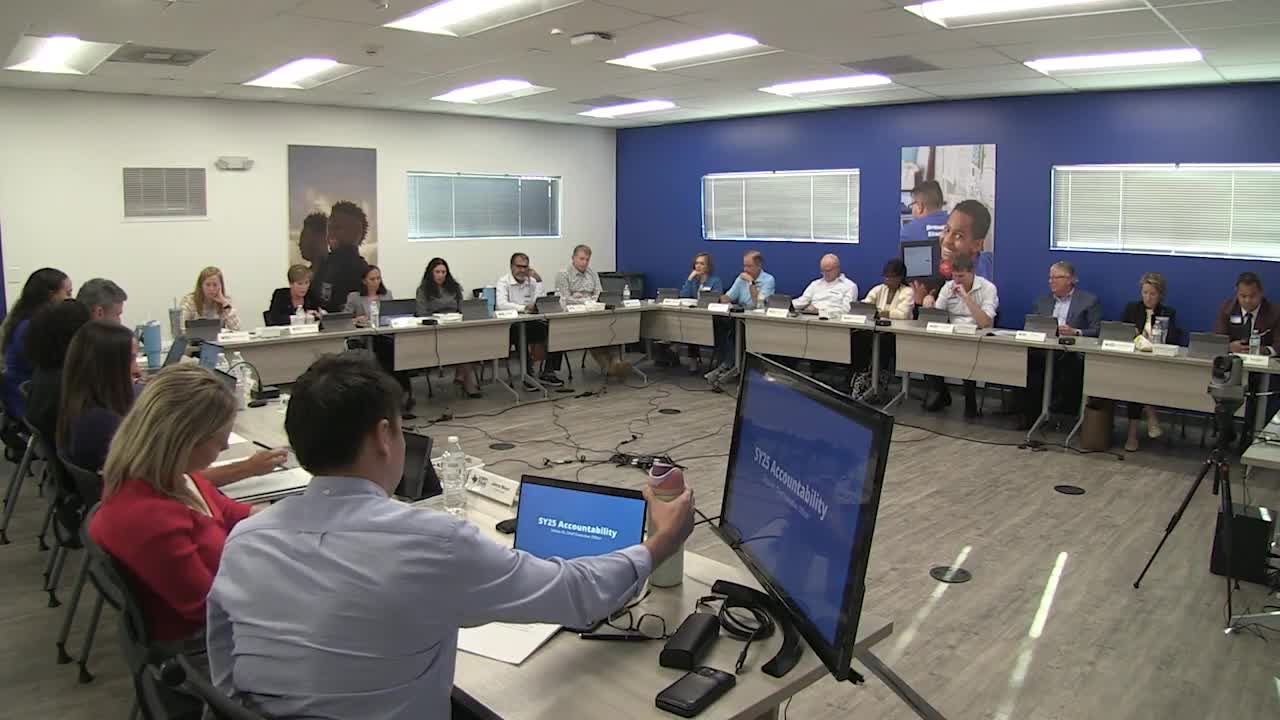
Summary
Saba Ali, chief executive officer of KIPP Texas, told the board on Sept. 25 that the network has gained 11 accountability points over three years but still must accelerate student achievement to match top CMOs.
Saba Ali, chief executive officer of KIPP Texas, opened the academic report at the Sept. 25 board meeting by saying, “We’re proud of our growth, and we need to improve our student achievement.” Academic leaders presented three years of accountability trends, described targeted interventions where performance has lagged, and outlined the strategy for year two of a multi‑year academic plan.
Why it matters: KIPP Texas is a large charter management organization; modest changes in system performance affect college readiness and long‑term outcomes for thousands of students. Management reported that 38 of 54 schools increased at least one letter grade between school years 2023 and 2025, and that the share of A/B schools rose from 21% in 2023 to 57% in 2025. At the same time, leaders said overall achievement still lags peers and remains the organization’s primary focus.
Key results presented: Saba Ali and Rona Simmons, chief academic officer, said the district’s overall accountability rating rose 11 points over the past three years. Transformation schools outperformed the rest of the network, increasing an average of 13 points compared with 5 points for other schools. KIPP Texas reported it now has five D schools and zero F schools; 7 schools declined overall between 2023 and 2025.
Reading and writing focus: leaders said reading gains have been supported by a multiyear early‑literacy strategy (including DIBELS monitoring in K–2), but writing performance is the clearest remaining constraint on the state reading/writing combined metric. Rona Simmons said students’ writing scores were low on the state prompt — “out of a 10 on the writing portion of the reading test, our students averaged about 3.5 points” — and that improving students’ ability to “write to respond” is the quickest route to raise the combined score. To address grading burden and provide consistent feedback, KIPP Texas is piloting an AI‑assisted scoring tool for writing and launching writing academies for teacher leaders this year.
Other academic actions: the network will continue to scale the teacher evaluation and coaching system piloted in transformation schools, sustain math academies, and add targeted supports for grade levels and schools where declines are concentrated. Staff said remediation for students who “do not meet” is an explicit focus; about 37% of students are in the upper tier of “does not meet” and could be moved with focused intervention.
Board discussion and next steps: board members asked whether the same approach will be followed in year two; leaders said the strategic approach will continue with targeted refinements. Management also described how instability in school leadership was associated with declines at several campuses and said the network is directing instructional excellence resources to those sites. The board requested follow‑up monitoring and regular reporting on the grade‑level cohorts showing decline.
What remains open: leaders did not project exact timelines for when full parity with top CMOs will be achieved and did not provide peer‑by‑peer comparative writing data (state public reporting merges reading and writing in the published metric). Management committed to monthly and quarterly monitoring and to sharing more detailed cohort and grade‑level data with the board.