Math Homework Hotline episode focuses on integer operations with callers solving live problems
Summary
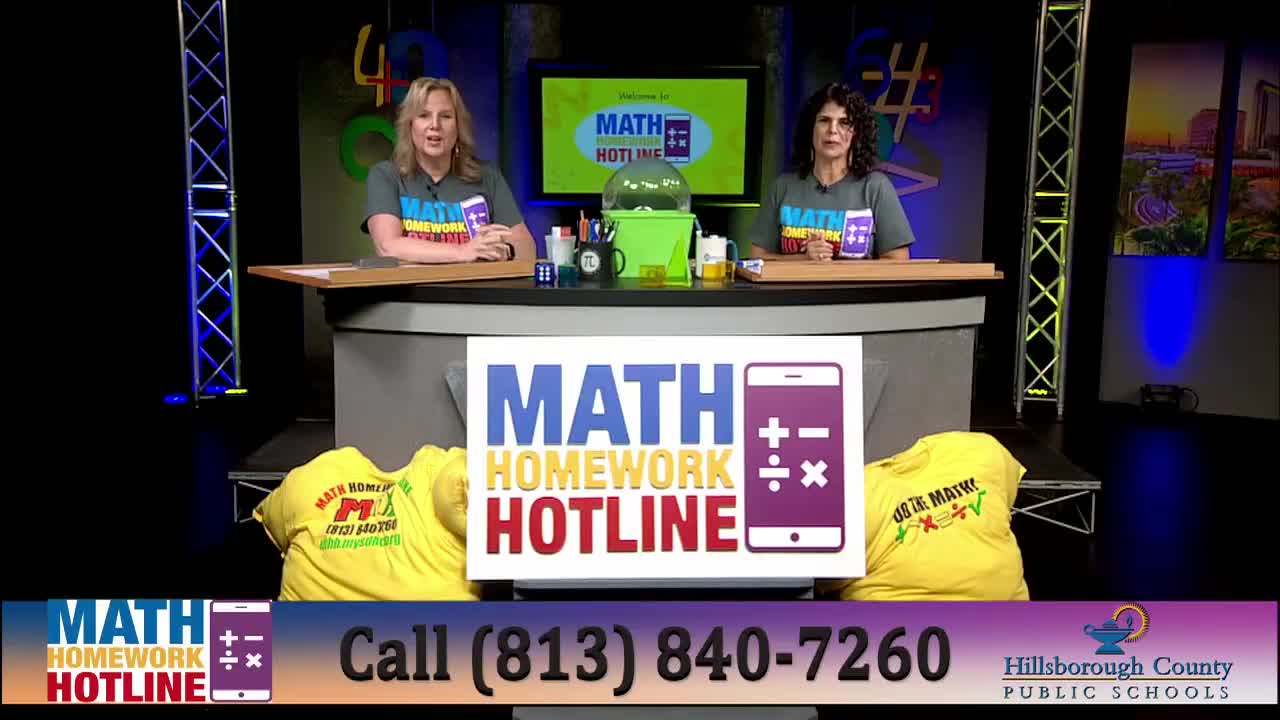
Hosts Maggie Mixon and Canela Prado devoted a Math Homework Hotline livestream to integer operations — addition, subtraction, multiplication, division and absolute value — using word problems and caller participation to illustrate methods and common student errors.
Maggie Mixon, host of the Math Homework Hotline livestream, and co‑host Canela Prado focused an hourlong episode on integer operations — the rules for adding, subtracting, multiplying and dividing positive and negative whole numbers — and walked students through several word problems and practice strategies while callers solved problems live.
The episode matters because integer rules are foundational to algebra and higher mathematics, and the hosts emphasized concrete techniques and error checks teachers and students can use when working on exams and homework.
Mixon and Prado opened with a challenge problem that combined five integer expressions. Caller Rasheed gave the correct final answer: “Minus 13.” The hosts then used that example to review how to evaluate each part (6×(−7) = −42; 6 + (−7) = −1; 6 − (−7) = 13; −6 + (−7) = −13; −6×(−7) = 42) and demonstrated cancelation of opposing terms to get the final −13.
They presented multiple word problems to show different operations and interpretations: a baseline of −15 with a surge of magnitude −9 subtracted from it produced −24 (hosts explained that “magnitude” means absolute value, so −15 − |−9| = −24); an energy cell moving from −30 to +25 had a total change of 55 units; a capacitor holding +2 that “loses 17” resulted in −15; a storage tank at −6,480 with a generator adding 7,915 yielded a resulting total of 1,433; a sensor reading of −3 that adds back 11 produced +8. For division, the hosts set up −42 divided into −7 calibration groups and showed the per‑group result of +6. For multiplication, they showed 1×(−6)×(−9) = +54 and an example of successive multiplications 4×(−9)×5 = −180.
The episode emphasized routine checks and strategies: use a number line for orientation, “CUB” (circle numbers, underline the question, box action words) for word problems, the “crib rails” analogy for absolute value (wrap negatives in bars and take absolute value), and a simple sign rule mnemonic for multiplication and division: same sign → positive; different signs → negative. Hosts repeatedly advised students to re‑read multi‑part questions to answer every part and to write units (the hosts used “units” for energy labels throughout).
Student callers participated: Rasheed solved the pumpkin challenge live; Brandon (calling from Williams and identified as a student of Miss Ferguson) worked on fraction‑to‑decimal equivalence related to −3/5; several other students and teachers received T‑shirt prizes announced on air. Sponsors referenced during the episode included Edgems (unit table of contents in workbooks) and Mathnasium (local learning centers). The hosts closed by inviting viewers to tune in next week and reminding students to check their work during tests.
The hosts used only methods and numeric examples they showed on the livestream; no policy or external regulation was cited.