
Mimosa Hall renovation draws sharp public criticism over tree removal, consultation and use of ARPA funds
Get AI-powered insights, summaries, and transcripts
Subscribe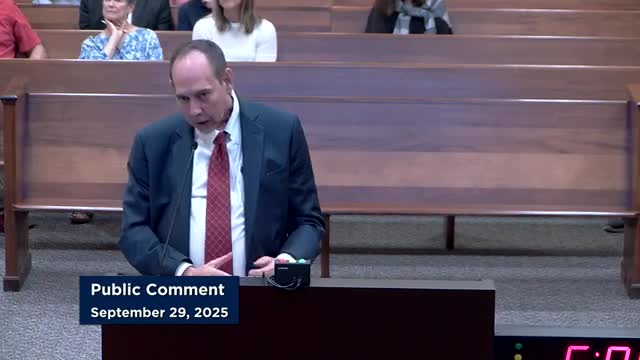
Summary
Roswell’s plan to renovate Mimosa Hall and create a larger Founders Park prompted multiple residents to criticize tree removal, the city’s consultation steps and the use of ARPA funds; city staff said SHPO determined Section 106 review was not triggered and that additional archaeological work had been performed.
A long-running plan to renovate Mimosa Hall and create a larger connected park drew substantial public comment Sept. 29 as residents protested removal of large trees, expressed concern about historic‑preservation review and questioned use of American Rescue Plan Act (ARPA) funds.
Residents said they were surprised by significant tree removal and by aspects of site work done before the public saw final construction documents. "The assault on the natural environment, the assault on the beauty, the assault on the history was staggering," former Mimosa board member Gus Haydorn said. Multiple speakers said the city did not submit project materials to the Historic Preservation Commission (HPC) in a way that allowed the HPC to exercise the review they expected.
City staff disputed some of the public characterizations while acknowledging communication gaps. Steven Malone, director of parks and recreation, said the city engaged a third‑party historic‑preservation consultant to review the design and determine whether federal Section 106 review under the National Historic Preservation Act was triggered. Malone said that consultant submitted materials to the State Historic Preservation Office (SHPO) and SHPO advised that because the project relied on ARPA funding there was no federal trigger for Section 106 review. Malone said the consultant and the city also completed additional archaeological surveys as a matter of due diligence even though the site had been categorized as a low probability for artifacts.
"That was their sole function as they went through this design and the scope of work that we were working," Malone said of the consultant who examined federal compliance. City historic‑assets manager Dina Bush described her qualifications and noted the city undertook phase‑2 archeological surveys beyond minimum requirements.
But preservation specialists and other residents said city staff did not exercise the local review steps that should have protected known historic features. Jacqueline Bass, a historic‑preservation planner who says she has 30 years of professional experience, said the city did not prepare or include a report required by the Unified Development Code when a project affects a documented archaeological site. She said the project’s construction documents did not show mitigation steps for an identified site (recorded as 9FU819 in the Georgia site file) and that community review was limited to “high‑level renderings” rather than construction drawings.
Sally McKenzie and others presented emails they said show SHPO concluded it had no Section 106 jurisdiction because the project used ARPA funds; those emails were read aloud at the meeting. City staff confirmed the SHPO correspondence in public responses and said SHPO deleted the project from its tracking system because no federal trigger existed. Residents said ARPA’s federal‑funding status should not undercut local preservation responsibilities and asked why the city had not pursued a more inclusive public process or sought additional review.
Several council members and staff acknowledged shortcomings in public communication. "This was a project that's been in the works for a couple of years...the city did not break any laws," Council Member Christine Hall said, but she and others said the city could have done a better job explaining the sequence of steps and the timeline. Council Member Sarah Beeson said she regretted not asking about the number of trees that would be impacted and called for better communications going forward.
Staff supplied these procedural points: the property’s zoning is Parkway Village; the project had been presented at high level to friends groups and historic‑interest groups and HPC was given materials and invited to comment; archaeological phase‑2 work was completed; construction documents went through standard community development review; and the city procured design and preservation consultants as part of the design scope. Malone said the project team changed elements of the design in response to consultant and staff input and that some historic materials (for example, stone steps) were preserved for reuse.
Many residents asked for a fuller, independent review or an explicit apology for poor communication. Council members said they would improve public outreach and encouraged residents to pursue available channels — HPC, Friends of Mimosa and Bullock, and public hearings — to engage before construction milestones occur.
Status: staff said construction documents have been reviewed by Community Development and that the project remains under city review; since SHPO concluded that Section 106 review was not triggered by federal funding, the city said local ordinances and the UDC govern review and mitigation.