
Lawmakers hear implementation updates and industry, recycling and environmental perspectives on Washington's carryout-bag law
Get AI-powered insights, summaries, and transcripts
Subscribe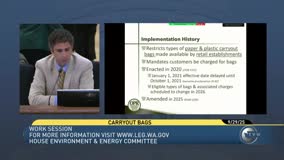
Summary
Committee received an overview of Washington's carryout-bag law and its scheduled changes, enforcement status and fiscal effects, followed by industry, recycler and environmental testimony about bag thickness, fees, recycling and public behavior.
The House Environment & Energy Committee heard updates and competing perspectives on Washington's statewide carryout-bag law, including enforcement practice, revenue effects and supply-chain and recycling implications as the state prepares a scheduled fee increase and pending changes to the types of bags that can be provided.
Jacob Blips and Tracy Taylor briefed the committee on the statutory scheme: the state law restricts single‑use thin plastic bags and requires retail establishments to charge customers a pass‑through fee for paper and reusable plastic film bags. The fee is currently 8¢; the Legislature previously scheduled an increase to 12¢ for plastic reusable bags to take effect Jan. 1, 2026, and the Legislature left that increase intact last session. The scheduled increase in the minimum thickness requirement for plastic reusable bags was delayed: the thicker (4‑mil) minimum will not take effect until 2028, and last session the Legislature added a temporary 4¢ civil penalty on 4‑mil or thicker bags while the transition rules apply.
"These pass through charges that are currently 8¢ ... are retained by the retail establishment," Jacob Blips said, adding they are taxable sales but deducted for B&O tax calculations under the 2020 law. Tracy Taylor described revenue reporting: retailers have reported B&O deductions for the fee (roughly $2.5M in fiscal 2022, $3.5M in FY23 and $3.6M in FY24) and an assumed state sales‑tax base effect of roughly $3.7M in annual sales tax revenue (per the fiscal estimate). Ecology manager Peter Lyon said the agency has prioritized education and complaint‑driven enforcement and that, to date, "we have never imposed a $250 fine on any retailer thus far." Ecology also said it had received 872 noncompliance reports and generally responds with technical‑assistance letters and a graduated enforcement path before conducting a site visit.
Industry witnesses told lawmakers the law is confusing for retailers and that current fees do not fully cover rising bag costs. Brandon Huskeeper of the Northwest Grocery Retail Association said retailers will "do everything they can to avoid the additional 4 cent penalty" and described increased per‑bag costs after the 2020 shift from thinner to thicker film. Smaller retailers and convenience-store representatives said bag use and purchase patterns vary by neighborhood, store type and region, and that paper-bag supply is constrained: paper pallets hold far fewer bags than plastic pallets, which drives transportation and per‑bag costs.
Recyclers and curbside operators urged that plastic film bags remain out of commingled curbside recycling streams because they wrap equipment and cause processing problems; Republic Services and other MRF operators said film should be returned to store take‑back points for specialized recovery. Environmental and local-government speakers said bans and fees reduce litter and marine impacts: an academic analysis cited by 0 Waste Washington correlated local bag policies with 25–47% reductions in shoreline bag litter in U.S. cleanup data.
Ending: Committee members heard a wide range of views as agencies and stakeholders prepare for the statutory fee increase to 12¢ and the 2028 thickness transition; Ecology urged continued education and a complaint process, industry asked for predictable policy and attention to supply‑chain limits, and recyclers and environment groups urged stronger measures to reduce litter and keep plastic film out of curbside streams.