
Ouray County budget work session: EMS faces roughly $1.3 million shortfall; commissioners seek options
Get AI-powered insights, summaries, and transcripts
Subscribe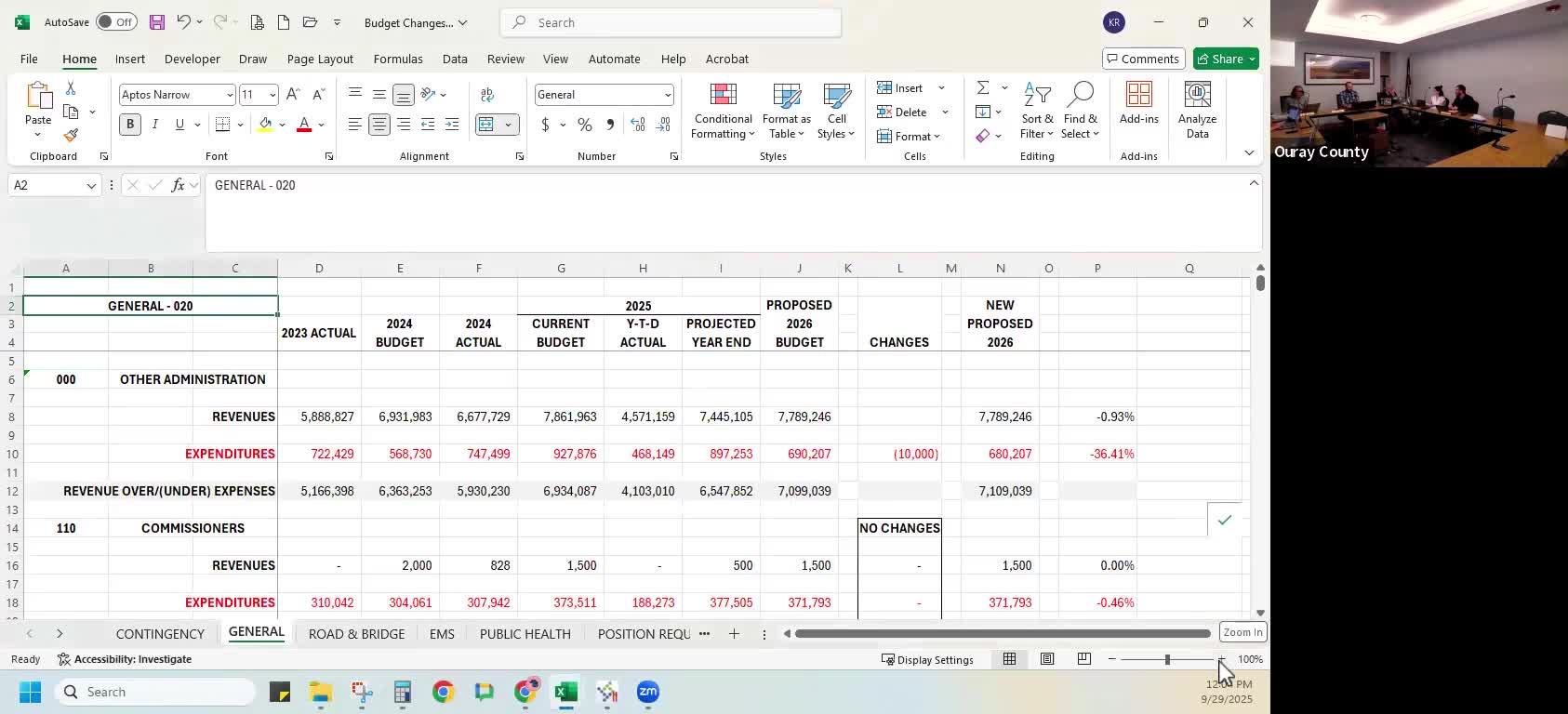
Summary
Commissioners identified an approximate $1.3 million gap in the county EMS budget for 2026, discussed delayed ambulance deliveries, lower-than-expected transport reimbursements and lost marijuana excise tax revenue, and directed staff to gather billing and delivery details and pursue revenue and operational options.
Commissioners at the Ouray County budget work session on Sept. 29 discussed an estimated $1.3 million shortfall in the county emergency medical services (EMS) budget for 2026, citing lower-than-expected ambulance billing reimbursements, delayed ambulance deliveries and the loss of projected marijuana excise tax revenue.
Why it matters: EMS is a core public-safety service. Commissioners said the scale of the gap would require either substantial additional transfers from the county general fund, program changes such as paramedicine or mutual-aid reliance, or new local revenue. Commissioners directed staff to get specific billing, outstanding receivables and delivery-timing details from EMS before finalizing the budget for publication.
Commissioners and staff walked through the numbers and the principal causes of the shortfall. Cara (finance staff) presented the budget-change spreadsheet and highlighted EMS as a major variance. She and other staff told the board that year-to-date transport reimbursements are below prior years and that seasonal collections (summer events, standby fees) have been delayed, contributing to lower actual revenues than budgeted.
Commissioner (chair) asked about ambulance billing timelines and outstanding billed-but-unpaid amounts; residents and other commissioners described common delays in insurer processing and balance billing for patients. Kara said the county contracts with a billing company and that Medicare/Medicaid and private insurers limit the amounts that can be collected, leaving substantial unreimbursed costs.
Commissioners discussed an ambulance order the county has placed that appears to be delayed. The board was told the ordered ambulance represents approximately $260,000 in capital that may not be delivered in 2026; a portion of that cost had been expected to be covered by grant funding (roughly $112,000), meaning both revenue and expenditure lines would fall if delivery is delayed.
Potential revenue and program options discussed included: - Pursuing better collections and benchmarking ambulance charges against nearby districts (Montrose Fire, Telluride Fire) to ensure pricing follows “reasonable and customary” practice (raised by Kara and other commissioners). - Expanding reimbursable services such as paramedicine (a program EMS leadership has proposed) to reduce unnecessary transports and increase billable events. - Increasing standby/recovery of wildfire-related reimbursements, which staff estimated could yield up to $100,000 in 2026 if realized. - Seeking donations or reviving membership programs (noted historically) and targeted community fundraising for EMS support.
Operational tradeoffs were a major focus. Commissioners repeatedly raised mutual aid as a fallback if the county cannot afford ambulances, rapid-response vehicles or adequate staffing; several members warned mutual aid could materially increase response times for parts of the county with difficult roads (Log Hill and County Road 1 were discussed as examples). The board noted the county’s two-mill EMS levy was established in the early 2000s and has not been increased, and several commissioners suggested voters may need to be engaged on potential future revenue measures.
Directions and next steps: Commissioners directed staff to do the following before publishing the budget: (1) meet with EMS leadership (Nate and others) to get detailed billing and receivable figures and clarify collection processes; (2) verify the delivery timetable for the ordered ambulance and the grant deposit status; (3) compare fee schedules and collection practices with neighboring ambulance districts; and (4) explore whether short-term backfills from the general fund are legally and practically available and, if so, what magnitude is feasible later in the year.
The board left the EMS discussion without a final funding decision, saying the item would be parked for now while staff gathers the requested data and potential mitigation options. The finance staff was asked to show how various scenarios (ambulance delivered in 2026 versus delayed to 2027; increased paramedicine revenue; varying levels of general-fund backfill) would affect the published budget.