
Superior council rejects $9.75 monthly solid-waste fee after lengthy debate
Get AI-powered insights, summaries, and transcripts
Subscribe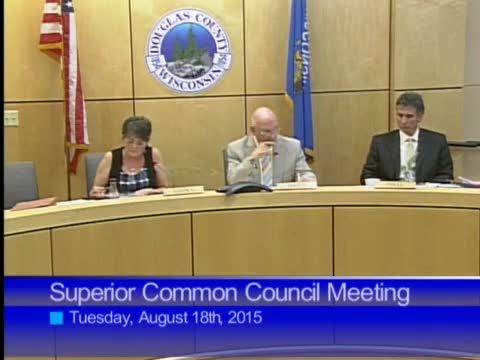
Summary
The Superior Common Council voted down an ordinance on Aug. 18 that would have kept city trash collection in-house and imposed a $9.75 monthly solid-waste fee for residential and small commercial premises beginning Jan. 1, 2016.
The Superior Common Council voted down an ordinance on Aug. 18 that would have kept city trash collection in-house and imposed a $9.75 monthly solid-waste fee for residential and small commercial premises beginning Jan. 1, 2016. The council also rejected a late amendment to reduce the proposed fee to $7.75 a month.
The fee proposal was presented by Finance Director Jean Vito, Public Works Director Todd Janigo and other staff as a measure to stabilize the landfill utility, build a contingency reserve and avoid deep cuts to core city services. "I strongly' I I wanna go on record strongly recommending $9.75," Finance Director Jean Vito told the council during the presentation. The administration said the landfill currently carries roughly $8 million in related debt and that future costs'including capping the current cell and long-term monitoring'make a reserve necessary to avoid transferring large subsidies from the general fund.
Why it matters: Councilors and members of the public sharply disagreed on whether the fee amount and structure were equitable. Supporters of the $9.75 figure argued the charge was small compared with the cost of privatizing collection or allowing the landfill utility to run deficits that would force cuts to police, fire and public works. Opponents said the monthly charge would disproportionately burden low-income and fixed-income residents and urged either a lower fee or targeted relief for vulnerable households.
The administration outlined three scenarios evaluated with consultant input: do nothing (leading to a projected multi-million-dollar deficit), retain collection with a $9.75 user fee (administration's recommendation) and privatize collection under a private offer (a Waste Management proposal that would have billed residents higher monthly rates but would have yielded an immediate one-time payment to the city and removed equipment and staffing costs). Public Works Director Todd Janigo and consultant advisers detailed that building a new landfill cell would likely cost $11 million or more when permitting, mitigation and construction are included, and that an expansion faced substantial wetland permitting hurdles.
Council debate focused on two competing priorities: protecting city finances and avoiding additional costs to residents. Councilor Dan Olson, who moved an amendment to cut the fee to $7.75 per month, argued the lower fee would largely eliminate the historic subsidy the general fund has provided and keep costs lower for households. "It comes down to a dollar 79¢ a week to have somebody from the city of Superior ... pick up your garbage," Olson said. The amendment failed on a roll call vote.
Other councilors warned that a lower fee would produce early-year deficits in the landfill fund and likely require the council to raise rates again within a few years or subsidize the utility from the general fund. Councilor Sweeney, a member of the internal review group, said the $9.75 figure was derived through repeated analysis and consultation and described it as the most prudent option to preserve core services.
Public comment mirrored the council split. Several residents and social-service advocates told the council higher fees would harm seniors and low-income households. "Think about the poor people in this community and think about what you're going to do to them," one speaker said during public comment. Waste Management representatives touted their proposal, noting a near-$778,000 one-time payment the company offered to buy existing equipment and a lower monthly charge for smaller containers in their pricing schedule.
Outcome and next steps: Councilors conducted a roll-call vote on the amendment and then on the original ordinance. The amendment to reduce the fee to $7.75 failed. When the council later voted on the administration's $9.75 ordinance, the motion did not receive the necessary majority and failed as well. With no fee established, the council left the utility in its current state and did not adopt the proposed user charge or privatize collection. City staff indicated the financial shortfall and landfill obligations remain unresolved and that the city will need to return to the issue with alternative options and updated figures.
Details and context: The administration said the city currently expects the existing landfill cell to provide space through about 2022 and that capping and post-closure care will carry multi-year costs that a dedicated reserve is intended to meet. The city also has a $3.50 monthly recycling fee already in place; the proposed solid-waste user fee was intended to be separate from recycling charges. Officials repeatedly cautioned that tipping fees imposed by the Wisconsin DNR and other external charges are outside city control and could raise utility costs in the future.
What the council asked staff to do next: Multiple councilors requested clearer options for household relief, such as targeted exemptions or alternative billing schedules, and asked staff to provide revised scenarios showing the fiscal effect of targeted low-income relief. The mayor and administration said staff will return with revised analyses and that council direction will be needed before the city can adopt a fee or pursue privatization.