
Superior council adopts amended solid‑waste fee; debates franchise offers and pay‑as‑you‑throw option
Get AI-powered insights, summaries, and transcripts
Subscribe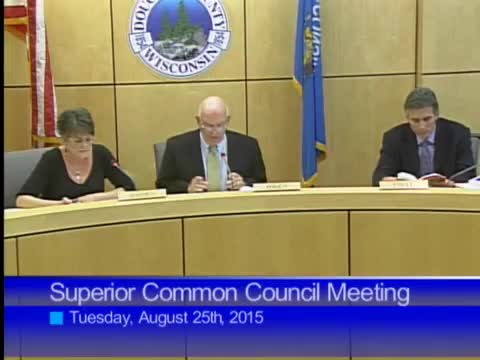
Summary
The Superior Common Council approved an amended ordinance to charge residential and small commercial premises a monthly solid‑waste fee starting at $7.75 in 2016, with a scheduled increase to $9.75 on Jan. 1, 2019; the meeting also included presentations from Waste Management and a pay‑as‑you‑throw vendor and discussion of landfill revenue risks.
The Superior Common Council voted to adopt an amended solid‑waste collection and disposal ordinance on Aug. 25, 2015, approving a $7.75 monthly fee for residential and small commercial premises beginning Jan. 1, 2016, with a provision for a $9.75 monthly fee to begin Jan. 1, 2019, and a $5 monthly charge for each additional container. The measure passed after an amendment was approved by a 7‑3 vote and the ordinance was carried by the same margin in final action.
Council and staff said the fee is intended to close a budget gap in the city’s general fund created by shortfalls at the landfill enterprise and to preserve municipal curbside collection rather than privatize the service. Finance Director stated that if the council did not act and the landfill continued to depend on the general fund, the city could face a roughly $1.1 million gap in 2016 that would swing a planned $390,000 general‑fund surplus to a $710,000 deficit and require immediate cuts.
Waste Management representatives presented a franchise proposal that included an offer to purchase city‑owned collection trucks and carts for a combined $777,776 payable within 60 days after the contract start, and proposed resident rates under a 10‑year term (example rates shown: 96‑gallon cart $10.65/month; 64‑gallon $9.80/month; 32‑gallon $8.65/month; senior rate $7.45/month). Daryl Hoagstra, public sector manager for Waste Management, said the company would keep existing collection days, offer cart size options, and hire five full‑time public works employees conditionally, subject to background checks and DOT screenings.
Paul Gardner, a representative of WasteZero, outlined a pay‑as‑you‑throw (bag‑based) system his firm supplies to municipalities. Gardner said such programs typically reduce landfill tons by about 44% and can generate bag‑sale revenue and tip‑fee savings; he estimated, using city tonnage approximations, that such a program could deliver roughly $1.1 million a year in combined revenue and savings. Gardner said WasteZero supplies the bags, manages retail distribution, and can provide turnkey setup within about 30–90 days; he noted an onboard camera ($2,000 per truck) can be used to detect compliant bags.
Councilors asked operational and rate‑indexing questions of Waste Management — including whether fuel adjustments and a consumer price index would be used to set future rate changes, and whether the current truck automated arms would accept smaller carts. Jim Borash, Duluth‑Superior district manager for Waste Management, described the company’s safety programs, drive‑cam incident coaching, onboard computing system for route tracking and customer exceptions, and centralized dispatch.
Council discussion returned repeatedly to the city’s exposure to revenue from an existing contract with the WSSD (the regional waste hauler/processor contract referenced in staff remarks), which staff said expires in mid‑2019 and generates material revenue for the landfill enterprise. The mayor and several councilors said that uncertainty — and possible future increases in state DNR fees — supported building a reserve and moving to a fee structure that would reduce the city’s fiscal exposure. Councilor Garfield introduced the ordinance and read amended language that set the $7.75 start rate and the later $9.75 step; the amendment also included language allowing a reduced‑size container at a lower rate beginning Jan. 1, 2016, and specified billing and lien collection procedures referencing Wisconsin Statute 66.0627.
Public comment was limited; resident Michael Plante, who said he reviewed the materials posted online, urged the council to adopt a fee now to address the immediate shortfall and continue discussion of alternatives afterward. Several councilors said they supported revisiting the fee annually and monitoring landfill negotiations and tonnage to determine whether adjustments (including lowering fees in the future) would be possible.
The ordinance, as amended, requires billing and sets penalties and collection procedures. Council members also asked staff to continue negotiations with external parties and to provide regular updates to the council on landfill enterprise finances and WSSD contract status.
Details from presentations and council discussion: Waste Management offered to buy city trucks ($715,000) and carts ($62,776) for a combined $777,776; Waste Management presented sample customer rates for automated carts and said it would offer cart size choices, maintain current collection days, and seek to hire five city public‑works employees conditionally. WasteZero described a 33‑gallon labeled bag system, provided examples of 44% average reductions in landfill tonnage from client municipalities, and projected bag revenue plus tip‑fee savings that, according to their model using city data supplied during the meeting, could approach $1,135,000 in year‑one combined benefit. The finance office reminded the council of a statutory deadline of Sept. 1 for the first introduction of the mayor’s 2016 general‑fund budget and said the budget must be submitted to the clerk a week before that deadline.
The council approved the amendment to the ordinance by roll call (7 in favor, 3 opposed) and then carried the ordinance as amended by the same margin. Councilors and staff said they will continue reporting to the council on landfill revenue and closure planning and will revisit the fee and alternatives as more financial information — including the outcome of negotiations with WSSD and updated tonnage projections — becomes available.