Fargo consultants recommend new parking management RFP, code changes and fund consolidation
September 26, 2025 | Fargo , Cass County, North Dakota
This article was created by AI summarizing key points discussed. AI makes mistakes, so for full details and context, please refer to the video of the full meeting. Please report any errors so we can fix them. Report an error »
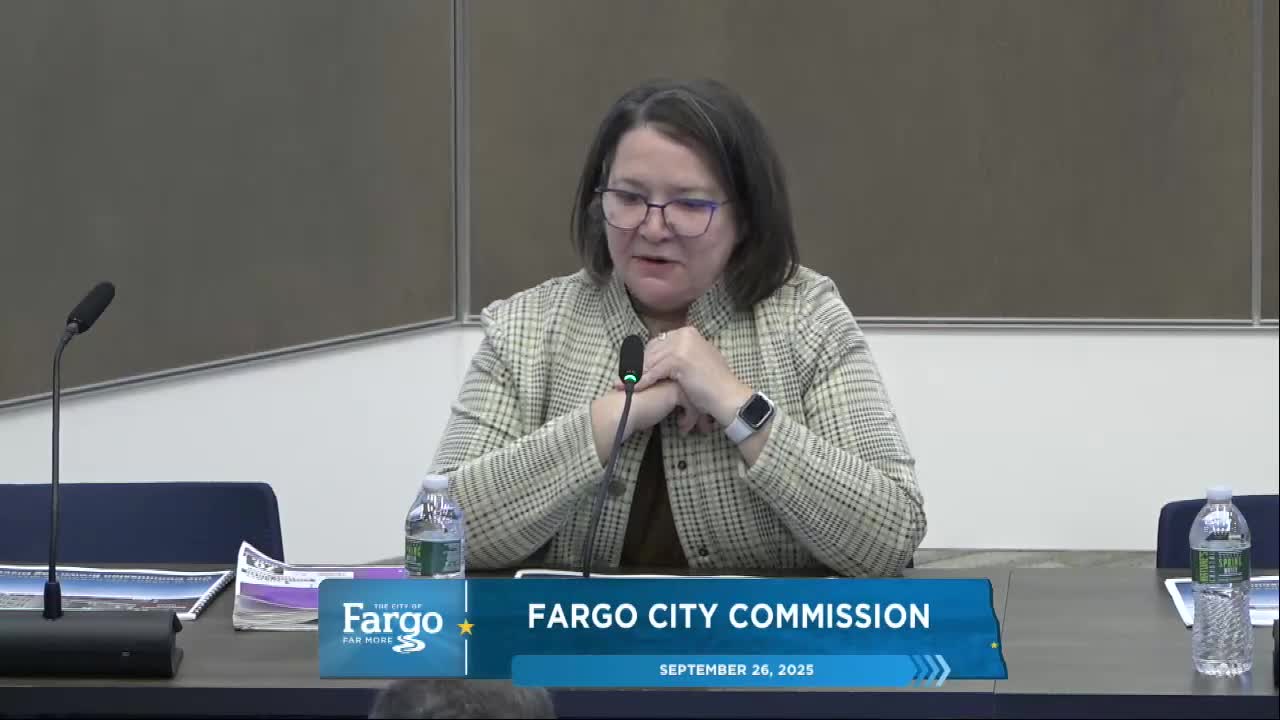
The consultants said the goals of the study were to document the inventory, measure utilization, assess how the city delivers parking services, and produce an RFP to replace an expired vendor contract. "Today, we wanted to kind of kick off a phase 1 of some downtown parking analysis as we move forward," said Nicole Crutchfield, City of Fargo planning director. Consultant Casey McNames of KLJ summarized the study’s framing: “When we think about parking management, we think about the positive outcomes that impact, aligned city goals around providing reliable parking availability, supporting economic development, improving safety, and mitigating congestion.”
Why it matters: Consultants said the city has invested in parking assets and that, under most demand scenarios tied to MetroCog demographic forecasts, Fargo retains a net surplus of public parking now and in the forecast horizon. That gives the city flexibility to prioritize management changes and vendor procurement rather than immediate new supply. The report also examined public‑private ramp agreements at sites identified in the study as Rocco, Mercantile and the soon‑to‑open NP ramps and flagged the need to account for any contractual restrictions when drafting the RFP.
Key recommendations and next steps. Consultants recommended the city: publish a parking‑management RFP in mid‑October; require respondents to submit a line‑item proposed operating budget; offer a 5‑year contract term (with options not to exceed 10 years); and onboard a vendor in January 2026 if contracting proceeds on the proposed schedule. The consultants also recommended short‑term code changes and operational shifts to enable a modern contract, including:
• Require first‑offense parking citations to carry the established fine rather than routinely issuing warning tickets;
• Extend the appeal period for parking citations from five days to 10 days and give a designated third‑party operator authority to adjudicate appeals; and
• Set vehicle impound eligibility at three or more delinquent parking citations and allow a designated contractor to tow vehicles at the Fargo Police Department’s request.
The presentation also recommended consolidating parking functions under a single city department or designated point of contact, continuing to outsource day‑to‑day operations to a private operator, and, over time, moving toward an enterprise fund model for parking as revenues and debt‑service conditions permit. "We are recommending the city migrate from the parking commission ... to a consolidated department," McNames said. The consultants said their mid‑ and long‑term vision includes hiring a full‑time parking manager as the program grows.
Financial context. The consultants presented a holistic financial picture that included day‑to‑day operating revenue and expenses, capital needs and debt service. They said the parking program shows positive net operating income on daily operations but that factoring in capital and mortgage/debt service produces several years with negative net operating income—partially offset by TIF revenue in the model. The consultants advised that respondents to the RFP include transparent, line‑item budgets so the city can compare proposed cost structures instead of a single “all‑in” management fee.
Operational changes discussed. The team proposed several operational changes the RFP could advance in partnership with the vendor: consolidate citation adjudication and collections under the operator; allow the operator to hold and maintain parking technology contracts; consider shortening on‑street time limits to spur turnover and shift longer‑term parkers to ramps; reduce or remove a first hour free in off‑street facilities to encourage better use of assets; and extend paid parking into evenings and Saturdays where demand supports it.
Legal and policy constraints. Consultants noted a state law that currently restricts conventional parking meters in North Dakota and advised the city attorney and commission to review whether modern digital payment approaches would comply with state law. Commissioner Stowe said the city should consult legal staff and possibly state legislators about alternatives so on‑street payment can be an upfront, customer‑friendly option rather than relying principally on citations. The consultants also recommended updating the city’s definition of parking meters to include electronic devices if the city chooses a digital or asset‑light approach.
Public‑staff engagement and oversight. Consultants said a cross‑departmental staff work group (police, public works, auditors and other departments) and interviews with the incumbent operator, Interstate Parking, informed the study. The recommended oversight model calls for the operator to submit an annual budget to the city and monthly financial packets; a designated city staff person would review and monitor those reports through the city’s normal budget and audit processes. The presentation noted that current accounting for parking revenue and expenses is fragmented across multiple funds and that consolidation would improve clarity.
Questions and responses. Commissioners raised concerns about balance between welcoming visitors and enforcing turnover, the effect of changing free parking periods, and the visibility of rates to businesses. Commissioner Pecor said, “I think creating something that's consistent and easily, easily communicated to the businesses is of most importance.” Commissioner Strand and others urged a careful, community‑focused approach as downtown activity recovers. The consultants said peer cities vary in their approaches and that many U.S. cities are adopting mobile and kiosk payment systems; some cities are moving away from free periods for paid parking areas.
Implementation considerations and timing. Consultants stressed the need to account for existing public‑private agreements and for adequate enforcement resources if the city shortens on‑street time limits. They proposed a near‑term RFP and code tweaks, mid‑term consolidation of funds and technology, and a long‑term hiring of a dedicated parking manager. The consultants said the RFP will ask proposers to recommend payment technologies, permit solutions, and creative approaches for on‑street management that respect state law.
No formal commission action was recorded during the presentation; staff said they will finalize the RFP and return to the city commission for approval of any contract and budget changes. The consultants will post the full presentation online and provide commissioners with copies.
View the Full Meeting & All Its Details
This article offers just a summary. Unlock complete video, transcripts, and insights as a Founder Member.
30-day money-back guarantee
Sponsors
Proudly supported by sponsors who keep North Dakota articles free in 2025

