
Forsyth County staff brief commissioners on community grants awards, reporting and policy questions
Get AI-powered insights, summaries, and transcripts
Subscribe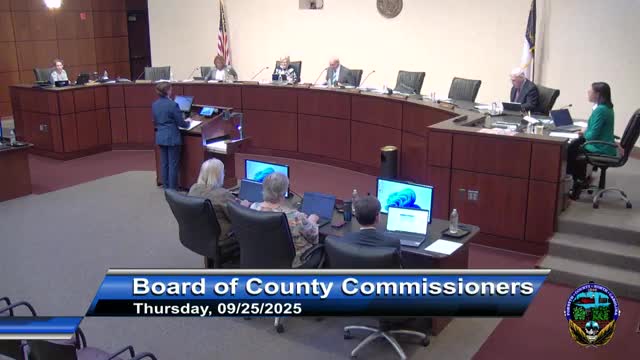
Summary
County grant administrator reported FY25 and FY26 award totals, rollout of new reporting in Neighborly, and sought board guidance on a budget cap, carve-outs for recurring grantees and whether capital projects should be allowable.
Bailey Arnold, the county’s grants administrator, told the Forsyth County Board of Commissioners on Sept. 25 that staff closed fiscal year 2025 and is rolling out a more rigorous reporting and monitoring process for the FY26 grants program. The update matters because commissioners must clarify how much the county will set aside for community grants, what counts as an allowable expense and whether recurring grantees should be carved out of the competitive pot. Arnold summarized FY25 results, saying that 27 organizations received a total of $1,849,750 in awards and the county disbursed $1,837,086.69; one grantee returned or did not need the full award, leaving $12,113.31 unspent. For FY26, staff received 77 applications, awarded 32 organizations $1,816,812, and after one organization withdrew a $15,000 award, staff is administering 31 active projects totaling just over $1.8 million in awards. Arnold said the FY25 grantee reports were compiled into single‑page summaries modeled on ARPA impact reports and that FY26 reporting will be more robust and quarterly. Arnold described a new grantee portal (Neighborly) that requires monthly quantitative expenditure reporting, activity logs and supporting documentation. “They have 3 tabs and a submission tab, but the first 1 is very quantitative,” Arnold said, describing fields for expenditures by category, participant counts and progress toward contracted outcomes. She said she has met one‑on‑one with about 20–25 grantees and scheduled roughly 20 site visits between October and December. Commissioners pressed staff on interpretation of the policy language about whether community grant funding is “available” and therefore subject to mid‑year reductions if county revenues fall. County Manager Robinson told the board that staff interprets “funding available” to potentially apply both to the annual funding decision and, in extreme circumstances, to mid‑year reductions, but that legal and policy clarity from the board is needed. Robinson said staff would communicate with grantees “as soon as we would know” if a mid‑year reduction were necessary. Several commissioners sought clearer lines of authority and process: some said they expected that a manager’s recommended budget would propose a cap; others said a cap should be set in advance so staff can vet applications up to a board‑set maximum. Arnold said staff followed the policy guidance and that FY26 used a cap similar to FY25 ($1,849,200), but asked the board whether to retain that amount or choose a different cap. On allowable costs, staff reported a working interpretation that direct program delivery expenses tied to a contract (for example, a program manager who oversees the grant activity) are allowable, while HR, core finance staff, occupancy, utilities and certain capital or construction expenses were treated as unallowable in the FY26 review process. Arnold said legacy contracts used broader “operating expense” language and that the new policy tightens monitoring and documentation. Commissioners debated whether to permit capital grants on a case‑by‑case basis; County Attorney and staff said capital contributions are not prohibited but would require additional monitoring terms (for example, multi‑year covenants tying facility use to specified services). On next steps, staff said applications for FY27 would open in October if the board agreed. Commissioners signaled consensus that the county should set a cap to guide staff vetting, that all applicants should apply (no carve‑outs were adopted that day), and that staff would not commit funding to grantees until the budget process produced a clearer funding recommendation. Arnold said staff will continue quarterly reporting to the board under the new format and that clearer application training for FY27 applicants will be provided in advance. Less critical details: Arnold noted the community grants policy did not take effect until Sept. 19, 2025, so reporting requirements in the new policy do not retroactively apply to FY25 awards.