
Governance committee backs annual reset of choice-program waitlists, tighter lottery oversight
Get AI-powered insights, summaries, and transcripts
Subscribe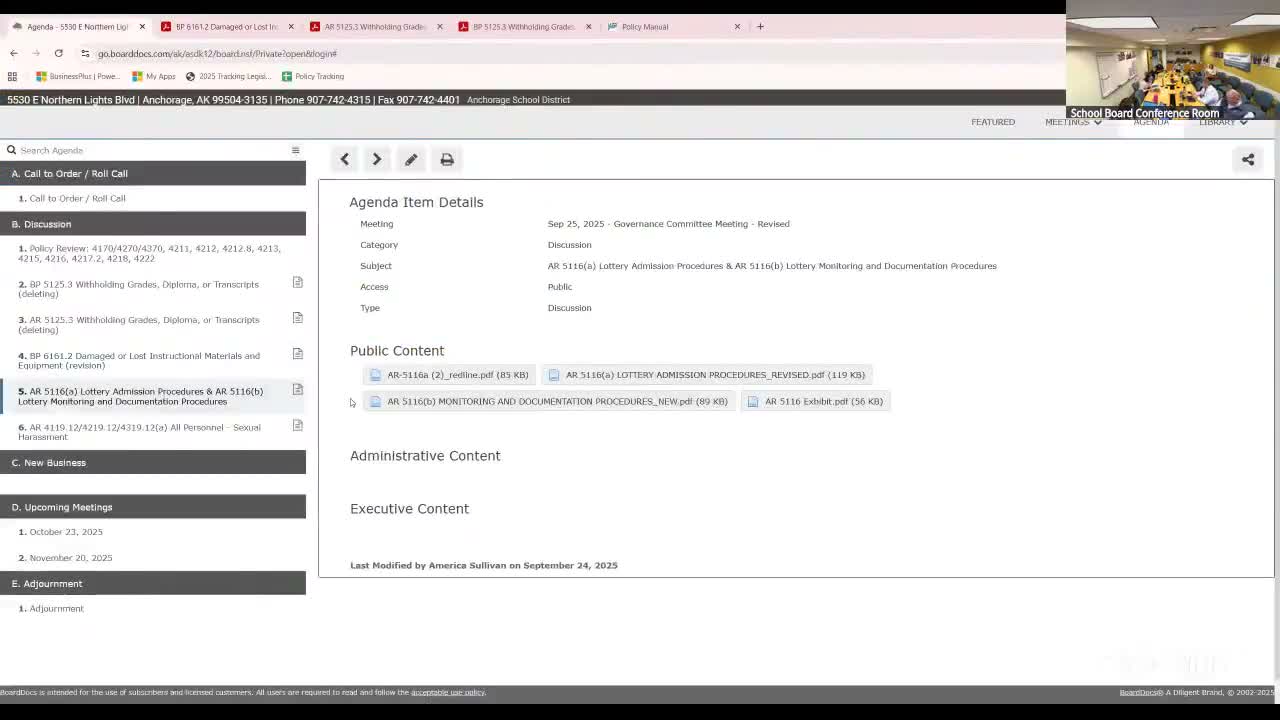
Summary
The ASD governance committee reviewed a proposed administrative regulation to reset school choice waitlists annually, bar prescreening of applicants, adopt a centralized monitoring process and provide an annual lottery report to the board; administrators will return with a revised regulation next month.
The ASD School Board Governance Committee on Sept. 25 reviewed an administrative regulation that would reset school choice lottery waitlists each year and tighten monitoring of lottery practices, and asked administration to return with a revised draft next month. Robin Harris, senior director of Choice Schools, told the committee the change is timed to the district’s migration to a new lottery system called Scribbles and is intended to improve fairness for families.
Harris said, “So, this revised AR just refreshes our lottery each year so that families have equal access.” The regulation would also prohibit prescreening or preinterviewing students before a lottery and would require centralized monitoring by Harris’s office, including principal attestations and contact logs to support audits.
The committee’s interest in the change comes after administrators reported some schools maintain multi-year waitlists — in a few cases “at length of 200 students” — that can persist when the district’s old system rolls over names each year. Harris said wiping waitlists at the end of each school year and requiring families to reapply would reduce carryover that, she said, “erode[s] a little bit of trust” and limit equitable access.
Committee members also asked that the AR explicitly require the district to provide the board with the annual lottery-monitoring report. Harris agreed the report could be produced on a calendar-year schedule tied to the lottery opening, noting the district’s timing would likely put the final report in January. She said the centralized report would summarize lottery trends, compliance and needed improvements and could be made public.
Board members raised operational questions about space and staffing that constrain how many students a program can admit even when demand is high. A committee member noted that some schools have limited classroom availability — citing Polaris as having “1 classroom availability at this point” — and warned that adding seats in a single year can create cascading capacity pressures in subsequent years.
Action and next steps: the committee asked administration to finalize wording, include the annual-report commitment, and bring the revised AR back to the governance committee next month for review before it goes to a full-board agenda.