
Board approves COPs authorization after lengthy debate over COPs/TANs hybrid for Buckeye work
Get AI-powered insights, summaries, and transcripts
Subscribe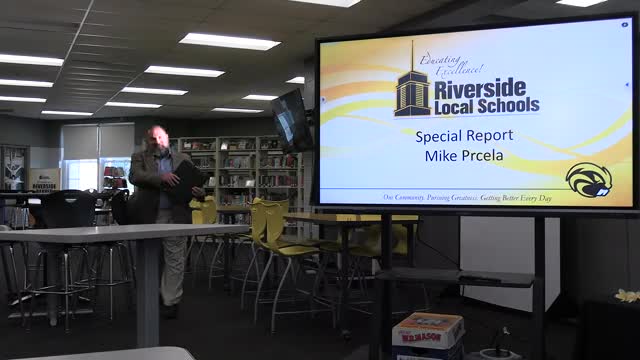
Summary
The Riverside school board voted 3-2 to authorize lease-purchase financing (certificates of participation) as part of a proposed hybrid financing package that would also use a $3 million tax anticipation note; board members voiced concern about timetable, disclosure details and long-term obligations tied to Buckeye facilities.
The Riverside Local School District board on Wednesday approved a resolution authorizing certificates of participation (COPs) financing — over two dissenting votes — after a detailed presentation on a hybrid financing plan that would pair COPs with a $3 million tax anticipation note (TAN) to fund construction and renovation work, including Buckeye additions and renovations.
The authorization followed a 90‑minute discussion led by financial adviser Mike Purcello, who described a hybrid structure intended to lower overall interest costs by combining a TAN (10‑year maximum maturity) with longer‑term COPs (up to 30 years) for the bricks‑and‑mortar portion of the project.
Purcello said the TAN portion is limited by statute to using up to 50% of revenue from a given permanent improvement levy for debt service; he described using about $3 million in TANs alongside approximately $9 million in COPs as one likely split, producing a combined annual payment he and district staff estimated at roughly $825,000 depending on final pricing and interest rates. "The tax anticipation note is a much stronger credit [to investors]," Purcello told the board, and combining the two vehicles can reduce overall debt service by an estimated 15 percent compared with COPs alone.
Board members pressed Purcello and Treasurer Steve Thompson for specifics on timing, disclosure, and the risk the district would take on if a mortgaged facility — in the discussion, Buckeye's older portion — became unusable. Purcello described the COPs structure as a sale/leaseback using a special purpose entity and explained that certificate holders would have a lien under the ground lease; if the district ceased to use or damaged the asset, certificate holders could seek remedies under that contract. "If the district is unable to pay that debt service, the trustee, by lien and proxy of the certificate holders, basically has a legal outlet to come in," Purcello said, while adding that such takeovers have not happened in Ohio.
Several trustees said the board lacked enough concrete numbers to vote. Trustee (transcript) Miss Grama (board member) called the COPs authorization "premature" without finalized guaranteed maximum price (GMP) figures and full disclosure of fees and insurance costs. Thompson and Purcello said architects and the construction manager expect a GMP for the building within weeks and that the firm is working to finalize a site GMP so the board can see a single package if possible. Purcello said the underwriter and bond counsel (Dinsmore/Tom Wilson) have been briefed and that bond insurance and other cost‑of‑issuance items would be accounted for in the investor packet prior to pricing.
Trustees who opposed the motion said the board needed more time to consider bond or levy alternatives and the long‑term implications for the district's permanent improvement (PI) and general funds. Opponents cited several concerns: COPs are annually appropriated lease payments rather than traditional voted debt; COPs may limit future flexibility because the ground lease pledges assets; a COPs‑heavy structure could affect the district's credit profile if other near‑term borrowing needs arise; and the PI forecast packet did not show all anticipated TAN payments. "If that's the plan and the COPs is what we have in the PI fund forecast, the PI fund forecast is only accounting for the COPs," one trustee said, adding that the TAN payment "is not on there" and would create additional pressure in the PI fund.
The motion authorizing COPs financing as presented passed, 3‑2. After the vote, Purcello and Thompson told the board they will continue refining the disclosure, pricing assumptions and the packaging of COPs and TANs and will return with the finalized borrowing documents and pricing details. Purcello described an aggressive prepayment or refinancing option that would allow the district, after five years, to refinance or pay down debt if rates improved — a feature required by recent law limiting midterm refinance frequency.
Trustees and staff also discussed alternatives including a voter‑approved bond or a permanent improvement levy (time‑bound or continuous). Treasurer Thompson told the board that one mill currently generates approximately $1,727,000 for the district and that a 35‑year bond to raise roughly $14 million would likely require less than a 0.5‑mill levy, depending on interest rates. He cautioned, however, that state legislative changes and other risks mean the board needs to plan carefully.
The district will continue to finalize GMPs, cost‑of‑issuance estimates, and the disclosure before any final sale; Purcello said the proposed schedule targeted a closing in late October but that the timeline has flexibility. The board directed staff to provide the board with full disclosure documents, a breakdown of cost‑of‑issuance and fee estimates, and updated PI fund forecasts showing TAN and COPs payments combined.
Trustees who voted in favor said the authorization allows the district to pursue the most cost‑effective financing while leaving options to refinance after five years. Trustees who opposed said the board should wait until the GMP and all issuance details are complete and consider broader options, including asking voters for additional levy capacity to cover a larger project.
The board also heard related briefings during the same meeting on the construction status of Riverside and other projects and on legislative risks to property tax collections. Purcello warned that state legislative proposals under discussion could affect levy revenue calculations and carryover limits but said Moody's and other ratings agencies typically treat pending legislation as a risk only after laws are enacted. "If you were to be forced to go to a time‑bound levy on your existing permanent improvement, that puts pressure on you as far as getting it renewed," Purcello told trustees.
The district indicated it will return to the board with detailed financing documents for formal approval before pricing or closing any transaction.