Get Full Government Meeting Transcripts, Videos, & Alerts Forever!
Get email alerts on the Property Rights And Buffers topic
No spam. Unsubscribe anytime.
Zoning board overturns director’s order, allows Newman family to keep perimeter fence in Highlands Park
Summary
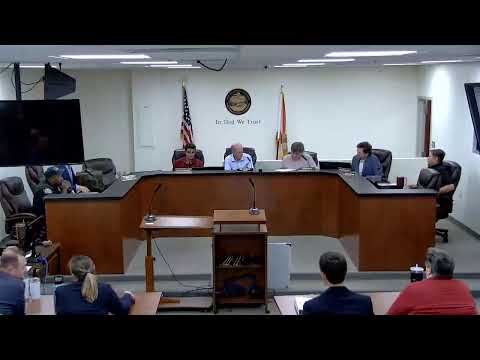
The Walton County Zoning Board of Adjustment on Sept. 25 reversed a Planning Director’s determination and allowed Paul and Cynthia Newman to keep a six-foot wooden fence at their rear property line in Highlands Park, finding the Land Development Code ambiguous and construing the ambiguity in favor of the property owners.
The Walton County Zoning Board of Adjustment on Sept. 25 upheld an appeal filed by Paul and Cynthia Newman and reversed a director’s determination that required the Newmans to move a six-foot wooden fence 10 feet inside a platted landscape buffer in the Highlands Park subdivision. The board’s de novo review concluded that the county’s land-development code is ambiguous on whether perimeter fences are permitted inside a required landscape buffer; the board voted to resolve that ambiguity in favor of the property owner.
Why it matters: The ruling affects where property owners may place fences relative to platted landscape buffers in older Walton County subdivisions. Several speakers warned the decision could create inconsistent outcomes unless the county clarifies its code; proponents argued the ruling protects a core property right to exclude trespassers.
What the appeal contested: The Newmans installed a six-foot wooden fence at or just inside their rear property line to stop repeated trespassing and, by their account, to protect the household from nearby beehives and safety risks. Planning staff initially indicated by email that the fence placement was permissible, but interim Planning Director Steven Schoen later issued a written director’s determination concluding the fence was within a required 10-foot landscape buffer and therefore must be moved unless the property owner reduced the buffer through the alternative screening/wall option identified in the code.
Legal and planning arguments: Attorney Robert Kaufman for the Newmans argued the applicable 2004 PUD language and the county code allowed fences at property lines and that the code does not clearly prohibit fences in the buffer; he also cited Florida case law that zoning or land-use ambiguities should be construed in favor of property owners (Rinker Materials Corp. and Persaud Properties) and state policy recognizing the right to exclude (statutory references introduced at the hearing).
Planner Melissa Ward testified that the PUD approval language specifically listed fences as permitted within setbacks and that a landscape buffer on the plat was not a preservation or environmental buffer but a compatibility buffer intended to separate differing densities. Ward argued a property-line fence plus plantings inside the buffer would enhance, not defeat, the buffer’s purpose.
County testimony and director’s rationale: Interim Planning Director Steven Schoen said his written determination adopted a different reading: the buffer language and the list of prohibited uses implied fences were not allowed within the buffer. Schoen told the board that where the code does not list a use as permitted in the buffer, his interpretation is that it is not allowed; he also offered the reduction-by-wall alternative as the county’s available remedy.
Public and association input: The Highlands Park Homeowners Association president testified the HOA and the neighborhood’s architectural review committee had approved the fence, that the HOA had itself installed perimeter fencing in adjacent common areas, and that the HOA wanted consistency across the subdivision. Paul Newman told the board he and his wife had put the fence up only after seeking counsel and ARC approval, and that trespassing and bee swarms had been immediate safety concerns.
Board finding and outcome: After de novo consideration, the board found the code ambiguous and, applying the established rule that ambiguities be construed in favor of property owners, sustained the appeal. The board tied much of its reasoning to reliance interest — that the Newmans and their HOA relied on staff guidance — and to property-rights language cited by the applicant’s attorney and planner. The board’s motion to approve the appeal passed with all members voting in favor.
What the board did not decide: The board’s order focused on the director’s interpretation and whether the fence must be moved; it did not resolve possible future code updates or broader county policies. The board noted that code enforcement processes remain available to neighbors if the Newmans fail to meet other obligations such as required replanting of the landscape buffer where vegetation was removed.
Ending: The Newmans may keep the fence while the HOA and property owner proceed with replanting and other measures the board and planning staff discussed. The county may consider clarifying the LDC language in future code amendments to avoid similar disputes.