Get Full Government Meeting Transcripts, Videos, & Alerts Forever!
Get email alerts on the Municipal Budget topic
No spam. Unsubscribe anytime.
Broomfield leaders outline 2026 budget priorities, hold second study session
Summary
City officials held the second study session on the proposed 2026 budget, emphasizing a 20% reserve goal, a new police facility, an enterprise resource planning (ERP) rollout, and bonds for water and wastewater projects; department heads answered questions about appraisals, court services, hazardous‑mitigation planning and other items.
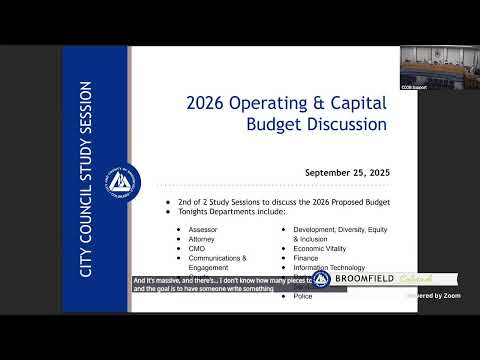
City and County of Broomfield officials held the second of two study sessions on the proposed 2026 budget, reviewing department requests and answering council questions on items that include a planned new police facility, an enterprise resource‑planning software rollout and bonds for water and wastewater infrastructure.
Deputy City and County Manager Dan Casey told council the 2026 proposal reflects a shift from rapid growth to a maturing community and prioritizes: mandates from federal and state requirements, contractual obligations, and critical public‑health and safety needs. He said staff aim to preserve a 20% general‑fund reserve as part of enhanced financial stability.
The proposed calendar calls for a public hearing on the budget during the City Council meeting on Oct. 14, 2025, and final consideration and adoption at the regular meeting on Oct. 28, 2025. Council will accept public comment at both meetings.
Most of the meeting consisted of department‑by‑department presentations and questions. Highlights and clarifications provided by department heads at the session included: - Assessor: Jay Umash said valuation work for the 2027 appraisals is underway but that the office cannot yet preview results. He restated that the department used a sales window of July 1, 2022, through June 30, 2024, to set the 2025 valuations and noted the appeals process remains the same. Umash reported 509 total appeals for 2025 and said 317 were filed through the office’s new online portal (about 60%); 51 were handled in person, 126 by mail and 15 by email. He said the assessor’s office has nine staff members and anticipates one to two retirements in the coming year, prompting succession‑planning work. - Courts: Municipal Court Judge Amy Bachman described the court’s navigator program, which connects people who appear in court with services including mental‑health and housing supports. Bachman said the court recently lost a state grant that had paid for appointed counsel at first appearance; the court must now budget for those costs. She also said the court is developing an electronic check‑in process and a probation case‑management module to improve tracking. - Emergency management and planning: Clay Shuck, director of operations, said the city will hire a consultant to update its FEMA‑required hazard‑mitigation plan; the work is budgeted at roughly $75,000 and is expected to span 2026–27, with multiple approvals required before the plan returns to council. - Finance and ERP: Graham Clark, finance director, and IT Director Kateri Abeyta described a planned ERP implementation intended to replace multiple legacy spreadsheets and systems; staff said they expect the work to be multi‑year and stressed they will avoid heavy customization and plan training and staff supports during the transition. - Information technology and broadband: Abeyta and deputy director Robert Belton discussed the city’s “dark fiber” strategy—building extra conduit to lease fiber strands to providers—and said multiple providers are in active discussions or construction phases. IT staff also described an internal AI initiative focused on increasing staff AI literacy, creating an AI steering committee and reviewing vendor tools before adoption. - Economic vitality and redevelopment: Economic Vitality Director Robert Smith reviewed efforts to market the U.S. 36 corridor and the former FirstBank Center / Arista area for redevelopment, and he said staff will hold a roundtable with property owners and brokers to coordinate investment and activation of the corridor. - Parks, recreation and senior services: Staff said program registrations are near capacity in some areas and that senior services are preparing a strategic review to align services with a growing older‑adult population while working within current staffing levels. Staff confirmed respite‑care funding for the next contract year is in place. - Communications: Director Julie Story described phased website improvements, efforts to clean outdated content, and the city’s real‑time event text alerts (separate from emergency mass‑notification system) intended to notify residents of event changes.
The study session included public comments. Dan Sonnison and Annie Bryson, residents of the Eagle Trace North neighborhood, urged council to prioritize purchase or protection of water rights and reservoirs associated with the local golf course near Broomfield High School. Bryson also argued, as a matter of budget priority, that the city could protect existing assets rather than take on new large projects; she cited a figure — "$80,000,000" for a new police station — as part of her argument that the city should preserve existing water resources. Those figures were presented by the speaker as a public comment, not as council findings.
No formal votes or policy adoptions occurred at the study session; the meeting was informational and intended to let department heads answer council questions before the Oct. 14 public hearing and the Oct. 28 adoption vote.
Council members asked department heads about legislative and statutory limits on property tax methodology, the assessor’s online appeals rollout, risk and safety work in the city attorney’s office, court services capacity, broadband builds, redevelopment strategy for the 36 corridor and operational pressures on parks and senior programs. Departments provided numerical and program details where available (for example, the assessor’s appeals counts and the 07/01/2022–06/30/2024 appraisal window). Several staff said they would return with additional information in later meetings.
The study session closed with council thanking staff for the presentations and reminding residents of the two upcoming public budget meetings in October.
What happens next: staff will continue refining the proposed budget and return to council at the Oct. 14 public hearing and Oct. 28 final adoption meeting. No binding action was taken during the study session.