Lifetime Citizen Portal Access — AI Briefings, Alerts & Unlimited Follows
Seattle officials outline $30 million federal-backfill plan for food, housing and immigrant services
Loading...
Summary
City officials briefed the Select Budget Committee on a plan to use up to $30 million from the proposed B&O tax proceeds to mitigate likely federal funding cuts to SNAP, housing and immigrant-serving programs, proposing funding increases to Fresh Bucks, food banks, emergency rental assistance and legal defense for immigrants.
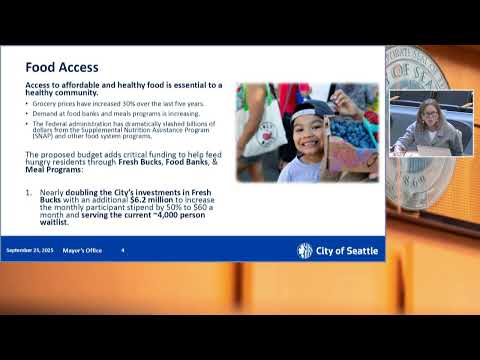
Seattle officials on Sept. 25 told the City Council’s Select Budget Committee they are proposing to use up to $30 million in proceeds from the proposed business-and-occupation (B&O) tax to protect local food access, housing and immigrant and refugee services from likely federal cuts. The proposal, presented by Deputy Mayor Greg Wong and department directors, would direct the money into three priority “buckets”: food access, housing and shelter services, and immigrant and refugee supports. Wong said the proposal is a risk assessment rather than a precise prediction of federal actions: “We are not dealing with a, necessarily logical or coherent federal government at this time.” The funding matters because city leaders say federal proposals and agency actions could sharply reduce assistance that many Seattle residents rely on. The executive’s package would expand the Fresh Bucks program, increase funds for food banks and prepared-meal programs, add emergency rental assistance and a reserve for shelter, and enlarge legal and workforce supports for immigrant and refugee communities. Deputy Mayor Greg Wong framed the work as a near-term mitigation strategy tied to the Seattle Shield Initiative, the B&O-tax-funded program the council forwarded to voters. He told the committee the third B&O “bucket” could provide “up to $30,000,000 in proceeds that may be used to mitigate the impact of federal funding decisions.” Office of Sustainability and Environment interim director Michelle Caulfield described the proposed Fresh Bucks changes: the program currently serves about 12,000 residents with a $40-per-month benefit and has a waitlist of more than 4,000 households. The mayor’s proposed budget would expand program capacity and raise the monthly benefit to $60. “Fresh Bucks reaches residents disproportionately burdened by poverty, food insecurity, and diet related chronic diseases,” Caulfield said, citing a University of Washington evaluation showing higher food security and fruit-and-vegetable consumption among Fresh Bucks participants. Human Services Department Director Tanya Kim detailed other food investments. The executive proposes a $3,000,000 addition for food banks and $1,000,000 for meal providers, bringing HSD’s food-and-nutrition portfolio to about $30,000,000 — a roughly 16% increase from the 2025 adopted budget, Kim said. She told the committee food banks now operate as community hubs offering mobile pantries, home deliveries and grocery access. On housing and shelter, Kim said the mayor’s package adds $4,000,000 for emergency rental assistance — bringing the city’s total rental-assistance capacity to $11,500,000 — and proposes a $9,000,000 appropriated reserve to allow rapid local backfill if federal shelter or Continuum of Care funding is reduced. Kim cited the King County Continuum of Care as an example of an award potentially at risk and noted the city has already filed legal challenges to some federal actions. Hamdi Mohammed, director of the Office of Immigrant and Refugee Affairs (OIRA), described threats to programs that support naturalization, legal representation for unaccompanied minors and other services. He told the committee the president’s 2026 budget proposal would eliminate the Community Development Block Grant (CDBG) program nationally and warned of cuts to legal-orientation and immigrant-defense funding. “We are seeing federal policy changes that are dismantling vital programs that serve our immigrant and refugee communities,” Mohammed said. Mohammed and budget staff said some local mitigation is already in place. The council previously approved a $300,000 midyear supplemental for immigrant legal defense and “know your rights” trainings; OIRA said $200,000 of that was put into a request-for-proposals (RFP) for legal defense and $100,000 for rights trainings. Mohammed noted OIRA’s ongoing base appropriation for legal defense is $1,300,000 annually, bringing the office’s current legal-defense funding this year to $1,600,000 with the supplemental. Council members pressed for more detail on who would be affected and how the city would allocate the funds. Councilmember Teresa Rivera asked why only $300,000 of the supplemental was directed to legal defense; Mohammed and Budget Director Dan Eder replied that the $300,000 was the supplemental for 2025, that $200,000 was RFP’d to legal defense immediately, and that the mayor’s 2026 proposal (roughly $3,700,000 for immigrant-related investments) would likely include a larger share for legal services after further community listening and a competitive process. Council members also asked for a clearer accounting of CDBG-exposed programs and which city services rely on those federal dollars. Deputy Mayor Wong and director-level staff said they would provide more detail to the committee on CDBG exposures and the proposed allocations. The presentation included several quantified clarifications: Fresh Bucks serves 12,000 households and has a 4,000-household waitlist; the executive proposes boosting the Fresh Bucks benefit from $40 to $60 per month; HSD’s food-and-nutrition portfolio would rise to approximately $30,000,000; the rental-assistance funding increase would bring the city’s total to $11,500,000 and the proposed emergency reserve is $9,000,000; OIRA reported current legal-defense funding at $1,300,000 plus a $300,000 supplemental, for $1,600,000 in 2025 pending 2026 allocations. Next steps: council members asked the executive to supply a breakdown of CDBG impacts and a fuller accounting of legal-defense funding sources and planned 2026 allocations. Officials said they will follow up with detailed spend plans and RFP timelines if the B&O tax passes and the backfill monies become available.