Get Full Government Meeting Transcripts, Videos, & Alerts Forever!
Get email alerts on the Elementary School Budget topic
No spam. Unsubscribe anytime.
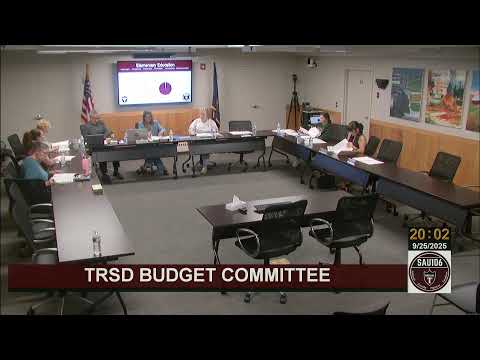
Budget committee accepts Timberland elementary budgets for 2026–27 after review of supplies, furniture and technology needs
Summary
Budget Committee members on Sept. 25 voted to accept the Timberland elementary schools’ proposed operating budgets for fiscal 2026–27 for further review after principals outlined key cost drivers and longer‑term needs.
Budget Committee members on Sept. 25 voted to accept the Timberland elementary schools’ proposed operating budgets for fiscal 2026–27 for further review after principals outlined key cost drivers and longer‑term needs. The presentation covered classroom supplies, library restoration, information‑access fees for online math resources, replacement furniture cycles and requested classroom technology pilots; committee members also discussed safety radios and a pending district safety grant that could offset some costs.
The presentation, led by Steve Harris, principal at Atkinson Academy, and Mary Sullivan, principal at Pollard, explained that the elementary group serves about 1,600 students across five schools and roughly 365 staff and that the set of elementary budgets represents less than 0.5% of the total district budget. "I'm Steve Harris, the principal at Atkinson Academy," Harris said as he opened the school‑level overview. "So our biggest driver in elementary is supplies," Sullivan said, citing pencils, glue and other consumables for young students.
Why it matters: committee members said the items are small in the context of the district budget but important to classroom functioning and equity across schools. The committee flagged wide per‑pupil differences in some lines — for example, replacement furniture and technology use — and sought clarification about why Atkinson’s replacement and equipment requests were higher than other schools. "I just think that your budget is a little on the high side," one committee member said during questioning. Committee members also asked whether technology purchases proposed by principals should instead come from the district technology budget; committee member Sue Sherman said, "I want them all to have the technologies you need. I don't understand why they're part of your building budget and not part of our technology budget." Principals said they were coordinating with the district technology leader but included initial estimates as “seeds” for future discussion.
Most important facts - Enrollment and staffing: presenters said the elementary group expects about 1,600 students in 2026–27 across five elementary schools, with roughly 365 total staff. Atkinson recently added a preschool classroom and principals estimated Atkinson’s enrollment rose by about 25–30 students compared with two years earlier. The presenters used September 1 counts for consistency with board reporting. - Budget drivers: presenters identified five main drivers: classroom consumable supplies (pens, glue, crayons, Play‑Doh), reinstated library budgets cut in the prior round, textbooks and teacher materials, information‑access fees for online learning programs (named examples included ReadyMath and i‑Ready), and replacement equipment/furniture cycles. - Technology: principals described pilot work on interactive projectors/interactive whiteboards and said they would work with the district technology staff on potential districtwide purchasing. They also explained variation across schools: some grade levels or buildings opt for printed workbooks rather than online access, which lowers that school’s information‑access line. - Safety radios and grant: Atkinson presented two replacement radio lines (a small line for principal’s office radios and a larger replacement‑equipment line for furniture and equipment). Presenters said the district has an outstanding safety grant application for districtwide radios submitted by district staff; if approved, purchases may be reimbursed in a later year and reduce local line‑item burden.
Committee reaction and vote: members pressed principals for clarifications on why some schools’ per‑pupil costs were higher, asked for clearer line descriptions (for example, distinguishing walkie‑talkie purchases from furniture), and discussed districtwide consolidation of software licenses. After discussion, a member moved to accept the Timberland elementary school budgets for review; the committee voted to accept the budgets for review (motion approved; vote recorded as unanimous during the meeting).
Context and next steps: presenters noted that many purchases follow replacement cycles (furniture and equipment ages out) and that some items are seeds for multi‑year planning (interactive classroom displays, expanded preschool furnishing). The committee also asked administration to provide clearer line descriptions (for example, separating walkie‑talkies, batteries and furniture) and to coordinate with the district technology office on which items should move into the central technology budget. The committee scheduled virtual school walkthroughs and asked for availability from members to attend in coming weeks.
Ending: The committee accepted the elementary budgets for review and will reconvene budget discussions after staff provides the requested clarifications and after the district receives decisions on pending grants that could affect radio and safety equipment lines.