Rock County supervisors propose $1-per-hour alternative to COLA as budget talks continue
Loading...
Summary
Supervisors presented the recommended 2026 budget and an alternative compensation approach that would add $1 to each cell of the county pay grid for 2026, intended as a one-time measure to reduce pay disparity and improve recruitment. The recommended budget also includes a 2.5% COLA and other key funding items.
Rock County supervisors and staff presented the recommended 2026 budget on Sept. 25 and discussed a proposed one-time alternative to the standard cost-of-living adjustment (COLA) that would add $1 to every hourly cell on the county’s pay grid for 2026.
Supervisor Wilson, presenting with Supervisors Tillman and Schwartz, said the pay grid covers most county employees and that roughly 1,170 full-time-equivalent positions (about 87% of the county workforce) use the grid. The supervisors proposed distributing available wage dollars as a flat $1-per-hour increase to each pay-grid cell rather than a uniform percentage COLA.
“Instead of applying a standardized percentage, a dollar per position on the grid,” Supervisor Wilson said, explaining the rationale: the $1 approach narrows pay disparity because percentage COLAs give larger raises in dollars to higher-paid employees while low-wage positions receive smaller absolute increases.
Wilson and colleagues gave examples. Under a 3% COLA, a lower-grid employee at $19.23 per hour would see an annual increase of about $1,200; the $1-per-hour plan would instead increase that position’s annual pay by about $2,080. At the top end, a $61.21 hourly wage under 3% COLA would rise by about $3,820 annually, but under the $1-per-hour plan would increase by $2,080 — the same dollar increase received by the lower-paid worker.
The supervisors framed the alternative as a one-time measure for 2026 to reduce recruitment and retention problems in mid-range pay grades (labeled G–J in the presentation) and to mitigate the worst-case impact of higher employee health-insurance premiums on take-home pay. They said the $1-per-hour approach produced budgetary costs close to the 3% COLA used as a baseline in their calculations but acknowledged a potential shortfall (they estimated about $400,000 if the budget contains a smaller COLA).
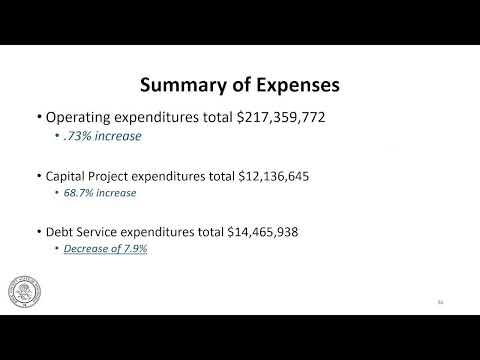
Kristen, a county staff presenter, summarized the administrator’s recommended 2026 budget. The recommended budget is balanced and includes a 2.5% COLA, an operating levy of just over $69 million, a levy increase of 7.05 percent, assignment of $3.2 million in sales tax to the highway fund to begin repaying a prior advance, and borrowing of about $4.7 million for highway and park projects. The recommended budget also reduces Rock Haven’s tax-levy dependence by about $1 million and includes debt-levy adjustments.
No formal vote was taken on either the supervisors’ $1-per-hour alternative or the recommended budget during the meeting. Supervisors and staff said the $1 approach would require a budget amendment and review by the finance committee; the presenters said they would calculate any funding gap and prepare a proposed amendment for committee consideration. The board’s schedule: detailed budget review sessions in October, an October 30 public hearing on the budget, a Nov. 6 finance-committee appeals session, and a Nov. 12 final adoption of the budget and tax levy.
Why it matters: The compensation approach affects recruitment, retention, and the distribution of wage increases across county employees. The recommended budget’s levy and borrowing decisions affect future tax levies and capital projects including highways and parks.
What was not decided: The board did not adopt the $1-per-hour plan or amend the recommended budget at this meeting. Any change would require a formal budget amendment and committee process.