Get Full Government Meeting Transcripts, Videos, & Alerts Forever!
Get email alerts on the Housing Rent Regulation topic
No spam. Unsubscribe anytime.
Council adopts mandatory rent-disclosure and exemption-clarification ordinances after extended public comment on algorithmic pricing and building compliance
Summary
The council unanimously adopted Ordinances 25-098 and 25-099 after a lengthy public hearing in which tenants and advocates described alleged algorithmic price-fixing, lack of building transparency and enforcement gaps; speakers pressed for stronger enforcement, mandatory security and immediate remedies for large landlords.
The Jersey City Municipal Council unanimously adopted two ordinances on Wednesday aimed at strengthening tenant protections and transparency: Ordinance 25-098 requires landlords to include a sworn disclosure on rent increases to help enforce the city’s ban on algorithmic price-fixing; Ordinance 25-099 clarifies that state-level exemptions from local rent caps do not excuse landlords from local transparency, registration and disclosure obligations.
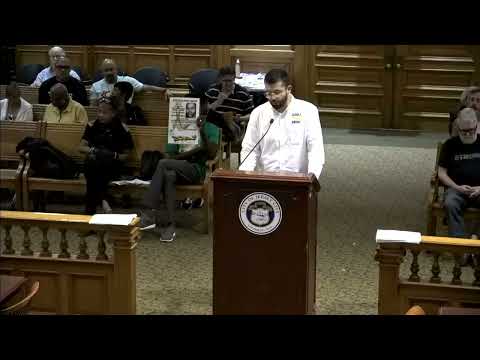
The public hearing drew multiple tenant leaders and members from buildings across the city, including residents of Portside Towers, who described long-running problems they say stem from large corporate landlords. Speakers urged the city to enforce ordinances now on the books rather than rely on slow court processes.
What the ordinances do
Ordinance 25-098 adds a mandatory disclosure to leases and rent-increase notices requiring landlords to swear they did not use shared competitor data, algorithms or collusive practices to set rents; the change brings in potential remedies available under the New Jersey Consumer Fraud Act if statements are false, including treble damages, speakers said. Ordinance 25-099 clarifies that state exemptions are narrow — they exempt a building only from limits on periodic or regular increases in base rent — and that exempt buildings still must comply with registration, rent-roll and landlord-identity disclosure requirements.
Public testimony and enforcement concerns
Kevin Weller, a resident at rent-controlled Portside Towers, said the disclosure will give tenants “real teeth” because a false sworn statement could trigger criminal perjury charges and consumer-fraud remedies. He and other tenants argued that algorithmic pricing investigations by state and federal authorities show the need for local enforcement tools; multiple speakers referenced the U.S. Department of Justice and state attorney general investigations into algorithmic price-setting.
Daniel Feldman, another Portside tenant, said the ordinance creates “a doable double liability” because landlords would face perjury exposure and treble damages under the Consumer Fraud Act for false disclosures. He and other tenants called for the city’s enforcement offices to use subpoenas and criminal processes where warranted to compel evidence from landlords and service providers.
Multiple tenants and tenant organizations also described widespread operational failures at Portside Towers that they tie to landlord noncompliance: the absence of resident superintendents, missing landlord-identity disclosures, chronic elevator and ventilation problems, and the lack of 24/7 uniform security in buildings of the size required by city code. Speakers said those safety and habitability problems made civil enforcement slow or ineffective, and they called for stronger, faster enforcement tools.
Council debate and votes
Council members debated the practical reach and enforcement burden of the measures. Sponsors and supporters said the disclosure requirement is a modest, single-paragraph addition to standard leases; opponents did not prevail in public testimony. Councilmember Solomon described the measure as a “good law” that strengthens enforcement and said that “if you’re following the law, all you have to do is add one clause to your standard lease.” Ordinance 25-098 and 25-099 were adopted unanimously, 9-0.
Enforcement and next steps
Speakers and council members repeatedly raised enforcement capacity as a limiting factor. Director Richardson and municipal prosecutor Jake Hudnut appeared at caucus to explain staffing constraints; several speakers urged the city to allocate more resources to the Division of Housing Preservation and to use subpoena powers and the municipal prosecutor’s office more aggressively. Tenants said additional enforcement options planned by the council — including an ordinance to create mandatory minimum fines for continuing violations — will be necessary to deter repeat noncompliance. Council members indicated further steps, including referrals to planning or other agencies, would follow as needed.
Speakers quoted in this article spoke during the Sept. 24, 2025 council meeting.