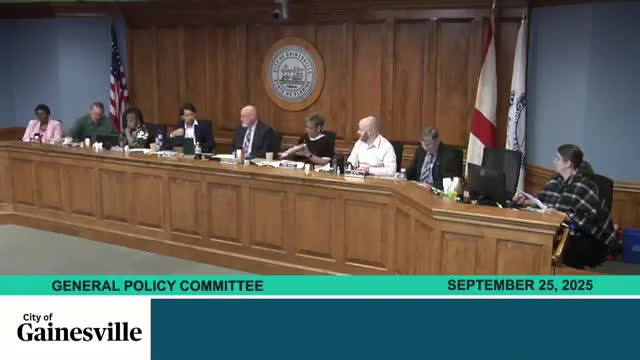
Commission sends public-right‑of‑way camping and median safety changes back to staff; directs community engagement
Loading...
Summary
The committee referred proposed updates to public-right‑of‑way ordinances — including language on public camping/sleeping and rules for medians — to the city attorney and staff for revision and best-practice research and directed staff to engage community stakeholders; the median restriction was approved subject to further legal review.
The General Policy Committee on Sept. 25 directed staff and the city attorney to review and rework proposed updates to public‑right‑of‑way ordinances addressing camping and sleeping on public property and pedestrian safety in medians, and it asked staff to bring best practices and stakeholder input before the commission.
Staff said the primary drafting problem in the camping-and-sleeping ordinance is the word “overnight,” which is not defined and has created inconsistent enforcement. Phil Mann, the city’s special projects administrator, asked the committee to authorize the city attorney to draft modifications and advertise the ordinance for formal readings. Mann said removing “overnight” from two sections would let police apply the state statute on public camping and public sleeping immediately rather than waiting for a time test.
Commissioners and the police chief warned that enforcement needs clear, narrow language. Chief Moya said officers now treat “sleeping” differently from a short nap and that, in practice, GPD uses a 10 p.m. to 8 a.m. window; the chief asked for clearer direction so officers have consistent discretion. The city attorney noted recent changes in state law and a Supreme Court decision that affect the city’s exposure and the legal framework for enforcement.
On the medians issue — raised as a Vision Zero pedestrian-safety measure — staff recommended removing the existing 6‑foot width carve-out and prohibiting standing or lingering on medians unless a median is specifically designed for pedestrian use (for example, a marked pedestrian island). Staff said a portion of pedestrian fatalities from 2022–2024 occurred on medians without crosswalks. The committee directed staff to refresh legal research on forum‑analysis case law (the historical practice of treating roadways as public fora for speech) and to return recommendations to ensure any restriction is narrowly tailored.
The committee voted to send the proposed ordinance changes to the city attorney and staff for further review and to incorporate best practices. That referral passed on a 5–2 vote. Separately, the committee unanimously directed staff to engage community stakeholders and advocates, including houseless-services providers, and to return with impact analysis and best practices.
Ending: Staff will return the drafted ordinance changes to the commission after the city attorney and relevant departments research case law, enforcement practice, other jurisdictions’ models, and stakeholder input.