Get Full Government Meeting Transcripts, Videos, & Alerts Forever!
Get email alerts on the Special Education Privacy topic
No spam. Unsubscribe anytime.
Parents and staff tell Colonial Heights School Board of special‑education failures and privacy breach
Summary
At the Sept. 23 school board meeting, parents and a district employee urged action after complaints about virtual speech services, alleged failures to provide court-ordered special‑education supports, an unlicensed school psychologist, and a district privacy breach; callers said cases are pending in court and asked the board to investigate.
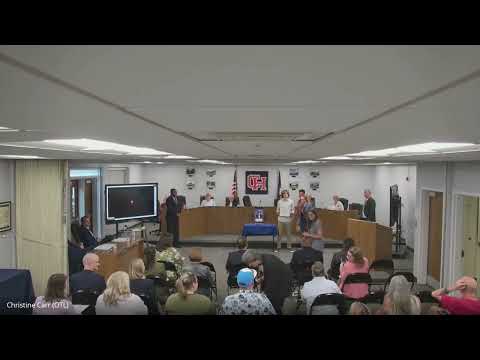
At the Colonial Heights School Board meeting on Sept. 23, 2025, parents and a district employee told the board they had experienced inadequate special‑education services, alleged violations of federal and state student‑privacy rules, and asked the board to investigate and discipline staff where appropriate.
The complaints began with Morgan Shinkle, a pre‑K teacher at Lakeview and a parent, who said Lakeview is in its second year of using a virtual speech‑language pathologist alongside an in‑person speech‑language pathology assistant and that arrangement “is not ideal.” Shinkle said the assistant cannot perform required diagnostic testing, forcing screenings to be done remotely or by already strained district SLPs. “We are grateful to have an in person speech assistant, but they cannot replicate nor replace a fully licensed speech pathologist,” Shinkle said.
The most extensive public comments came from Cindy Bell, a district employee and university supervisor at Virginia Commonwealth University, and Janice Brookwood Jackson, a parent of two children with disabilities. Bell said she had disclosed sensitive housing information to district employees on a need‑to‑know basis and later learned those details “were common knowledge” inside the district. She cited school board policies GBB (prohibition of abusive work environments) and GBCB (employee code of professional ethics and conduct) when urging the board to enforce confidentiality and follow its grievance process.
Jackson told the board she believes the division is repeatedly violating the Free Appropriate Public Education guarantee (FAPE), IDEA Part B, and the Family Educational Rights and Privacy Act (FERPA). She said a due‑process order requiring Orton‑Gillingham–trained instructors for her daughter had not been carried out, that the school system employed a school psychologist, Michael Subchak, who “has not held a valid license since 2015,” and that her son was unlawfully unenrolled from North Star Academy without prior written notice. “You are protecting staff, some unlicensed, some abusive, while retaliating against children with disabilities,” Jackson said, and told the board that litigation is pending in circuit court and the Virginia Court of Appeals.
Board members did not take formal action during the meeting on the complaints. No motion to open an investigation or to refer the matters to an independent investigator or legal counsel was recorded at the meeting; callers repeatedly urged the board to ensure the district follows its grievance policy and to remedy any statutory violations.
Why it matters: IDEA Part B and FAPE govern services to students with disabilities and can trigger compensatory relief and attorney fees when a district fails to comply. FERPA governs the confidentiality of student and family education records; employees and parents raised concerns that sensitive information had been improperly discussed within the district.
What callers asked for and what the board did: Shinkle asked for consideration of options to bring a full‑time licensed speech‑language pathologist to Lakeview, including contracting locally or raising pay; Bell asked the board to confirm that the district has followed step 2 of its grievance policy; Jackson asked for investigations, disciplinary action where warranted, and proper allocation of IDEA Part B funds. There was no board vote or directive recorded on those requests at the Sept. 23 meeting.
Context from district reports that evening: the board discussed budget calendar approval, routine financial reports and capital projects planning elsewhere on the agenda but did not address these public complaints in committee or take a formal vote in open session on the allegations during the meeting.
Documentation and next steps claimed by speakers: Jackson said “hundreds of thousands of dollars have been paid to the school board attorneys to fight parents instead of educating children,” and said cases are pending; Bell said she was awaiting confirmation that the district had progressed to step 2 of the grievance process. The board did not provide a timeline or public response to the allegations during the meeting.
The public‑comment period at Colonial Heights School Board meetings allows speakers to address the board for up to five minutes and does not by itself create an investigatory action. Board members may choose to refer complaints to staff, counsel, or an independent investigator at a subsequent meeting.