Get Full Government Meeting Transcripts, Videos, & Alerts Forever!
Get email alerts on the Utility Rates And Capital Investment topic
No spam. Unsubscribe anytime.
Mercer Island utility board weighs mid‑biennium rate increases as aging water, sewer and storm systems drive capital needs
Summary
Mercer Island utility staff and outside consultants told the city’s Utility Board that extensive capital work — including a major water supply replacement and lake‑line sewer projects — plus higher regional sewer charges justify proposed rate adjustments.
Mercer Island utility staff and outside consultants told the city’s Utility Board on Tuesday that an extensive list of overdue capital projects and higher regional treatment charges require rate increases for the three enterprise utilities. Ben Schumacher, financial analyst for the City of Mercer Island, said city staff and FCS/Bowman consultants recommended maintaining the previously adopted plan for water and proposing smaller adjustments for sewer and stormwater after applying updated assumptions.
The recommendation presented to the Utility Board keeps an 8% annual increase for the water utility in 2026, reduces the board’s previously proposed 4.5% local sewer increase to 4%, reflects a revised King County sewer forecast that raises the county pass‑through to 7.5%, and lowers the stormwater proposal from 8% to 6%. “When we think about rate studies, they really do provide a forward looking evaluation of utility fees,” Angie Sanchez Renash, project principal for the consultant team, said during the presentation.
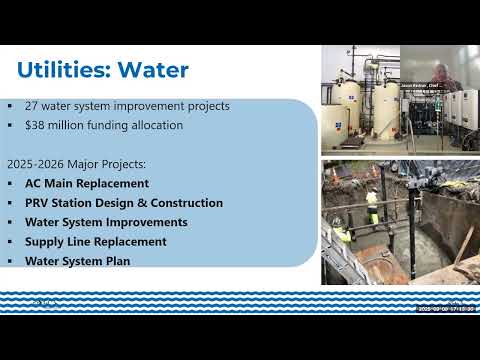
Why it matters: the board was shown a multi‑year capital program that staff says reflects “once‑in‑a‑generation” reinvestment in aging infrastructure. Jason (city staff) told the board the water capital list includes 27 projects with more than $38 million in funding in the 2025–26 biennium and emphasized a major new supply‑line replacement and a program to replace roughly 4–5 miles of asbestos‑cement pipe and to rehabilitate 20 of the system’s 83 pressure‑reducing valves. He said those capital needs, plus previously unplanned emergency repairs, drive the water recommendation.
On the sewer side, staff described a unique, island system with about 13 miles of sewer pipe in the lake and 17 pump stations that move wastewater to two King County connection points on the east side. Jason said the city’s sewer work includes 16 capital projects and about $12.3 million of funding in 2025–26. Staff warned that the lake‑line and pump‑station work is costly, subject to complex permitting and historically tied to overflows at east‑side pump stations during wet weather. The board heard that King County’s updated rate forecast — provided to the city in mid‑2025 — is materially higher than earlier projections and is expected to add several dollars a month to customers’ bills as a pass‑through cost beyond the city’s local sewer charge.
Stormwater, the smallest of the three utilities, has a shorter project list (11 projects, roughly $2.7 million for 2025–26) and substantially less asset data than the other utilities. Staff said a new condition assessment program using CCTV and other tools is underway to better prioritize stormwater capital and maintenance.
Realization factors and financing: to avoid overstating near‑term spending the city applied “realization factors” — reductions to planned capital spending that reflect expected delays from staffing vacancies, permitting, construction windows and coordination with other projects. The presentation noted a 90% realization factor for sewer and an initial 90% for stormwater that drops to 75% in later years. Staff also described a policy target for annual rate‑funded system reinvestment (RFSR): $3.9 million target for water, $2.0 million for sewer and $1.2 million for stormwater. The city’s finance director, Matt Mordecher, explained that the City Council’s updated financial management policies (adopted May 2024) call for considering debt financing for large projects (policy threshold described in the presentation: projects above about $2.5 million or with long useful lives).
Projected bill impacts: the consultants presented sample monthly single‑family bills (converted to monthly for comparison). For a ¾‑inch meter with 700 cubic feet of monthly use, the water bill would rise from $76.96 to $83.11 under the 8% plan (+$6.16). Local sewer would rise from $65.65 to $68.28 under a 4% local increase (+$2.63); King County treatment charges were projected to add about $4.38 in 2026 under the county forecast. Stormwater would rise from $25.07 to $26.58 under a 6% increase (+$1.51). Combined, the total sample monthly bill shown in the packet was about $240.63 — roughly a mid‑single‑digit percent increase overall in 2026 depending on final pass‑throughs from regional partners.
Board discussion and next steps: board members pressed staff for more historical context on multi‑year rate changes, asked for scenarios that remove the large water supply project to isolate its effect, and urged active engagement with King County and Seattle Public Utilities about their rate forecasts because those regional charges are the largest uncontrollable component of residents’ bills. Staff committed to provide a Q&A matrix and additional materials ahead of an in‑person special meeting scheduled Oct. 28 at the community center; the board set an internal deadline of Oct. 14 for questions to allow staff time to prepare materials for the public meeting and subsequent Council review.
Actions taken: the board approved the prior meeting minutes by voice vote and later agreed by voice vote to postpone an EMS rate discussion to the Oct. 28 special meeting (motion made and seconded; voice votes recorded, no roll‑call tally provided).
What remains unresolved: staff flagged that several capital projects may slide into 2027 because of permitting, construction windows and staffing, and that the large water transmission replacement will likely require a 2027 debt issuance of roughly $39 million for which debt service will begin in subsequent years. Staff also noted that some emergency repairs (for example, the recent East Mercer Way supply‑line replacement and earlier SPU supply interruptions) were not included in the planned CIP and may require use of reserves or rate adjustments if costs exceed small yearly emergency allowances.
The presentation and board discussion focused on factual budgetary, operational and regulatory drivers. Staff and consultants emphasized that county and regional rate forecasts — particularly King County’s updated sewer forecast — are out of the city’s direct control but will materially affect customer bills and are a priority for the city’s interjurisdictional engagement.