
District 200 presents state-of-the-schools update; staff cite rising test results, large facilities plan
Get AI-powered insights, summaries, and transcripts
Sign Up Free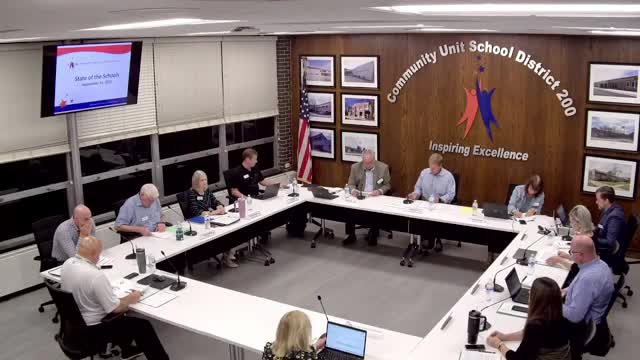
Summary
District 200 staff briefed the Board of Education in a workshop-format update on academic outcomes, student experience and a multi-year facilities program, noting improvements in several dashboard metrics, new career-pathway work and planned capital issuances for middle-school projects.
At a workshop setting, District 200 staff gave the board a “state of the schools” update that summarized progress under the district’s 2018–2025 strategic planning cycle, highlighted recent gains on student learning dashboards and described an extensive capital program for middle schools. Dr. Schuler, a district staff member in district leadership, introduced the presentation as “what it really is is a recap of the major items that are on your work plan for this year.”
The presentation detailed student achievement, learning acceleration, career-connected pathways, student and staff experience, safety work, operational finances and community engagement. Melissa, a district staff member who led the academic portion of the briefing, said “it’s a great time to be a student in District 200” while describing upward trends on multiple metrics reported on the Illinois State report card and the district dashboard.
Why it matters: the briefing framed the board’s near-term decisions — for example the schedule of future data briefings, follow-up work on attendance and the October presentation of 2025 state test adjustments — and outlined a multi-year capital program tied to a voter-approved middle-school referendum and future bond issuances that will affect district construction plans and timelines.
Staff described academic measurement and recent results first. Presenters said the district uses frequent local screening (FastBridge three times per year) and the Illinois Assessment of Readiness (IAR) for grades 3–8, and that the high-school proficiency calculations also include course-based measures (for example passing Algebra II or other qualifying courses) and exam results. Melissa said the district has seen “a significant uptick in student learning results” compared with pre-pandemic measures and that the district will present the 2025 state-data updates at the October curriculum assessment meeting.
Board members asked about apparent gaps between K–8 proficiency rates and high-school measures. District staff explained the K–8 proficiency figures come only from state exams while high-school proficiency may be met by either a course grade or an exam score, which increases the number of students who meet the high-school definition of proficiency. Staff also said Illinois adjusted proficiency cut points for 2025; the district will show comparative percentile analyses to clarify how District 200 fares against other Illinois districts.
The board pressed on graduation-rate reporting. Dr. Schuler and Melissa explained that a small number of students who attend the district’s transition center are not counted in the state’s graduation-rate denominator until they finish at that center; staff said the district’s noncompletion rate is below 1 percent.
On college and career readiness, staff said the district has expanded “complete pathways” that combine sequenced courses, early-college credit and work-based learning. The district will expand an engineering pathway and middle-school electives tied to high-school pathways; staff noted expansion plans (entrepreneurship, culinary arts introduction and performing-arts sequences) and work to broaden internship and job-shadow opportunities. The district also said it will expand fall pre-ACT testing to grades 9–11 this year (previously administered in eighth grade) to support school-improvement planning.
Student experience and safety were a major focus. Presenters said student connectedness and extracurricular participation are up (the presentation cited a 12 percent increase in participation since 2018–19 and a 2 percent increase from the prior year), overall attendance rates near 94–95 percent, and a continued emphasis on lowering chronic absenteeism (defined in the presentation as missing 10 percent or more of the school year). On safety, Mr. Biskin, a district staff member in student services, described a four-part approach — connectedness, prevention, reporting (see something, say something) and drills/training — and said, “When students feel a sense that they are part of something, they're more likely to seek help, report concerns, and support others.”
The staff presentation also covered employee experience, professional learning and new guidance on artificial intelligence. Presenters said morale survey results are trending upward, new-teacher mentoring and induction continue, and the district has developed ethical-use guidelines for AI and formed cross‑town advisory groups to guide classroom use. Staff listed outside partners used for data and comparison work including ECRA and EAB.
On operations and facilities, an operations staff member summarized district finances and capital planning: the district reported a fund-balance level “just slightly above 31 percent” for fiscal year 2024, said it has invested more than $60,000,000 in facilities since 2017, and described a middle-school capital program tied to a referendum with more than $150,000,000 in planned work. The speaker said the district’s bond sale earlier in the year received a double-A-plus rating and that a second bond issuance is planned for January 2026; the presentation said construction bidding for the next issuance would go out in late October with award recommendations expected in December and substantial project completion targeted in August 2027.
Community engagement and communications work were described last. A communications staff member said the district is expanding advisory groups — citizens advisory (37 members), special-education parent advisory, safety and wellness advisory, career pathways advisory and a bilingual parent advisory — and will add a printed newsletter and the “Rooms” communication tool for staff, families and students.
Board directions and follow-ups noted during Q&A: staff said they will provide (1) additional comparative percentile data showing District 200’s rank among Illinois districts after the state’s 2025 proficiency adjustments, (2) a breakdown of attendance/absentee data by school level (elementary, middle, high), (3) an explanation of recent high-school bus pickup-time changes and the rationale for route timing, (4) the district’s audited FY25 financial report in December, and (5) a report from student ambassadors on projects at the board’s October meeting.
Formal actions at the workshop were procedural: the board voted to suspend rules and move into a workshop setting and later adjourned; no policy, budget or staffing votes were taken in open session during the presentation. The meeting concluded with a motion to adjourn that was seconded and approved by voice vote.
The board will receive the district’s 2025 state-data updates and several follow-up memos in coming weeks; staff said the October curriculum meeting and the December audit acceptance are the next formal events tied to the material presented.