Get Full Government Meeting Transcripts, Videos, & Alerts Forever!
Get email alerts on the Small Business topic
No spam. Unsubscribe anytime.
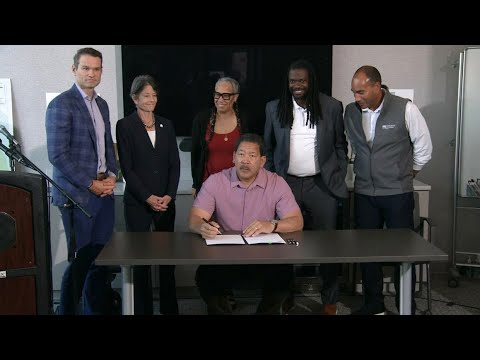
Mayor signs small-business package, expands repair grants and speeds permitting
Summary
Mayor Bruce Harrell signed two measures and announced a package of budget increases and programs intended to help Seattle small businesses, including a $5 million "Back to Business" fund, expanded storefront repair grants, exemptions to
Mayor Bruce Harrell signed two bills and announced a city package Tuesday aimed at easing costs and permitting barriers for Seattle small businesses. The measures and budget proposals increase funding for storefront repairs and neighborhood investments, raise the business-and-occupation tax exemption, and change city permitting rules to speed storefront re‑openings.
The package includes a proposed $5 million Back to Business fund over two years, with $2.5 million proposed for 2026; $1 million earmarked for grocery store security; $700,000 to support small food businesses focused on healthy, culturally relevant food and food‑desert areas; and a $4 million place‑based neighborhood investment fund, the mayor said. “We want small businesses to be able to employ people from their community,” Harrell said. “Our job as a city is to make that journey to owning a business easier, faster, more affordable.”
Why it matters: city officials said the measures are designed to reduce the time and expense that keep storefronts vacant and to give most Seattle businesses tax relief. Council President Sarah Nelson called the actions “a day of celebration” for maturing programs such as the storefront repair fund, which she helped restore after it ran out of money. “We must do more,” Nelson said, citing closures and long‑term vacancy as threats to neighborhood vitality.
City permitting reforms are a central piece of the package. The administration created the Permitting and Customer Trust (PACT) team with a target of halving permitting time for small projects — from 240 days to 120 days — and city staff reported a 57% reduction in review and issue time for businesses using the small‑business expediting program. Council legislation also exempts interior changes for spaces under 7,000 square feet from the city’s “substantial alteration” triggers that had required costly upgrades for previously vacant storefronts; that change, officials said, will allow small tenants to open more quickly.
Tax and financial measures announced include raising the B&O tax exemption threshold from $100,000 to $2 million and a matching deduction for mid‑size firms. “That means a mom‑and‑pop retailer or cafe with $2,000,000 in gross revenue will see a meaningful savings,” said Mark McIntyre, director of the Office of Economic Development.
The Back to Business fund will offer storefront repair grants of up to $3,000, a security grant component up to $6,000 for doors, lighting and gates, and flexible neighborhood investments for site cleanup and activation, McIntyre said. The city relaunched the fund in July and reported 85 businesses had used it, including reimbursement for a broken window at Retail Therapy on Capitol Hill and security doors for Quinn’s Pharmacy in Little Saigon.
Officials stressed the limits of city authority and pointed to state and regional actions that also matter. McIntyre cited a state law change that increased the cap on Sound Transit displacement payments from $50,000 to $200,000 as an example of how advocacy at other government levels produced direct relief for affected businesses.
Community partners highlighted the role of local financial intermediaries. Albertus Brooks Jr., executive director of the Rainier Valley Community Development Fund, said his organization works with the city and CDFIs to speed loans and technical assistance to business owners. Donna Moody, a restaurant owner and recipient of the city’s business ownership pilot, described how city and community financing allowed tenant improvements and helped create a neighborhood anchor. “The restaurant that’s been created is to me quite remarkable, and it is a community hub,” Moody said.
What changed and what’s next: the mayor signed the council bill changing substantial‑alteration triggers (cited as council bill 121047 during the event) and a second measure establishing fixed permitting timelines that conform to state law. Officials said the mayor’s proposed 2026 budget would add $2.5 million in each of the next two years to expand the storefront repair program; the precise budget adoption and program caps are subject to the forthcoming city budget process. City staff and council members said they will continue outreach through neighborhood business districts, chambers and community partners to publicize the programs and measure uptake.
Discussion versus action: officials framed much of the event as both an announcement of signed legislation and the launch or expansion of funded programs. Where officials reported formal action, they described bills as signed into law by the mayor; where they described goals or hopes (for example, reduced permitting times or fewer businesses needing repairs), those were framed as targets or expected outcomes rather than finalized results.
Limitations and unresolved details: speakers did not provide a single consolidated count of all businesses expected to benefit, and program longevity depends on the city budgeting process. The transcript statements that the Rainier Valley Community Development Fund “has provided more than a $100,000 in loans” were presented by the fund’s director during remarks; the amount was reported as stated at the event and not independently verified in the meeting record.
For small business owners, the immediate practical changes are the availability of repair and security grants, the change to building‑code substantial‑alteration treatment for spaces under 7,000 square feet, and an anticipated reduction in permitting time for many small projects.