Get Full Government Meeting Transcripts, Videos, & Alerts Forever!
Get email alerts on the Public Forum Curriculum Libraries topic
No spam. Unsubscribe anytime.
Residents urge support for media specialists and for protecting history curriculum during public forum
Summary
During the Sept. 25 public forum several residents spoke in support of library media specialists and defended inclusive history curriculum; speakers described books and memorials as tools for learning and urged the board to resist efforts to remove uncomfortable historical material.
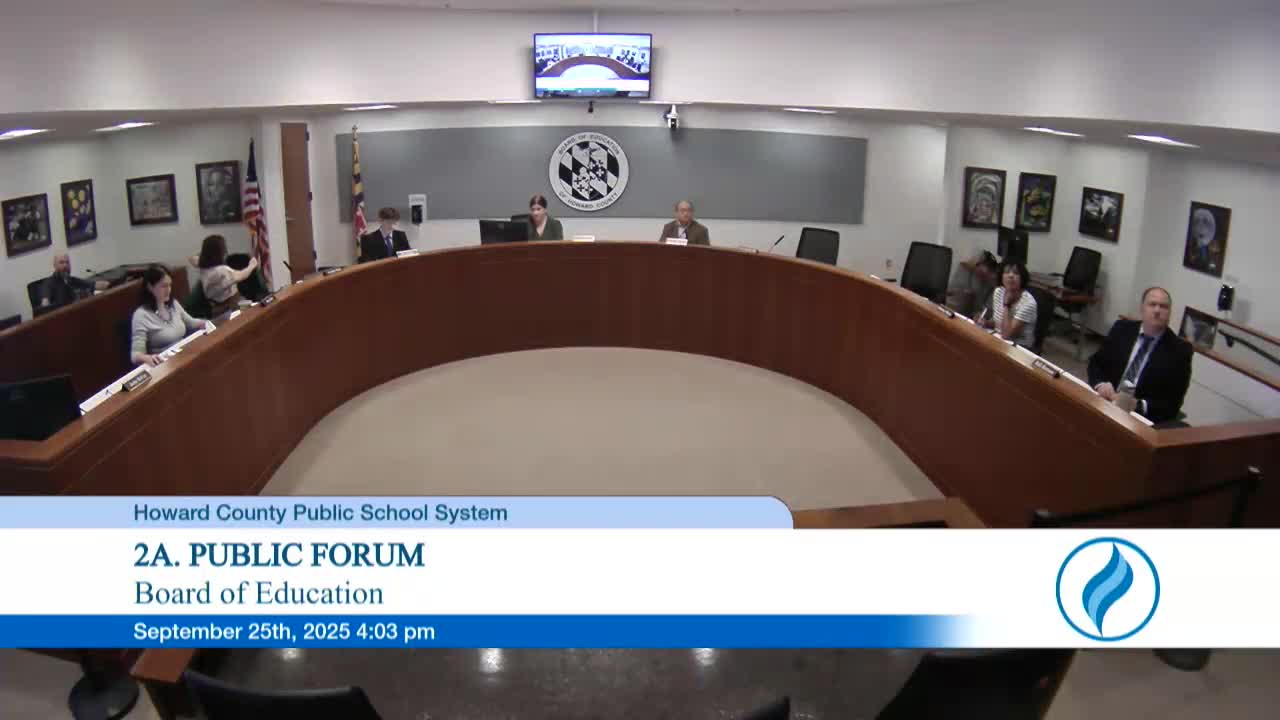
At the Howard County Board of Education public forum on Sept. 25 residents urged the board to support library media specialists and to preserve history curriculum that acknowledges difficult and painful aspects of the past.
Library support: Jennifer McClurg, who identified herself during public forum, asked the board to “trust” trained media specialists to select age-appropriate material and argued libraries are “gateways to literacy, critical thinking, and inclusion.” "Libraries are not just shelves of books," McClurg said, and she asked the board to continue supporting media specialists at all levels.
History curriculum: Paula Sebright said recent national debates and actions have put “history under attack” and stressed the educational value of studying painful episodes so students learn to avoid repeating mistakes. She described memorial practices she observed in Amsterdam and said decentralized, local memorials help communities reckon with the past.
Dissenting, ideological comment: Other public commenters, including Luisa Garrity and Susan Dreyes, framed recent national events and campus commentary through a religious lens and called for parental rights in determining curricula. They criticized what they described as “woke ideologies” in education and asserted that schools should not “impose” particular worldviews on children. Those remarks were offered during the public-comment portion of the meeting and represented the speakers’ opinions, not board policy.
What the board said and did: The board received public comments as part of its standard public forum procedures and made no formal action Sept. 25 in response to individual remarks. The board’s public forum guidance — referenced at the start of the meeting — restricts comments about individual personnel, active appeals and solicitation and asks speakers to observe decorum.
Ending: The public forum included a variety of perspectives. Board staff reminded speakers that written testimony may also be submitted to the board email address for official record and distribution.