Get Full Government Meeting Transcripts, Videos, & Alerts Forever!
Get email alerts on the Public Comments Anti Racism topic
No spam. Unsubscribe anytime.
Community speakers press board on consent agenda and demand anti‑racism policy be restored
Summary
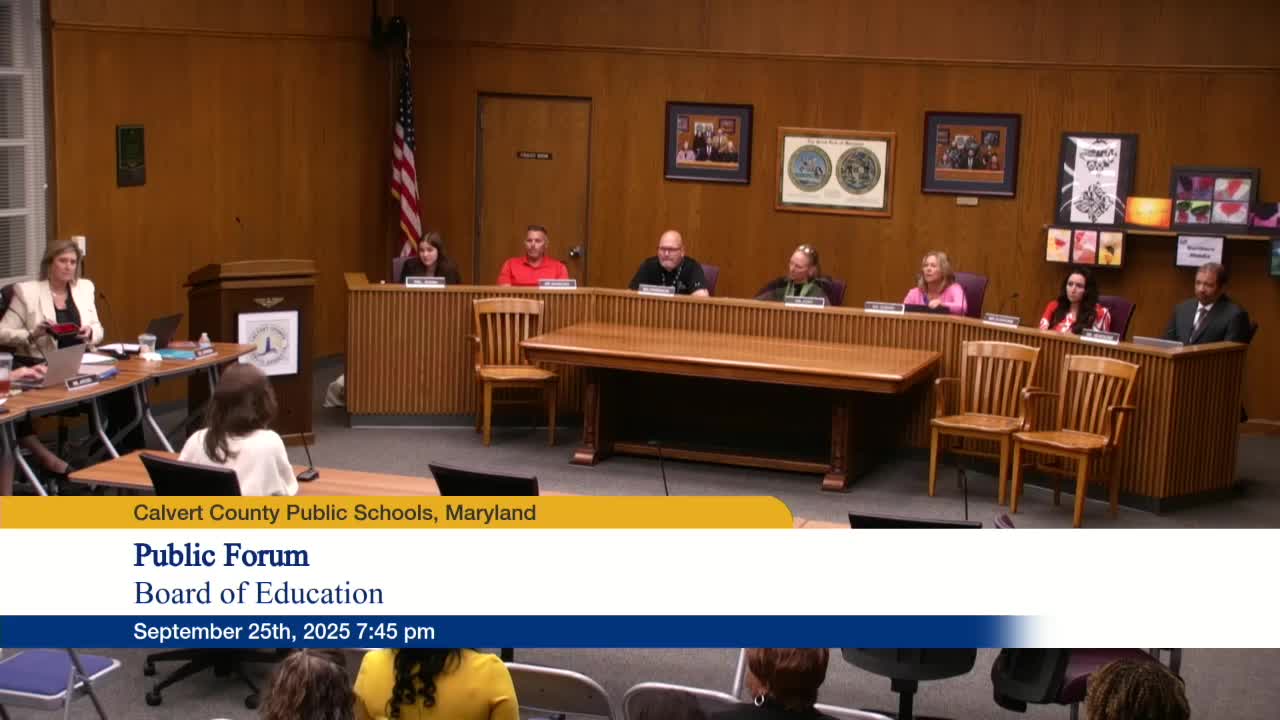
Multiple residents, students and community groups urged the Calvert County Board of Education to restore an anti‑racism policy and to change public‑comment procedures; speakers criticized use of the consent agenda for contested items and the board's timing for taking public comment.
Several members of the public used the meeting's public‑comment period to urge the Calvert County Board of Education to reinstate an anti‑racism policy and to change how the board handles public comment and consent‑agenda items.
Danielle Puck described moving contested or controversial items onto the consent agenda as a misuse of the process and urged the board to allow meaningful engagement before votes. "Yes. Pushing public comment to the end really kinda defeats the purpose of this whole civic engagement thing," Puck said during her two‑minute comment.
Sherry Tardio and Deborah Harris, representing community members and the NAACP of Calvert County respectively, urged the board to recognize that racism is distinct from general discrimination and to restore a policy that names and addresses racism explicitly. Harris told the board that incidents such as racial slurs, spray‑painted symbols and other race‑based attacks have occurred in the community and argued the existing discrimination policy does not adequately cover those harms.
A student speaker, Lola Wyatt, said the current public‑comment arrangement prevents students from speaking before board votes on agenda items that affect them and asked the board to consider adding an early public‑comment slot or splitting public comment into agenda‑related and general sections.
Several speakers praised district educators and asked the board to consider the equity implications of policy decisions, while the NAACP speakers offered to partner with the district. The public‑comment period concluded with several speakers asking the board to reconsider recent policy changes affecting diversity, equity and inclusion initiatives.
Board members did not take action during the public‑comment period. The board recorded the comments and acknowledged the speakers but noted that the meeting rules do not permit board discussion during public comment. Several board members later said they were reviewing public‑comment procedures and consent‑agenda usage and that staff had provided materials for the board to consider possible changes.