Get Full Government Meeting Transcripts, Videos, & Alerts Forever!
Get email alerts on the Special Education Continuum topic
No spam. Unsubscribe anytime.
Howard County principals and district staff outline next steps for special education supports and school visit protocol
Summary
Principals from the Howard County Association of Supervisors and Administrators told the Board of Education on Sept. 25 the district’s elementary continuum of services must be more flexible and consistent; district staff described recent pilot positions and promised further modeling and funding work.
Principals representing the Howard County Association of Supervisors and Administrators told the Howard County Board of Education on Sept. 25 that the district’s elementary continuum of special education services needs to become more flexible and consistent across schools.
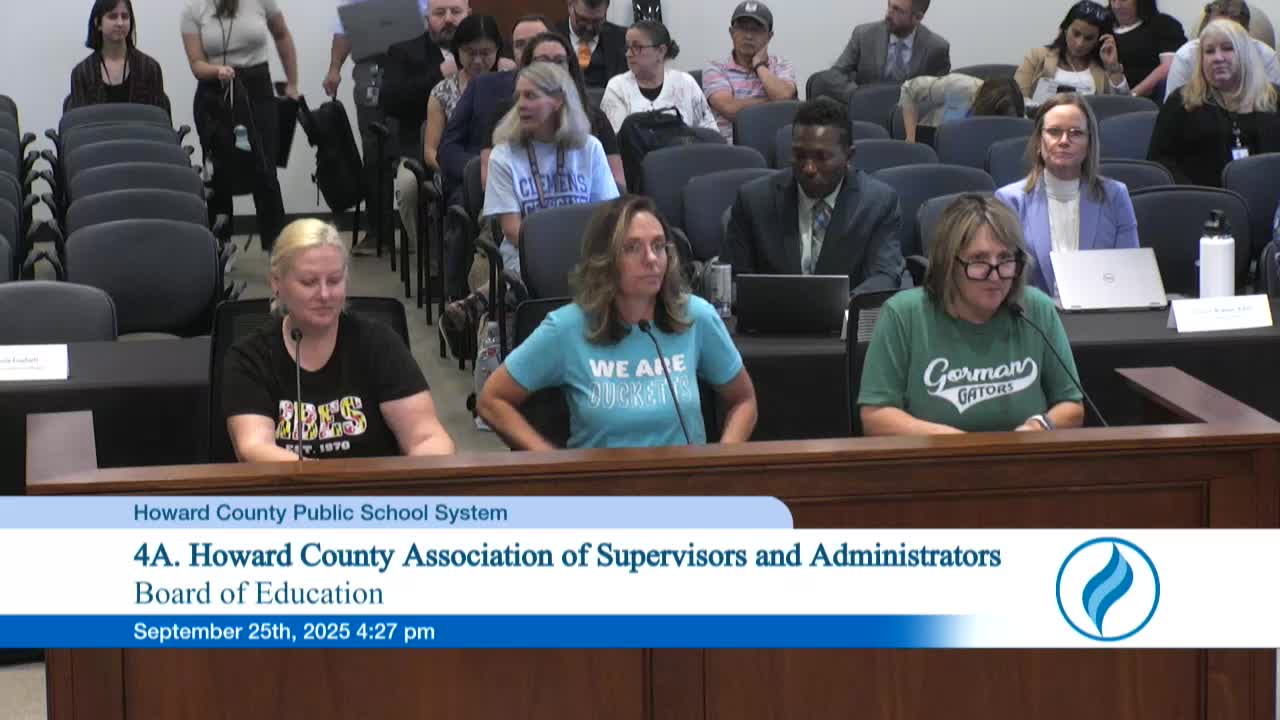
The principals — led by Debbie Holmes, principal of Gorman Crossing Elementary School and vice president of HCASA — said five elementary schools now have a dedicated special education instructional team leader and that those leaders have immediately improved scheduling, compliance, coaching for new teachers and coverage during crises. “These leaders have begun to send weekly updates with important information and identified needs, which has improved communication and alignment across staff,” Holmes said.
Why it matters: principals said increased student need and more complex caseloads mean a single set of practices is no longer sufficient and urged the board and central office to partner on building feedback loops, staffing structures and finances that let schools respond consistently.
District reaction and next steps came from Superintendent Bill Barnes and central office staff. Barnes said the new leaders were a pilot model and that central office will continue to “find the finances, figure out how to make that work” and try to reduce costs by changing how teams operate. Barnes asked board members to coordinate visits so principals are not overwhelmed and said staff will expand leadership roles and propose personnel adjustments for consideration.
Board members asked for guardrails and clearer invitation processes for school visits. Board Chair Mosley and several members described prior guidance that had limited board visits to short, prescheduled periods; members said they want longer, deeper visits but also want principals to be able to prepare staff. Barnes and HCPSS staff said they will put a structure in place and offered to let board members and school leaders pilot a schedule of longer visits with coordination through the central office.
Concerns and clarifications: principals said that the dedicated instructional team leaders cover tasks that include adjusting schedules to reflect caseloads, managing calendars for IEP meetings and modeling evidence-based strategies in classrooms. Gillian Spivey, principal at Running Brook Elementary, said the elementary continuum “has not kept pace” with evolving student needs and that rethinking how supports are organized is required. Board members pressed for data on how frequently leaders are pulled to cover crises versus doing the planned capacity-building work; principals said the leaders are not intended to be case managers and that coverage is primarily for emergency responses while vacancies in paras and substitute roles are being filled.
What was not decided: the board did not vote on any staffing changes or funding at the Sept. 25 meeting. Staff said they are working to identify ongoing funding, will present staffing proposals and will return with more detailed modeling and timelines. Superintendent Barnes said he has directed staff to pursue seed positions and other pilots and that a subset of those changes could be announced soon.
Ending note: HCASA asked board members to spend a day in schools — not just short visits — to observe classroom practice, dismissal and arrival and to better understand operational constraints. Several board members accepted the invitation to pilot longer, scheduled visits and staff committed to creating a coordinated schedule to avoid disrupting school operations.