
Brownsburg presents $83.6 million 2026 budget; levies, grants and capital projects drive key uncertainties
Get AI-powered insights, summaries, and transcripts
Sign Up Free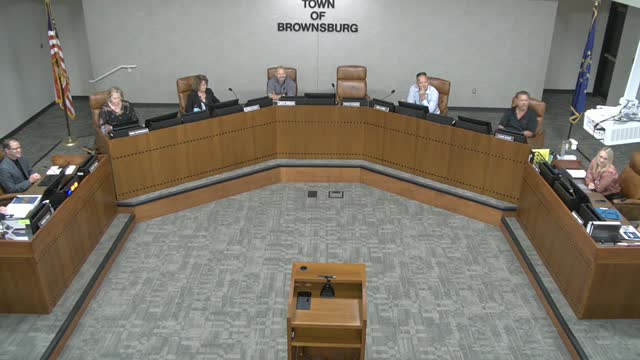
Summary
At a first reading of the 2026 budget, town staff presented $83,614,643 in department requests and outlined major capital projects, staffing requests tied to a federal SAFER grant, potential excess levy appeals and water and wastewater investments. Council set a public hearing for Oct. 9.
Town staff presented the first reading of the Town of Brownsburg’s 2026 proposed budget, showing $83,614,643 in department requests and highlighting capital projects, employee pay adjustments and several funding uncertainties that will affect the town’s tax rate and service levels. The council set a second reading and public hearing for Oct. 9.
The proposed budget includes nearly $15 million in capital projects, led by design work for an I‑74 interchange bridge, corridor work on North Green Street, a County Road 309 roundabout and multiple parks and utility projects. “Here is the overview of our capital projects. And as you can see, the I‑seventy 4 interchange bridge design is the biggest ticket on there,” said Deb, a staff member who presented the budget. The general fund request is slightly over $20 million; overall requests across funds total $83,614,643.
Why this matters: the package affects tax rates, service staffing and multi‑year obligations. Deb emphasized that Brownsburg’s service area and net assessed value have grown while the town has fewer employees than in 2018, saying the town now serves more people “and we actually have 8 less than we did in 2018.” That growth, combined with rising inflation and higher insurance costs, is a primary driver of the spending increases.
Major budget elements and funding notes - Capital projects: The budget lists about $14–15 million in capital work, including the I‑74 interchange bridge design, North Green Street corridor improvements, County Road 309 roundabout, White Lick Creek stabilization and wastewater treatment‑plant projects. The North Beltway TIF includes nearly $3 million budgeted to meet bond obligations and about $1.1 million for engineering and design work on a signal at Northfield Drive and County Road 625. - Public safety and staffing: The fire territory submitted requests that increased its budget by more than $3 million and included funding for 15 additional firefighters. The 15 positions are contingent on receiving a SAFER grant; Deb said the department “is asking for 15 more firefighters that they’re asking for a grant to get.” Chief Larry, the fire chief, told the council the SAFER grant decision timeline is imminent: “Their deadline is supposed to be October 1.” The town also discussed a possible excess levy appeal that, if approved by the state, would increase revenue by about $1 million for the civil (town) portion and roughly $1.5 million for the fire territory—numbers referenced by staff as illustrative of the possible gain if appeals are approved. - Utilities and infrastructure: Staff presented a wastewater capital need of just over $7 million for plant and lift station improvements, and the water fund includes line repairs, booster generators and a $900,000 budget line for lead service line work tied to a federal requirement. Deb said the town will use cash and reserves in the water fund where budgeted needs exceed estimated revenues. Town engineers and staff described recent well‑drilling efforts that found water but not sufficient capacity in initial sites; staff said they will “revisit the maps and the group and see where the next best spaces are.” - Parks and maintenance: The parks budget includes rehabilitation work — specifically pickleball court rehabilitation and ongoing maintenance — and staff cautioned about recurring surfacing costs. Amber, a staff member, noted that court surfacing typically needs replacement every three to five years because of heavy use. - Developer contributions, TIF and obligations: Staff said developer commitments toward the Northfield/CR‑625 signal (developments named in discussion included Pulte, Graystone and Fairview West) will be accounted for; staff committed to follow up to confirm receipts. The budget also shows continuing debt service and reimbursement obligations from prior development agreements (identified in discussion as Envoy and Scannell agreements), with the Scannell payment noted as in year 8 of a 15‑year schedule.
Process and contingencies The council heard that some items in the draft budget are included in anticipation of outside funding. For example, the fire territory included the 15 firefighter positions in expectation of SAFER grant support; if the grant is not awarded the territory would not hire those positions, staff said. The town will apply for a 2026 Community Crossings Grant for road work; staff cautioned that state grant rules have changed and that adopting a local wheel tax is one option communities must consider to maximize the grant amount. Deb said the town has until the statutory deadline for a growth excess levy appeal this year to submit that request; the town also continues to track state legislation dubbed SEA 1 (also referred to in discussion as SB 1) and said the town is concerned about its potential impacts on local revenues.
Council questions and follow‑up items Council members asked for clarification on several points, including whether developer contributions for a traffic signal had been received (staff: “We will look for that money… we’ll make sure that we reach out to them”), the timeline for SAFER grant decisions (Chief Larry: “Their deadline is supposed to be October 1”), and details on fleet and ambulance equipment purchases. Staff also said they are not budgeting the full $1.6 million of some projected revenues and are maintaining conservative revenue assumptions.
Next steps The council scheduled the next reading and a public hearing for Oct. 9. Staff will follow up on developer contributions for the Northfield/CR‑625 signal, continue work on grant applications (including SAFER and Community Crossings), revisit water‑well siting maps and refine budget figures before the public hearing and subsequent votes.
Sources: Town budget presentation at the first reading and questions from council members and staff during the meeting.