Get Full Government Meeting Transcripts, Videos, & Alerts Forever!
Get email alerts on the Transportation Roads topic
No spam. Unsubscribe anytime.
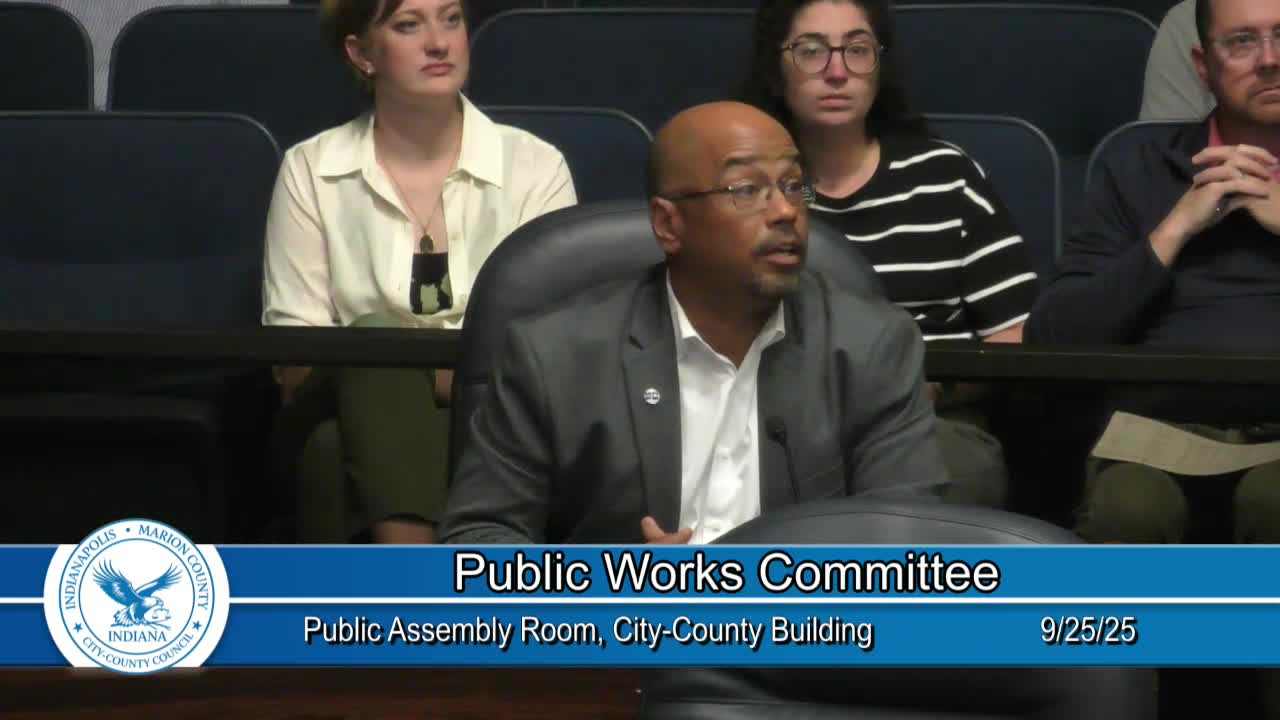
Public Works Committee backs DPW 2026 plan; activists say budget lacks Vision Zero funding
Summary
The committee recommended the Department of Public Works' 2026 budget to the full council after a detailed presentation on road treatments and delivery strategies. Public commenters and some councilors urged more explicit funding for traffic-safety (Vision Zero) measures.
The Public Works Committee voted to forward the Department of Public Works' 2026 portion of the city-county budget to the full City-County Council after a presentation that outlined road-treatment strategies, outputs and new procurement methods intended to accelerate resurfacing and maintenance work.
Director Wilson (Department of Public Works) presented a data-driven strategy that groups street work into several treatments: pothole filling (year-round, weather permitting), contractor strip patching (emergency rapid response on worst sections), in-house D4 crew work (small roadway segments and residential streets), residential resurfacing (contracted reconstruction or mill-and-overlay), and thoroughfare resurfacing (longer-term fixes that include ADA ramps and signals).
The presentation estimated contractor strip patching would cover portions of about 200 lane miles in 2026 (staff stressed patching is applied only to the worst sections within chosen segments) and noted about 40,000 potholes were filled countywide this year. The budget includes an anticipated minimum of $16 million per year for residential resurfacing tied to a state match (an $8 million local contribution matched by the state). The packet also includes a new $10 million allocation for contractor patching on top of an existing $6 million, producing a larger patching investment in 2026.
For counselor-select resurfacing projects — roughly $1 million allocated per councilor district, totaling about $19–$20 million — the department said it awarded contracts to three contractor teams (Reece, Raleigh, Milestone and E&B were named) and is using an alternative delivery method grounded in the state's amended build-operate-transfer procurement law. Mark St. John, the department's chief engineer, said the process selected contractor teams in July and is currently working with them to finalize design details and pricing so construction can proceed faster than traditional design-bid-build procurement. Staff said some counselor-select work should begin this fall, with most activity occurring in 2026.
Councilors pressed staff on why lane-mile outputs and resurfacing totals appear small relative to older assessments. Director Wilson and staff said residential resurfacing often includes design, ADA ramps, drainage, curb work, signal coordination and sometimes full reconstruction, which raises project cost per lane mile compared with simpler overlays. Staff emphasized Mayor's Action Center service requests and counselor input remain important data sources even as the department ramps up an Infrastructure Asset Management (IAM) plan to collect objective pavement condition data across the network.
At public comment, Connie Szabo Schmucker, advocacy director at Bicycle Garage Indy, urged the council to fund traffic-safety work, requesting $35 million to address traffic violence and criticizing the absence of a Vision Zero action-plan line in the DPW budget. Christina Hartley read a list of people killed on the city's streets so far this year and urged councilors to prioritize safety investments over repeated maintenance that she said does not prevent deaths.
Director Wilson acknowledged the Board of Public Works asked about a Vision Zero line item and said safety is “inherently included in everything we do,” listing safe routes to schools, protected bike infrastructure, sidewalks, tactical urbanism pilots and HAWK signals as examples. Staff said the department will present the Infrastructure Asset Management plan to the council in 2026 and provide ongoing updates to the committee.
Councilor discussion reflected differing views: some members said the budget is a prudent response to state fiscal constraints and recent revenue reductions, while others said it does not meet long-term maintenance needs identified in older infrastructure studies. The committee moved and seconded a do-pass recommendation for the DPW portion of the 2026 budget and requested a roll-call vote; the meeting concluded with the item forwarded to the full council for final action on the council's scheduled date.
The committee record separates discussion (treatment options, procurement methods, data collection priorities), directions (staff to present IAM plan in 2026), and decisions (committee recommended the DPW budget to full council). Public safety advocates indicated they will press the council for explicit Vision Zero funding during final budget debate.