Get Full Government Meeting Transcripts, Videos, & Alerts Forever!
Get email alerts on the Duna Unincorporated Nonprofit Amendments topic
No spam. Unsubscribe anytime.
Committee revises and advances changes to unincorporated nonprofit (Doona) statute
Summary
The select committee approved technical amendments to Wyoming’s DUNA law to clarify definitions, add conversion mechanics between UNAs and DUNAs, and to allow filing of statements of authority for real‑property transactions.
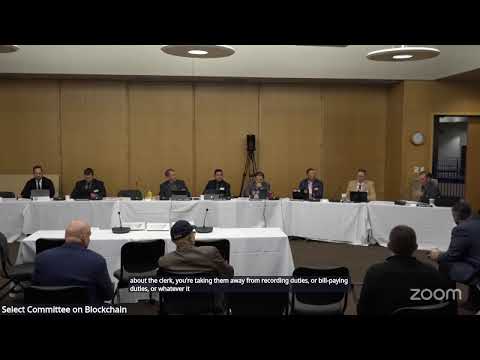
The select committee approved a set of technical amendments to Wyoming’s statute for decentralized unincorporated nonprofit associations (DUNAs), clarifying definitions and adding procedural mechanics for how a DUNA and ordinary unincorporated nonprofit associations (UNAs) may interact with real‑property records and with each other. LSO staff told the committee the draft “creates the definition of distributed ledger protocol” and clarifies that a DUNA may automatically convert to a UNA if the DUNA falls below the 100‑member requirement “unless the governing principles specify otherwise.” The draft also authorizes DUNAs and UNAs to file a statement of authority to transfer real property “in the office of the secretary of state,” a practice staff noted the secretary of state currently performs in some cases though county clerks historically handle land recording. Why it matters: Wyoming’s DUNA statute has been used by several prominent decentralized projects. The changes are designed to reduce ambiguity for operators and counterparties (banks, title offices and others) and to make the statutes more consistent and easier to use in practice. What the bill does and committee actions - Definitions and harmonization: The draft adds and shifts definitions (including moving a “charitable purpose” definition so it appears in the statutory section where it is used) and instructs LSO to consider whether the word choice “solely” or “merely” should be made uniform across the UNA and DUNA statutes (the committee chose the Supreme Court‑tested “solely” wording for consistency). - Member threshold and conversion: The statute will allow an automatic conversion from DUNA to UNA when membership drops below 100 unless the organization’s governing documents say otherwise. Stakeholders said the 100‑member threshold was set deliberately to distinguish more decentralized organizations from small private clubs and to limit unintended tax consequences. - Recordation of statements of authority: The bill allows a DUNA or UNA to file statements of authority for real property; staff noted that county clerks are the customary recorder for land instruments and recommended follow‑up with county clerks and the secretary of state to align filing practice and to decide whether records should be maintained in both offices. - Practical notes: Witnesses described active usage of the law by new decentralized organizations. A representative said several DUNAs have filed formation documents and are using the secretary of state filings and websites to show existence to banks and other counterparties. The committee discussed adding a certificate‑of‑existence process and a modest fee so the secretary of state could issue an official certificate of existence for UNAs and DUNAs. Stakeholder input and concerns - Practitioners from projects that have adopted the legal form said the statute functions as intended but benefits from clarifying language to ease banking and other commercial steps. - Legislative staff and projects recommended aligning a distributed‑ledger definition with other bills (for example, the Genius/Token Taxonomy drafts) and making the DUNA definitions technology‑agnostic so the statute will not freeze a particular technical approach. Next steps The committee approved the draft (roll call recorded: 7 ayes, 1 excused) and requested staff to issue conforming edits (notably: adopting a consistent “solely”/“merely” approach and checking secretary‑of‑state vs. county clerk practices on recording property statements). Staff and stakeholders signaled willingness to return to the committee with a short technical follow‑up addressing recording practice and a possible certificate‑of‑existence proposal.