Get Full Government Meeting Transcripts, Videos, & Alerts Forever!
Get email alerts on the Spdi And State Bank Amendments topic
No spam. Unsubscribe anytime.
Wyoming committee advances amendments to special‑purpose depository and state bank conversion rules
Summary
A legislative select committee on financial technology advanced a package of amendments to state bank and special‑purpose depository institution (SPDI) law, moving to support a conversion framework and to combine three related SPDI bills into one draft for next session after stakeholder review and recommended wording changes.
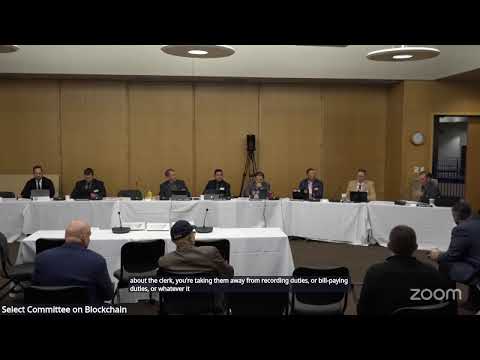
A legislative select committee moved Tuesday to support a draft that would set procedures for conversions between special‑purpose depository institutions and state banks and signaled support for combining three related SPDI bills into a single amendment package for the next session. The committee — after presentations from Legislative Service Office staff and State Banking Commissioner Jeremiah Bishop — agreed to support one bill draft that would authorize conversion applications, set review criteria and require a certificate of authority before any converted bank may commence business. The change was described by LSO staff as: “The bill draft authorizes the state banking commissioner with approval of the state banking board to convert the charter to a state bank and authorizes the charter to a state bank to be converted to a city.” Why it matters: the bills are intended to clarify how emerging charter types convert between each other, reduce some start‑up frictions for SPDIs, and create a state‑level resolution fund to cover costs if an SPDI fails. Supporters said the changes will make Wyoming’s charter options more competitive for firms seeking U.S. regulatory shelter while keeping supervisory controls in place. Key facts and outcomes - The committee voted to register support for bill draft 26LSO13 (state bank and SPDI conversion language) by voice vote; the motion carried. The committee then voted to combine three other draft bills (amendments to SPDI capital and certificate timing, repeal of the SPDI contingency account, and a creation of an SPDI resolution fund account) into a single “Speedy Bank Amendments” draft and to support moving that draft forward. - Commissioner Jeremiah Bishop described the conversion draft as following the same process as an initial charter application and said any converted entity still must meet the same requirements as a de novo charter to receive a certificate of authority. - Major operational changes discussed in the SPDI amendment drafts include changing the initial capital calculation from a three‑year estimate of operating expenses to a one‑year estimate, extending the deadline to commence business after receipt of a certificate of authority from six months to 12 months (with the ability to request extensions), and clarifying the review timeline (for example, LSO noted review and appeal periods in the drafts such as a 90‑day review and 30‑day certificate decision windows). - One draft would repeal the statutory requirement that SPDIs maintain a 2% contingency account backing deposits (Wyoming statute cited in the draft as 13 12 1 0 6), a requirement stakeholders said can be redundant to capital rules and an impediment to competitiveness. - Another draft would create a “speedy resolution fund account” to collect a portion of supervisory fees and use those funds if an SPDI required involuntary dissolution, with staff noting the commissioner currently could set the percentage by rule (the draft as written would allow 1%–99%; staff suggested the committee may want a narrower specification; the commissioner and staff discussed the working assumption of 25% as used with trust companies). Discussion points and conditions - Appeals and court venue: committee members raised questions about whether appeals of agency decisions should go to the Chancery Court or to the district court and whether existing Chancery Court rules that permit parties to “opt out” of Chancery jurisdiction would still apply. The committee agreed to add conforming language to clarify the venue and to permit the existing opt‑out mechanisms under court rules. - Certificate of authority sequencing: members asked that the statute be made explicit that the commissioner may set reasonable, institution‑specific requirements that must be satisfied before commencement of business even after a certificate of authority is issued; members requested a new subsection explicitly granting that authority to avoid ambiguity between existing subsections. - Contingency account repeal: Commissioner Bishop and industry representatives said capital requirements and supervisory authority provide other tools to address risk; they argued the 2% contingency account is redundant and often funded by customers rather than capital, creating operational friction. - Resolution fund: staff and Commissioner Bishop described the fund as a means to avoid pressing the general fund to pay for a protracted wind‑down of an SPDI; commissioner indicated the statutory pledge amount (currently described around $15,000,000 in the drafts) was an early estimate and may not reflect actual liquidation costs. Stakeholder input - Speedy charter applicants and industry participants testified in support. Julie Fellowes, cofounder and CEO of Bankwise, thanked the committee for the working‑group process and said the working group produced “good output.” - A representative of Kraken Financial said the proposals would “improve clarity, reduce unnecessary capital friction and enhance Wyoming’s competitiveness” and noted that, anecdotally, operational capital in some firms was far larger than the minimum ratios regulators expect. - The Wyoming Bankers Association testified in support of the committee’s suggested court‑venue amendment and of the overall drafts. Next steps and implementation notes - The committee asked staff to circulate the combined “Speedy Bank Amendments” draft, incorporate the clarifying language discussed in committee (court venue, explicit commissioner authority to set commencement requirements, and a clearer appeal path for denial of extensions), and offer the draft for member review prior to finalization. - Legislators discussed where the prime sponsorship should originate and suggested the Senate as a potential place to start given House calendar constraints. Ending note Committee members described the drafts as “sensible, traditional cleanup” aimed at reducing ambiguity and improving competitiveness while retaining supervisory authority; the committee’s next step is to circulate the combined draft and finalize conforming language ahead of the session.