Get Full Government Meeting Transcripts, Videos, & Alerts Forever!
Get email alerts on the Housing topic
No spam. Unsubscribe anytime.
Council approves 'Roots to Roofs' pilot allowing limited height and density bonuses for community-based affordable housing projects
Summary
The Seattle City Council adopted a time-limited 'Roots to Roofs' pilot on Sept. 23 that offers height and density bonuses to qualifying community-based developers to enable more affordable, community‑owned housing.
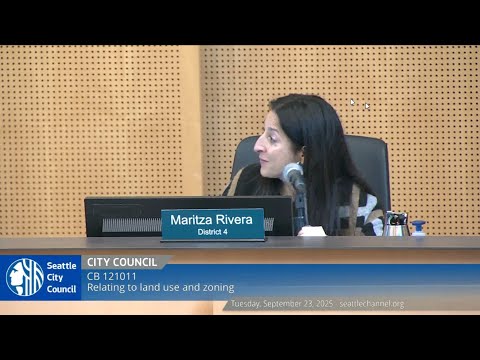
The Seattle City Council voted Sept. 23 to adopt the Roots to Roofs pilot program, council bill CB 121011, which grants community-based organizations (CBOs) and similar mission-driven developers the option of a height and density bonus on qualifying sites to enable more affordable and community-serving development.
Councilmember Dan Rink, the bill’s primary sponsor, described the pilot as a tool to help CBOs “build more via a height and density bonus.” He told the council the program is time-limited and capped at 35 total projects citywide with a maximum of five projects per council district.
Public comment at the meeting was extensive and sharply divided. Dozens of individuals and organizational representatives spoke in favor, including Rachel Snell, who said the pilot “would help address these harms, create more community-centered housing, potentially even some social housing, and doesn't cost the city much money.” Representatives of Central Area Youth Association (CAYA), Habitat for Humanity of Seattle, King, and Kittitas County, African Community Housing and Development, Friends of Little Saigon, and other community-based organizations spoke in support, citing the pilot’s potential to make projects financially feasible by waiving or easing requirements such as design review, mandatory parking, and contract rezone costs.
Opponents raised process and substance concerns. Several commenters said the public comment window had been too short; June Blue Spruce told the council the posted comment period was seven days and urged council not to vote that day. Other speakers including Jennifer Godfrey and Ruby Holland said the bill lacked robust affordability guarantees and could permit large permanent buildings with insufficient family‑sized units or long-term affordability protections.
Councilmember Lisa Hollingsworth offered two amendments that were adopted before final passage. Amendment B requires that at least 25% of the “median income” affordable units in qualifying projects be two-bedroom units or larger; Hollingsworth said that change was aimed at ensuring the pilot produces family-sized homes. In her words, the change was intended to “incentivize family-size units” and respond to community concerns about family housing.
Amendment C provides an optional incentive for projects that include family-size units by excluding above‑grade parking from floor-area-ratio (FAR) calculations; Hollingsworth described the change as an incentive rather than a mandate and said it recognizes differing transportation needs across neighborhoods.
Jess Simpson of the Housing Development Consortium told the council the pilot requires at least 25% of units be kept affordable for 50 years and is open to nonprofits, housing authorities, and public development authorities. Sponsor Rink and committee chair Rob Solomon both said the pilot adds another tool to the city’s housing toolbox and emphasized its limited scope as a pilot to test an approach focused on community ownership and equitable development.
After debate and the adoption of amendments B and C, the council voted to pass CB 121011 as amended. The roll-call vote recorded 9 in favor, none opposed. The chair signed the legislation at the meeting.
What the pilot does and limits: CB 121011 creates a voluntary program limited to a maximum of 35 projects, with no more than five projects per council district. It offers height and floor-area bonuses and relief from some zoning requirements for qualifying community-based developers, and it ties affordability requirements to the project’s proposed use. The amendments adopted Sept. 23 require a minimum share of family-sized units among the affordable units and offer an optional FAR exemption for above‑grade parking when family-sized units are provided.
Why this matters: The pilot is a targeted, time-limited change to land-use incentives meant to test whether easing zoning constraints for CBO-led projects can produce more permanently affordable and community-owned housing. Supporters say this will help organizations that historically struggle to make projects financially feasible. Critics say the pilot needed stronger, clearer affordability guarantees and more public engagement time before approval.
Next steps: With final passage, the pilot program is authorized; project-specific applications will require review under the pilot’s rules and any adopted conditions. Councilmembers and city staff said they expect to monitor early projects and report back to council as the pilot proceeds.