
Cobb County hears education on Georgia local-option sales taxes, including new FLOST option
Get AI-powered insights, summaries, and transcripts
Subscribe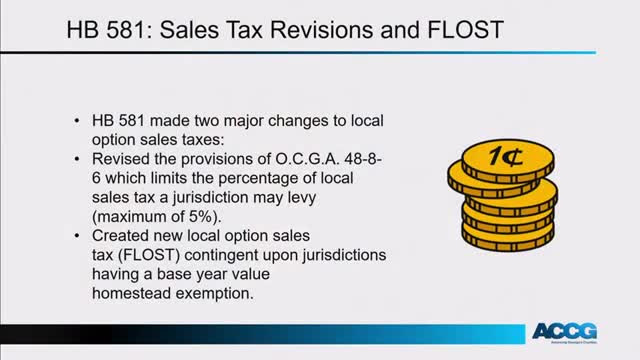
Summary
At an education session, Dante Bridal of the Association County Commissioners of Georgia (ACCG) explained Georgia's local-option sales-tax structure after passage of House Bill 581, outlining LOST, SPLOST, HOST, T-SPLOST and the new floating local option sales tax (FLOST) and how each could affect property-tax relief and local revenues in Cobb.
Dante Bridal of the Association County Commissioners of Georgia briefed the Cobb County Board of Commissioners in an education session on the state's local-option sales-tax options after passage of House Bill 581. Bridal told the commission the current maximum local sales-tax rate under state law is 5% and described the different pennies that counties may levy and how those pennies interact with homestead exemptions and municipal agreements.
Why it matters: Local-option sales taxes provide counties a way to raise revenue without raising property taxes, or alternatively to use sales-tax proceeds to roll back millage rates for property-tax relief. Which sales taxes a county can use affects how revenues are split between county and cities and what uses are permitted by law.
Bridal explained the primary types of sales taxes available under the law. He said two pennies are available to every local government and three additional pennies come from separate buckets (examples: LOST, SPLOST, HOST, and the FLOST) to reach the 5% maximum. He described SPLOST (special-purpose local-option sales tax) as a 1% penny for capital projects specified to voters, with level 1 projects prioritized for countywide facilities. "The SPLOST penny is used for capital projects," Bridal said. He said LOST (local option sales tax) is typically levied for maintenance and operations and is distributed monthly by the Georgia Department of Revenue according to a negotiated distribution certificate between counties and participating cities.
Bridal described the host (homestead option sales tax) as a sales-tax-funded mechanism to support a homestead exemption. He said the host is prohibited in counties that levy LOST, that it typically requires a local act by the county's legislative delegation and a two-question referendum (one to create the sales tax and a second to authorize the homestead exemption), and that up to 20% of HOST revenue can be reserved for capital projects. He cautioned that relief under a HOST is delayed once collections begin because the law requires a full calendar year of collections before the exemption is applied.
Bridal described three transportation-related SPLOST types: regional T-SPLOST (up to 10 years with a lower local match on LMIG grants), single-county T-SPLOST (levied up to 1%; can run six years if all cities sign an intergovernmental agreement), and transit SPLOST (available in metro counties, levied up to 1% and potentially available for up to 30 years). He said Cobb currently levies SPLOST and an "east" FLOST that is exempt from the 2% cap.
On the newest option, Bridal explained that House Bill 581 created a floating local option sales tax (FLOST) that is tied to a floating homestead exemption or freeze. "The FLOST is linked to having a floating homestead exemption or freeze," he said, and noted that the FLOST requires an intergovernmental agreement between the county and cities representing more than half of municipal population (counting only cities that levy a property tax). He said FLOST collections are distributed by the Department of Revenue to the county, which then remits shares to cities per the IGA, and that FLOST dollars are "to be used exclusively for property tax relief." Bridal explained that FLOST has a shorter start-up timeline than some other sales taxes: collections can begin 50 days after a successful referendum, rather than the roughly 80-day timeline for other sales taxes, which means a November ballot could produce January 1 collections.
Commissioners asked clarifying questions about how each tax affects millage rates and who benefits. Commissioners raised that the distribution of benefit can vary: home owners with higher assessed values may see more relief under some options, while non-homestead property owners (commercial, industrial, rental) can experience a burden shift. Bridal noted that LOST dollars can be used to fund local government operations and still be shown to taxpayers as a millage-equivalent saving, while FLOST is exclusively a taxpayer benefit unless the jurisdiction advertises otherwise.
The presentation was explicitly educational: county staff and Bridal emphasized the session was not lobbying or an indication the county would adopt any option. No formal action or vote was taken on sales-tax proposals during the meeting.
What to watch next: Bridal and staff noted legal and procedural prerequisites for some options (IGAs with cities, local acts for HOST renewals) and that timing for placing a question on the ballot depends on meeting those prerequisites; future consideration would require separate board action and, in some cases, state legislative steps or city participation.