
DuPage County chair proposes $644.7 million balanced 2026 budget with $18.1 million resiliency fund
Get AI-powered insights, summaries, and transcripts
Subscribe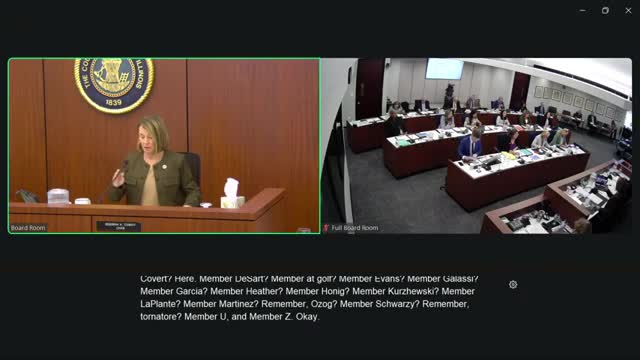
Summary
DuPage County Chair presented a $644.7 million balanced 2026 budget that relies on an expected FY2025 surplus and creates an $18.1 million DuPage Sustainability Initiative to address food insecurity, housing, stormwater and a contingency fund while maintaining a proposed $71.5 million property tax levy.
Chair Conroy presented DuPage County’s proposed fiscal year 2026 budget Tuesday, proposing a balanced $644,700,000 spending plan and a $263,100,000 general fund while seeking a $71,500,000 property tax levy. The budget relies in part on an expected FY2025 surplus and creates an $18,100,000 DuPage Sustainability Initiative Fund to address near-term needs if federal supports are reduced.
The proposal matters because county leaders say uncertainty at the federal level and recent proposals in Springfield could reduce local revenue for services residents depend on. “For the first time, we must plan based on threats to the very existence of the federal departments and programs our residents depend on,” Conroy said as she opened the presentation.
Under Conroy’s plan, the DuPage Sustainability Initiative is divided into three categories: food security, housing innovation and a community sustainability fund. For food, the chair proposed $1,000,000 in 2026 budget dollars plus a $1,000,000 transfer from any FY2025 surplus (totaling $2,000,000) and a separate $2,500,000 FY2025-surplus allocation to Loaves & Fishes’ food-distribution hub project; combined with $1,100,000 already in an ARPA interest fund earmarked for food, Conroy said the food insecurity allocation would total $5,600,000.
On housing, Conroy proposed a $5,000,000 injection from expected FY2025 surplus dollars for a first-time homebuyer program, to be paired with $5,000,000 previously set aside to create a $10,000,000 housing innovation fund that will support a land bank, a community housing trust and other measures the county’s Housing Solutions Committee develops.
The plan also would set aside $2,500,000 from surplus funds for a community sustainability category intended to respond to sudden changes in federal programs affecting residents. Conroy said the county projects at least a $25,000,000 surplus from FY2025 that can be used to address one-time needs and capital repairs.
Conroy proposed several surplus-funded capital and contingency items: $9,000,000 for stormwater management countywide, $4,000,000 for repairs at the Elmhurst Quarry (which she described as a vital flood-control facility), $5,000,000 for additional campus stormwater projects, $3,000,000 for campus capital needs through Facilities Management, and $1,000,000 to reserves. She also proposed $1,000,000 to support rideshare service and sidewalk and lighting work in Hinsdale Lake Terrace and asked that any additional FY2025 surplus be applied to funding the new Transportation Building on campus.
Public-safety and mental-health investments were another focus: Conroy said the sheriff’s office, the state’s attorney and the public defender would see higher budgets for 2026 than they had in 2025, and she recommended supporting Chief Judge Bonnie Wheaton’s expanded behavioral health court navigator program and other mental-health resources, including a courthouse support dog tied to the behavioral health court pilot. The county earlier cut the ribbon on a new crisis recovery center, which Conroy said opened Aug. 13 and is already accepting clients; she noted the center recently received a $250,000 donation from a national foundation.
On employee compensation and benefits, Conroy said healthcare costs will rise by more than 15 percent but that negotiations and plan adjustments will avoid double-digit employee cost increases; she proposed a 3 percent cost-of-living adjustment to be paid in December 2025. Conroy said the county would retain its traditional 80/20 cost sharing on employee health coverage and that IMRF pension obligations will be fully funded in FY2026.
Conroy framed her proposal as fiscally cautious: she said staff compared actual expenditures and five-year vacancy averages to better align 2026 line items with realistic costs after department and elected-official requests exceeded projected revenues by $34,000,000 during budget preparation. The chair said the county currently enjoys strong bond ratings from the three rating agencies and that the proposal preserves contingency levels should revenue pressures materialize.
Conroy closed by urging continued teamwork to refine and prioritize the plan in coming weeks. There was no final board vote on the budget in the meeting transcript; the chair concluded her presentation and the board moved on to public comment and routine agenda business.
(Ending) The chair’s full proposal will move through the board’s regular committee and adoption process; the presentation included multiple specific surplus-funded allocations that staff and committees will need to incorporate into formal appropriation ordinances and levy calculations before final adoption.