
Planning board conditions Home2-Hilton rezoning, asks applicant to lower building height
Get AI-powered insights, summaries, and transcripts
Subscribe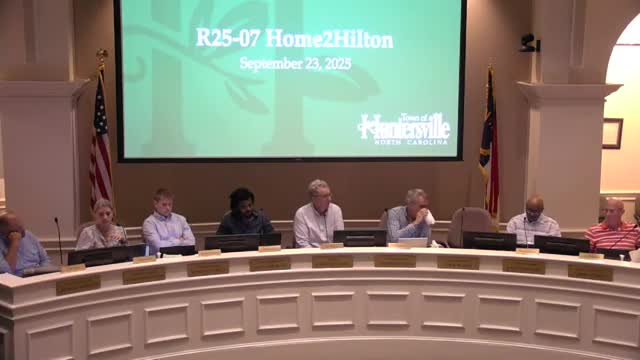
Summary
The board recommended approval of a conditional rezoning for a Home2 by Hilton hotel at 13830 Statesville Road but amended its motion to require a lower maximum building height (64 feet) and asked the applicant to provide detailed final elevations, enhanced buffers and a stream-mitigation plan.
The Huntersville Planning Board on Sept. 23 recommended approval of R-25-07, a conditional rezoning for a Home2 by Hilton hotel at 13830 Statesville Road (proposed 117-room hotel), subject to additional conditions and a reduction in the proposed maximum height. Staff raised compatibility concerns about a 70-foot hotel located close to existing residentially zoned lots behind the property and requested additional architectural detail, clearer buffer planting information and an approved stream mitigation plan before the town board vote.
Why this matters: the site sits on Highway 21 near Hillcrest Drive and abuts established residential lots. The hotel brand’s preferred design, as proposed, reached five stories and a 70-foot height measured to street grade. Huntersville’s highway-commercial building-type standards typically limit building height to 36 feet; a taller hotel requires conditional zoning and additional scrutiny about separation distances to residential zones.
Staff told the board that the proposed hotel would normally require a 210-foot separation from the nearest residential property if the building is 70 feet tall (three times the height), but the applicant requested a reduction to about 100 feet. Staff did not support the height/spacing modification as submitted; staff recommended alternatives such as lowering the building height, enhancing the buffer planting and limiting retaining-wall impacts to preserve the benefit of the buffer. The plan also showed a proposed 4,000-square-foot urban open space at the corner of Highway 21 and Dallas Street, but the town and applicant needed confirmation from NCDOT because that open space sits within an NCDOT drainage easement.
The applicant team — led by attorney Susan Irvin and supported by project engineer Peyton (last name not given) and owner PM Patel — described plans for an upgraded packet of hotel services, a commitment to enhance buffer plantings (more trees/shrubs than ordinance minimums, including 12-foot-evergreen specimens spaced every 20 feet in the second planting row) and a 6-foot masonry wall plus an 8-foot opaque fence along the rear to mitigate headlight glare and visual impact. The applicant also said that the Best Western immediately south is owned by the same owner and that the Home2 hotel would share an address and driveway with that property to avoid routing guests through adjacent residential streets.
Environmental and engineering staff raised two substantive points: 1) a proposed impact to a jurisdictional stream (a SWIM buffer) will require a mitigation plan approved by the appropriate agencies, and 2) retaining-wall heights in parts of the buffer (10–15 feet at the tallest location) may negate some buffer benefit unless the wall and grading are reduced or planting is staged to achieve screening. Staff also asked for final architectural elevations before final support could be offered under LU 8.2 (design excellence) and for a confirmation from NCDOT that the proposed urban open space can coexist with their drainage easement.
Board action: after discussion, the applicant indicated willingness to lower the building height; staff said the applicant could reduce the profile to about 64 feet by lowering (or ‘burying’) part of the first floor grade. The planning board amended its motion to make a 64-foot maximum height a condition of the recommendation; the board otherwise recommended the modifications shown in the staff report and asked the applicant to finalize buffer details and the stream mitigation plan. The motion passed by majority vote (three board members opposed).
Next steps: the applicant must provide final elevations, a mitigation plan for the stream impacts and confirmation from NCDOT on the urban open space. The recommendation will be forwarded to the town board; final permitting and construction require full construction-level grading, erosion control and stormwater approvals.