
Council hears East Lincoln Way corridor study recommending road diet and multiuse path; public feedback mixed
Get AI-powered insights, summaries, and transcripts
Subscribe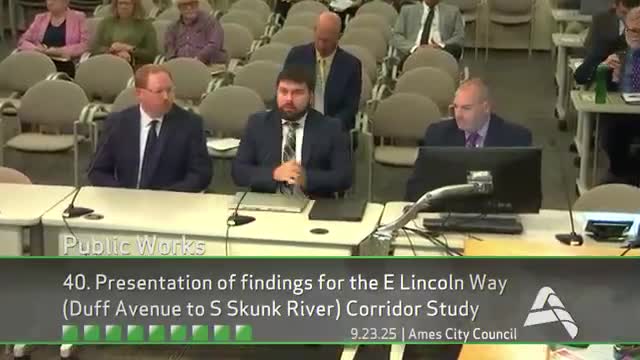
Summary
City staff and consultant presented a corridor study recommending a road diet on East Lincoln Way and new pedestrian and bicycle facilities, and said the proposed reconfiguration would improve intersection operations at Duff Avenue.
City staff and consultant Strand presented a corridor study for East Lincoln Way (Duff Avenue to South Skunk River bridge) and recommended restriping the four‑lane undivided roadway to a three‑lane section (one travel lane each direction and a two‑way left‑turn lane) plus a 10‑foot multiuse path on the south side and a 5‑foot sidewalk on the north side. Consultant Kyle Henderson said traffic volumes east of Duff are projected to reach roughly 13,000 vehicles per day by 2050 and that the corridor’s peak and hourly volumes are within accepted ranges for a three‑lane cross section. The proposal also calls for a west‑to‑east transition near Duff and a new dedicated left‑turn bay to reduce the intersection’s current split‑phasing requirement. Staff and consultant presented modeled intersection operations: with existing geometry the Duff–Lincoln intersection would operate at level‑of‑service E in 2050 with average PM peak delays of 64–71 seconds per vehicle; the proposed geometry with dedicated turn lanes and removed split phasing modeled as LOS C with PM peak delays of about 31–34 seconds. The consultant also reported a corridor crash history: 81 crashes on Lincoln Way and 52 at the Duff intersection between 2019 and 2023, with many rear‑end crashes at the intersection. Public engagement produced 683 responses; the East Lincoln Way three‑lane concept drew substantial opposition in the online survey (about half of respondents rated it strongly opposed), while the Duff‑Lincoln intersection improvements received more mixed feedback. Staff emphasized that the study is advisory and that final design, engineering and additional outreach will occur during the project’s design phase; council indicated it will consider formal action at a later meeting (Oct. 14) and that construction would not occur until 2027–28 at the earliest.