
District rolls out volunteer armed‑guardian program; staff warn of recruitment, training and ongoing costs
Get AI-powered insights, summaries, and transcripts
Subscribe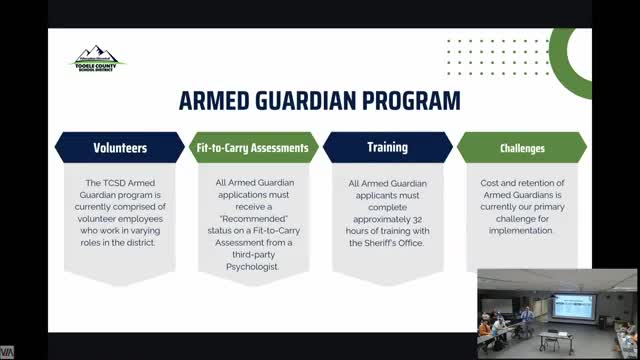
Summary
The district reported progress implementing a volunteer armed‑guardian program to meet the state’s armed‑presence expectation: 32 volunteers are in various stages of psychological screening and training, but staff said recruitment and annual requalification are costly and retention is an operational challenge.
District safety staff reported that a volunteer armed‑guardian program is under way to provide an armed presence in schools as required by recent state guidance. Staff said volunteers must pass a psychologist‑administered “fit‑to‑carry” assessment (the same type of screening used by some police agencies), complete classroom training, two range days and an active‑assailant scenario exercise.
Status and coverage: staff said roughly 32 volunteers are in the pipeline at various stages of assessment and training, and that “we have 7 full‑blown armed guardians” in service so far. Provided pending candidates clear the remaining fit‑to‑carry screenings, staff said every school except Dugway currently will have at least one guardian; Dugway remains an unresolved special case because of base access and military restrictions.
Screening and training: the third‑party psychologist conducting fit‑to‑carry assessments has been selective, staff said, and the district has seen an approximately 20% not‑recommended rate. The district pays $250 per fit‑to‑carry screening; because failed candidates must be replaced, staff noted the effective cost can be higher for a school if multiple candidates fail.
Training requirements are intensive: initial classroom instruction is a full day, two full days on the live range (extensive ammunition usage) and a four‑hour active‑assailant scenario that includes force‑on‑force exercises. Guardians must requalify annually.
Costs and retention: staff told the board the state provides a one‑time $500 stipend for each guardian, but staff warned the stipend is unlikely to cover the district’s total costs (ammunition, range time, substitute coverage, fit‑to‑carry fees and staff time). The district budgeted $20,000 this year for assessments and training and staff said that allocation is already nearly spent; estimates for broader implementation vary depending on retention, training format and whether simulators are used to reduce live‑fire costs.
Operational concerns and alternatives: board members discussed retention incentives and alternatives such as contract security; staff said a contracted guard at a single school could cost roughly $75,000 per year and that contract guards have different training and legal profiles than volunteer guardians. There was no board action to change program funding at the meeting, but trustees asked staff to return with cost scenarios including ongoing staffing and incentive strategies.
Quotations: “It’s crazy what we’re asking them to do for 1 time $500,” the safety presenter said, summarizing the recruiting challenge. The presenter added that the district prefers volunteers but acknowledged other districts offer stipends or hire contractors to fill the armed‑presence requirement.