
District report shows $43 million in building needs; board weighs reserves, bonds and rebuild options
Get AI-powered insights, summaries, and transcripts
Subscribe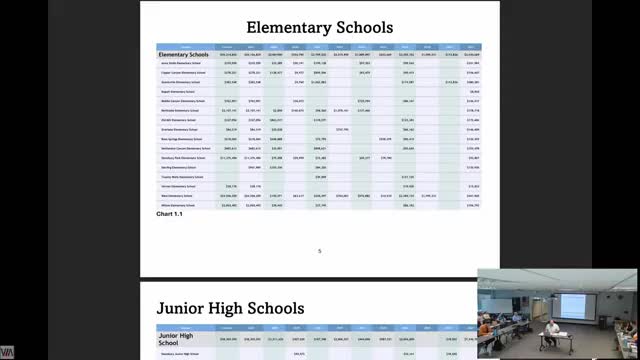
Summary
Facilities staff presented a facilities master-plan estimate showing roughly $43 million in immediate building needs and far larger long‑term costs for high schools and specific buildings; the board discussed prioritization, reserve use and whether to rebuild or repair aging schools such as West Elementary and Stansbury Park Elementary.
Facilities staff told the Tullah County School District board that a new master-plan review and condition assessment shows roughly $43 million in current building needs districtwide and much larger costs in the coming decade if deferred maintenance continues. The figures come from licensed architects and engineers who walked each building and from industry estimating software.
The report itemizes problems from cracked ceiling tiles to major mechanical systems and uses RSMeans cost estimates to put dollar values on repairs and replacements. “Current needs for our buildings is, you know, a little over $43,000,000,” said staff member Ian Silva, who presented the analysis. He told the board that a large share of the total for elementary schools is concentrated in a small number of older buildings and that inflation and industry escalation make postponing work more expensive year to year.
Why it matters: board members pressed staff to separate true safety-and-operations priorities from cosmetic or “want” projects and to show what could be accomplished without asking voters for new taxes. Several members said the district should back out sites already past useful life and consider replacement rather than continued large investments in structures that will soon need rebuilding.
Key details from the presentation: the $43 million figure is described as the sum to bring older buildings up to parity with the district’s newest facilities; West Elementary appears as a major line item (Silva identified about $24–25 million tied to that site in the current assessment). For high schools, staff highlighted concentrated needs — one industrial-arts (CTE/shops) building was listed at roughly $26 million and several high-school totals were shown in the tens of millions.
Board members and finance staff discussed funding options. Mark (staff member) said the district currently holds capital-project fund balances and that, “we do have a $100,000,000 in capital projects, sitting in the bank,” but board members noted much of that balance has prior commitments and that tapping reserves reduces future flexibility. Lark (staff member) and others outlined tradeoffs between using fund balance, issuing bonds and delaying work; the board asked staff to produce a prioritized “line” of work the district could afford from reserves without undermining credit metrics.
The presentation also separated building-only costs from site/civil elements (parking lots, athletic fields, storm drains). Silva explained the large discrepancy board members had noticed between per‑school totals and the grand totals: some large sums are in site/civil costs that the initial priority‑1 through -5 building lists did not include.
Board direction and next steps: trustees requested that staff return with a clearer prioritized package—ranked priority‑1 items (life-safety and systems that would prevent school operation), a second group of items likely to become priority‑1 soon, and an estimate of how much could be addressed from existing capital reserves. Trustees suggested a follow-up work session in December–January to review concrete options rather than continue open-ended discussion.
Silva emphasized the district’s move toward proactive asset management: the architects’ audit and the condition index were meant to enable long‑range budgeting so the district can schedule replacements before systems fail. “It’s upfront cost savings because the work just doesn’t happen…ultimately that problem never goes away,” Silva said.
What the board did not decide tonight: no new taxes or bond measures were approved, and no final decisions about closing or replacing West Elementary or Stansbury Park Elementary were made. A motion was made and seconded during the meeting, but the transcript does not record the motion text or a formal vote outcome. The board asked staff for a prioritized, dollarized recommendation the trustees could act on at a future meeting.