
Lewis County adopts comprehensive-plan update with land-use and short-term rental rules, multiple amendments
Get AI-powered insights, summaries, and transcripts
Subscribe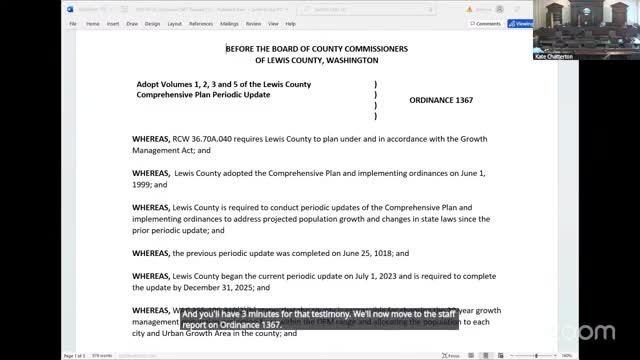
Summary
The Board of County Commissioners approved Ordinance 13-67 adopting a periodic comprehensive-plan update and several targeted amendments to development regulations, including new short-term rental permitting requirements scheduled for Jan. 1 and a set of zoning and design changes for the Packwood and Onalaska UGAs.
Lewis County commissioners voted 3-0 on Sept. 23 to adopt Ordinance 13-67, a periodic update to the county comprehensive plan and companion development regulations, after approving a series of amendments raised during the public hearing and staff presentation. The ordinance includes zoning map changes, updated development regulations and a new short-term rental permit section that county staff will implement with a Jan. 1 effective date.
The changes implement requirements of Washington’s Growth Management Act and update county codes and supporting documents, Planning Director Mindy Brooks told the commission during a staff report. “Every 10 years, Washington counties and cities are required to update our comp plans to address changes in the state law since the last periodic update and changes in growth,” Brooks said during the hearing.
The adoption carried additional, commissioner-approved amendments that alter how the county will regulate uses and design in both rural and two urban growth areas (UGAs). Key approved changes include: turning day-care, early-learning and kindergarten–through–high-school institutional uses into “permitted accessory” uses on agricultural, forest and mineral resource lands (chapter 17.42, table 2); adding an exception to a site-investigative-work exemption so that such work cannot be used to pre-authorize energy production where the use table does not allow it (chapter 17.30.31, exemption 5); correcting a scrivener’s error in the signs chapter (17.142.0.207); limiting new private roads to serve no more than 15 lots unless built and accepted to county road standards; a suite of design changes for the Packwood and Onalaska mixed-use/commercial zones (including lowering required storefront clear glazing from 50% to 30%, removing required covered pedestrian entrances, and removing site-specific roof-line and color palette mandates while retaining fire-resistant material requirements); striking a prohibition on drive-throughs in the mixed-use rules; and moving bicycle parking requirements into master-plan/binding-site-plan standards for large commercial developments while removing an on-site bike-parking requirement in one commercial zone.
Commissioners debated permitting detail and implementation timing for short-term rentals (STRs). Brooks said the county intends to make the STR code effective Jan. 1 to allow staff time to build out permitting processes, fee analysis and interdepartmental review steps. “My recommendation is that you adopt 17.105 to be implemented on January 1, and then we have the next 3 months to work on all of those pieces of it,” Brooks said. Under the adopted language, short-term rental permits will be processed as a Type 1 application and will include annual self-certification; staff will draft the fee schedule and implementation procedures and return them to the commission for approval.
Public comment during the hearing included Packwood resident and short-term rental owner Rob Maricle, who urged caution and asked for economic-impact analysis on proposed STR rules. Maricle told the commission the assessor had continued to tax his home as a short-term rental even after he said operations had ceased. “The assessor is applying his nebulous term of, quote, highest and best use of our property to justify us having to pay $18,000 this year in taxes,” Maricle said. He asked the county to amend section 17.105.0.05 to require the assessor immediately update tax designations when short-term rental operations cease; commissioners approved the broader STR code but left operational details, including fees, to be developed before January implementation.
Other public commenters raised localized issues: Onalaska resident Ron Schutte pressed staff on UGA capacity calculations and how critical areas and publicly owned lands are treated in land-capacity analysis; Bailey Williams, a Winlock child-care operator, asked that the resource-land rules allow outdoor, nature-based childcare as an accessory use to forestry operations—an amendment the commission approved to permit daycare as an accessory use on resource lands.
The county attorney and staff also noted they expect to discover scrivener’s errors during implementation and plan a cleanup amendment in roughly a year. Brooks said some portions of the adopted code will not go into effect until Jan. 1 to allow permit applications, review processes and fee schedules to be created. The board voted 3-0 to adopt Ordinance 13-67 as amended.
Nut graf: The ordinance is the periodic comprehensive-plan update required by state law; the commission adopted it with multiple amendments that downshifted some design mandates, added limited resource-land allowances for educational and child-care uses, set new subdivision/private-road thresholds, and approved a framework for short-term rental permitting to be implemented Jan. 1 with staff-directed development of processes and fees.
Outlook: County staff will prepare and present the short-term rental permit processes and fee schedule to the commissioners before implementation on Jan. 1; staff also expects to return within about a year with a cleanup package for discovered code errors.