
Committee forwards mid‑biennial budget amendment and August financial report; members press for public discussion of newly received settlement revenue
Get AI-powered insights, summaries, and transcripts
Subscribe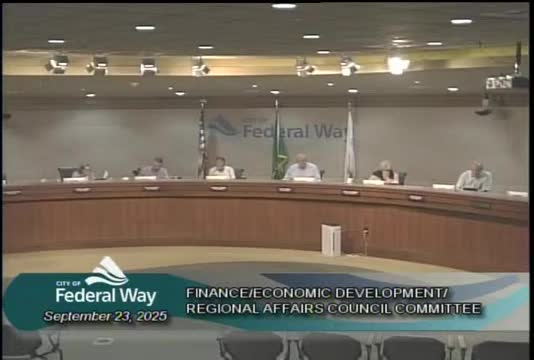
Summary
Staff presented Budget Amendment No. 2 (2025–26), including carryforwards, new grants and a one‑time telephone utility‑tax settlement; the committee forwarded the ordinance to public hearing/first reading on Oct. 7 and asked for a public discussion of how to allocate newly recorded settlement revenue.
City finance staff presented Ordinance 2025‑2026 Budget Amendment No. 2 for committee review and scheduled it for public hearing and first reading on Oct. 7. The amendment incorporates newly known revenues (including grants and a one‑time telephone utility‑tax settlement that predated 2021), approved contracts and carryforwards of previously authorized capital appropriations from 2024. Finance staff said the amendment also carries forward unspent 2024 capital project balances—including large carryforwards for the maintenance and operations facility and various public works capital projects—so that the previously approved funds remain available in the 2025–26 budget.
Staff detailed three grants/new revenues: a Washington Attorney General (AG) grant of $150,000 (used for public‑safety programs previously described in the packet), a Department of Commerce electric‑vehicle charging grant of $300,000, and a utility‑tax settlement from TracFone that yielded a one‑time unrestricted utility‑tax payment (staff reported a net after collection costs; staff recorded the gross settlement in the August financials). The exact collection/fee amounts and ultimate use will be shown in the final amendment and consent packet; staff emphasized that expenditures require council approval and that a separate collections fee was paid to secure the settlement funds.
The committee also reviewed July and August accounts payable and payroll vouchers and the August monthly financial report. Finance staff summarized revenue variances: sales tax and permit‑fee revenues remain below budget though generally at or above prior‑year levels, real estate excise tax is favorable to prior year but below budget, and overall the city’s unrestricted utility tax picture was boosted in the most recent month by the telephone settlement. Staff said unrestricted revenues had a modest unfavorable variance to the amended budget (roughly several hundred thousand dollars) but that restricted revenue categories (such as REET and restricted utility shares) had separate trajectories. Staff reported city cash and balances remain elevated compared with pre‑ARPA levels because of bond proceeds and earlier ARPA receipts, with ARPA remaining partially unspent and bond proceeds spending down.
Several council members raised process questions about newly received one‑time settlement revenue. Council member Jack Dovi asked why the settlement revenue was reflected in the budget without a prior council decision on allocation; staff replied that the settlement is recorded as revenue and that any spending of those funds requires future council action—staff said the present amendment records the revenue and a collections fee expense but does not appropriate spending of the proceeds. Council members asked for a public forum to discuss uses of that revenue and for more information on potential cuts and contingency plans if revenues soften: the committee chair and council president agreed a public hearing and follow‑up discussion are appropriate; the ordinance was moved to public hearing and first reading on Oct. 7.
The committee approved forwarding the August monthly financial report and the accounts payable vouchers to the Oct. 7 consent agenda (motions passed 3‑0). Staff said more detailed backup (line‑item questions and invoices, and a spreadsheet of department staffing hours for the farmers market) would be provided to councilmembers and in the Oct. 7 packet.
Ending: The ordinance will go to public hearing and first reading Oct. 7; staff will supply detailed backup materials requested by council including revenue‑and‑expense line details, lists of carryforwards, and follow‑up on the allocation discussion for the one‑time settlement revenue.